Vinay Kumar

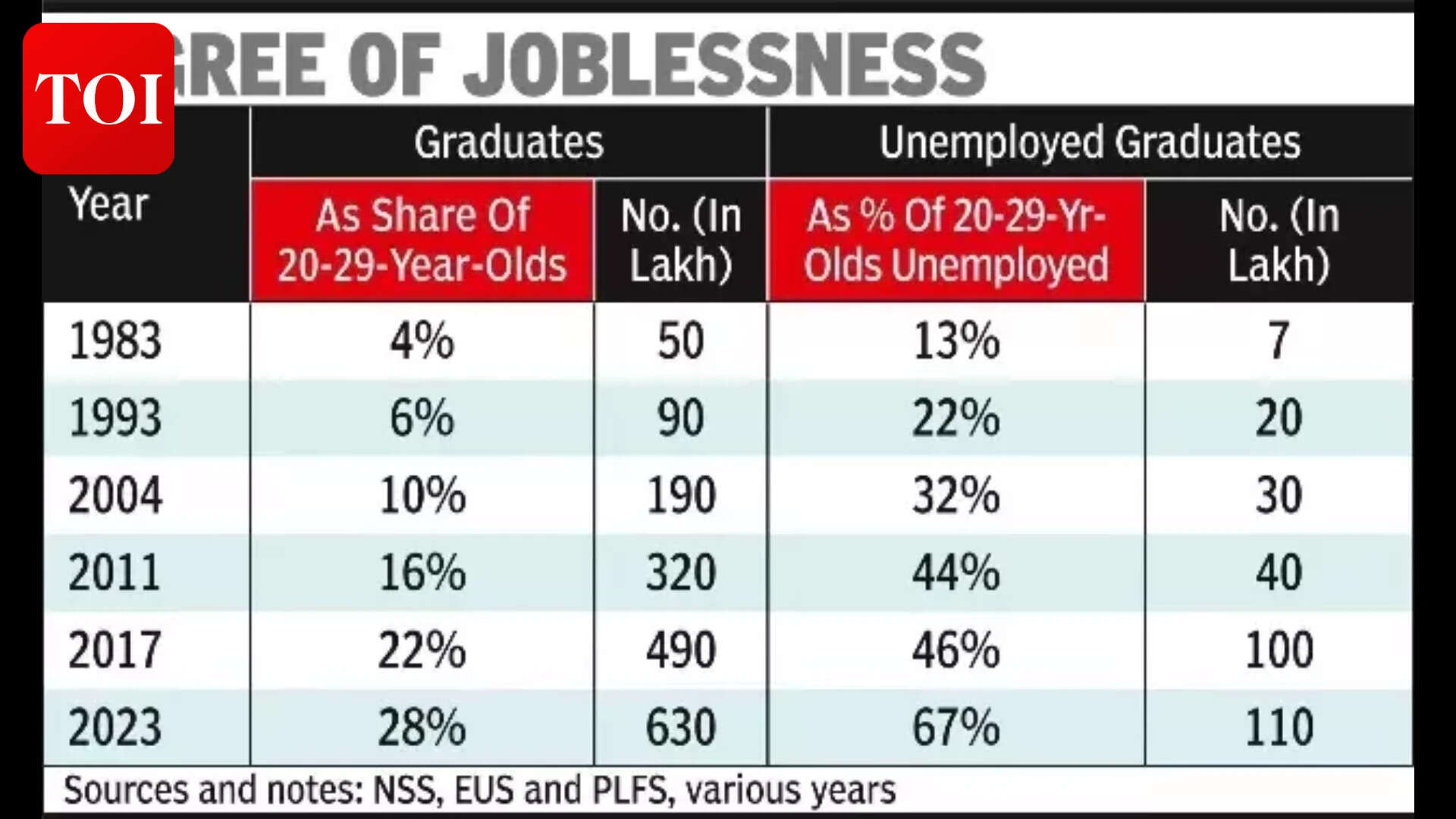
NEW DELHI: The share of graduates among unemployed youth (20-29 years of age) has more than doubled over the past two decades, at a time when India has made substantial progress in expanding access to higher education for its youth, said a report released by the Azim Premji University on Tuesday. Data showed that around 67% of unemployed youth in 2023 (around 1.1 crore) in the country were graduates, up from 32% in 2004 (30 lakh). At the same time, the share of graduates among youth has risen to 28% in 2023 (6.3 crore) from 10% in 2004 (1.9 crore). The report noted that between 2004 and 2023, approximately 50 lakh graduates were added every year, while the number of employed graduates rose by only around 28 lakh annually, out of which only 17 lakh were salaried. “Graduate employment, therefore, has not kept pace with graduate supply,” the report titled ‘State of Working India 2026’ noted.The failure to create adequate jobs for the burgeoning population of graduates has resulted in a situation of too many graduates and too few jobs. This has also contributed to the slowdown in graduate earnings,” the report noted.It argued that there are several reasons, including concerns around employability of young graduates, their lack of experience or mismatch in skill.The report also said that there was a greater capacity among the youth to wait before finding a job, a phenomenon that included the poorer households as well, due to better income levels than earlier. Besides, the report noted that while young graduates continue to have more monthly earnings compared to the non-graduates in entry level jobs, this premium is narrowing over time.
The gap between graduate and non-graduate earnings for youth increased substantially, especially between 2004 and 2011. Since 2017, however, there has been a slowdown in earnings growth for young men.The report also said that since 2017, the share of young men in education has fallen to 34% in 2024 from 38% in 2017, citing the need to support household incomes.In terms of access to higher education, the report added that financial barriers continue to restrict access, particularly in professional fields such as engineering and medicine, as the cost of pursuing these degrees often exceeds the annual per capita expenditure for poorer households. “This gap has narrowed somewhat between 2007 and 2017,” it said. The report drew on official databases going back four decades to see how youth’s participation in education and employment has changed, and the challenges and opportunities that arise in integrating them into the workforce.