
 Vinay Kumar
Singapore has been named the world’s most religiously diverse country in a sweeping study of 201 nations, reflecting how evenly its population is spread across seven major faith categories.The findings capture broader shifts underway globally. Christians remain the largest group at 2.3 billion, though their share of the world’s population has edged down. Muslims are the fastest-growing major religion, expanding by 347 million over the past decade. Hindus grew by 126 million to reach 1.2 billion, holding steady at 14.9% of the global population. Meanwhile, the religiously unaffiliated now account for 24.2% worldwide, the third-largest category, and Buddhists are the only major faith to decline in absolute numbers.At the opposite end of the diversity scale, Yemen, Afghanistan and Somalia rank among the least religiously diverse, while the Asia-Pacific region stands out as the most varied overall.These findings are drawn from a Pew Research Center report released in February 2026 as part of the Pew-Templeton Global Religious Futures project, funded by The Pew Charitable Trusts, the John Templeton Foundation and Templeton Religion Trust. The study ranks countries using a Religious Diversity Index (RDI) based on how evenly populations are distributed across seven groups: Christians, Muslims, Hindus, Buddhists, Jews, adherents of all other religions, and people with no religious affiliation.The rankings rely on demographic estimates previously published in Pew’s 2025 report, How the Global Religious Landscape Changed From 2010 to 2020, which synthesised more than 2,700 censuses and surveys. Each of the 201 countries and territories included had at least 100,000 residents in 2010 or 2020, collectively accounting for 99.98% of the global population in 2020.
How the Religious Diversity Index works
Pew’s Religious Diversity Index (RDI) assigns countries a score between 0 and 10. A score of 0 represents complete homogeneity, a population composed entirely of one religious group. A score of 10 would represent a perfectly even split among seven categories: Christians, Muslims, Hindus, Buddhists, Jews, adherents of other religions, and people with no religious affiliation, each group making up roughly 14% of the population. No country achieved a perfect 10.The “other religions” category encompasses faiths such as Baha’is, Daoists, Jains, Shintoists, Sikhs, Wiccans and Zoroastrians, as well as numerous smaller groups, including those often described as folk or traditional religions.
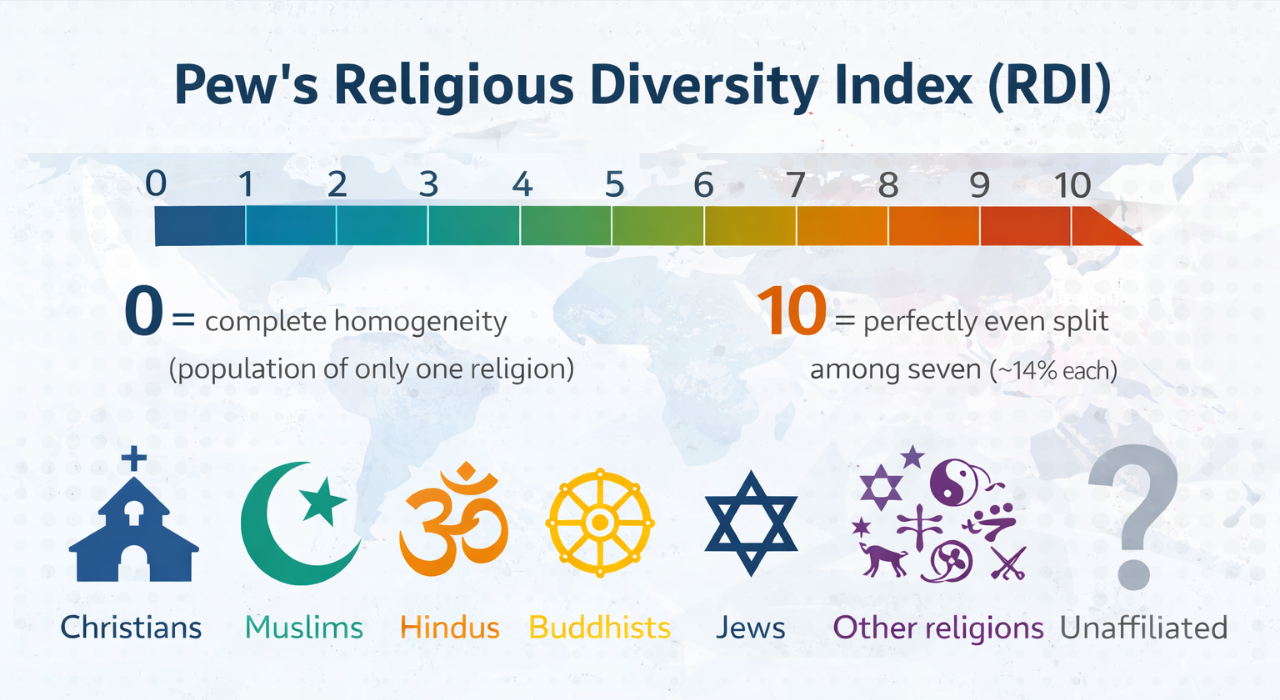
Pew Research Center’s Religious Diversity Index (RDI) scores countries on a scale from 0 to 10, measuring how evenly their populations are distributed across seven religious categories.
Of the 201 countries and territories studied, eight fall into the “very high” diversity range (scores between 7.0 and 10.0). At the other end of the scale, 41 countries are classified as “very low” diversity, with scores below 1.0. The largest number, 89 countries, sit in the middle, categorised as moderately diverse.
Singapore and the world’s most diverse societies
With a score of 9.3, Singapore comes closer than any other country to an even distribution across the seven categories. Buddhists form 31% of Singapore’s population, making them the largest group. But they are followed closely by religiously unaffiliated residents at 20%, Christians at 19%, Muslims at 16%, Hindus at 5%, and adherents of other religions at 9%. No single group holds a majority. Suriname ranks second and is the only Latin American country in the top 10. Its population is 53% Christian, 22% Hindu, 13% Muslim and 8% religiously unaffiliated, a demographic pattern shaped in part by descendants of 19th-century indentured labourers from British India.
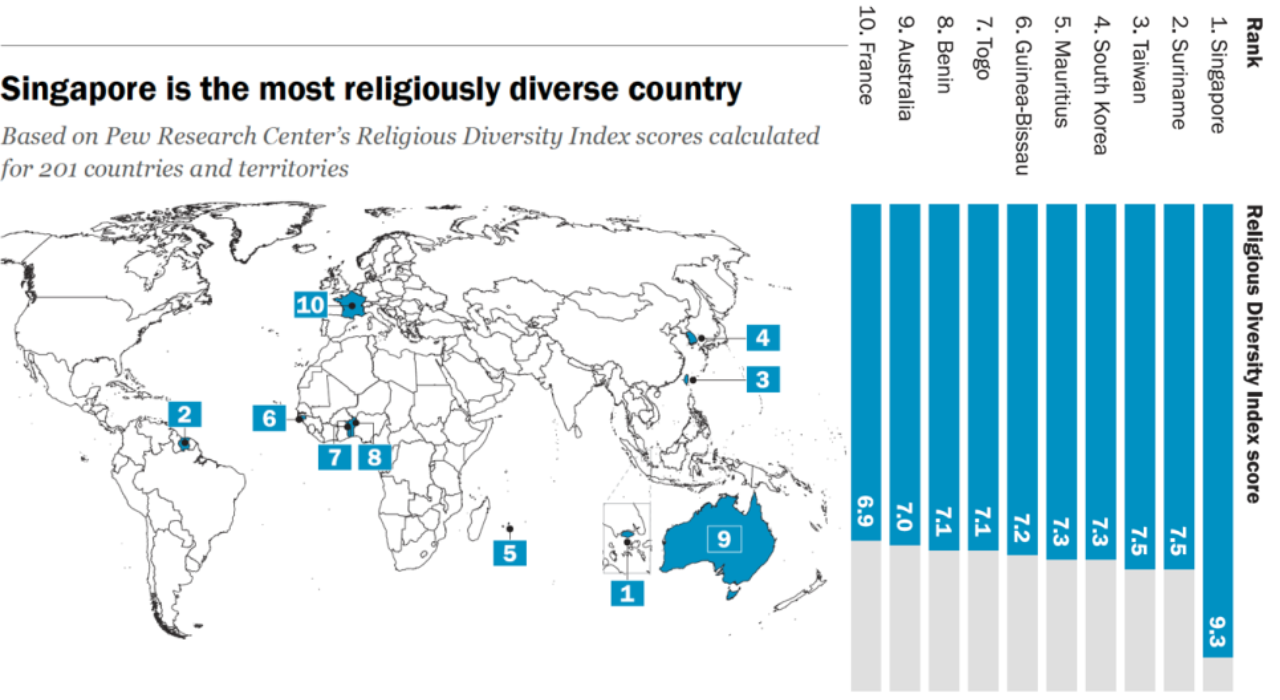
Singapore is the world’s most religiously diverse country, with Buddhists, Christians, Muslims, Hindus, unaffiliated, and other faiths all represented/ Pew Research
Most other countries in the top 10 are located either in the Asia-Pacific region, Taiwan, South Korea and Australia, or in sub-Saharan Africa, Mauritius, Guinea-Bissau, Togo and Benin. France is the only European country in the top 10. Its population is 46% Christian, 43% religiously unaffiliated and 9% Muslim, giving it an RDI score of 6.9. For comparison, South Korea scores 7.3 and the United States 5.8.
The least diverse countries
No country scores a perfect zero. But Yemen, Afghanistan and Somalia come closest. In each, Muslims account for 99.8% or more of the population. Overall, Muslims make up at least 99% of the population in eight of the ten least religiously diverse countries and territories. The remaining two, Timor-Leste and Moldova, are almost entirely Christian.
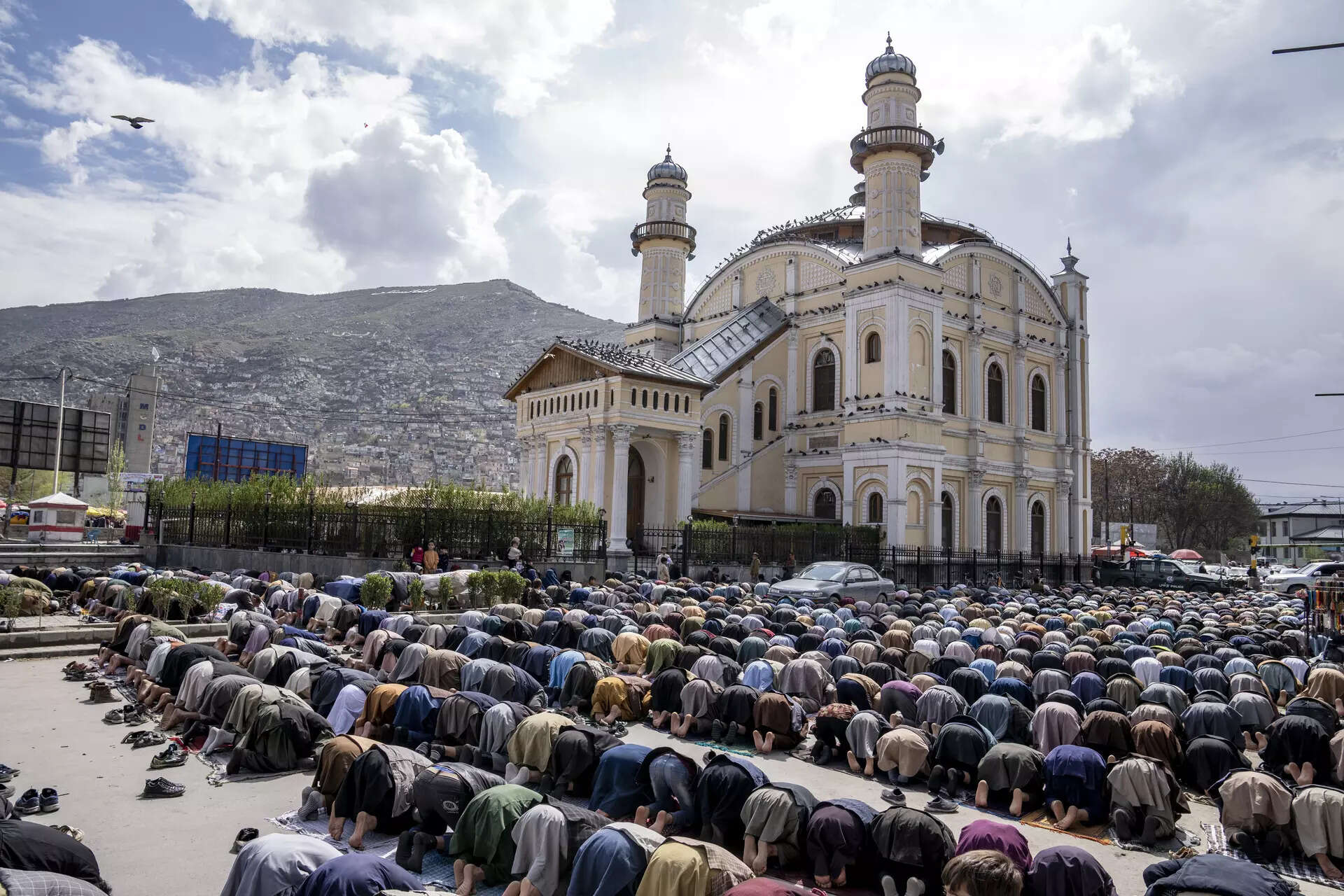
Afghan worshippers attend Friday prayer during the Muslim holy fasting month of Ramadan, in Kabul, Afghanistan, Friday. (File photo: AP)
Regionally, the Middle East and North Africa has the lowest diversity score at 1.3. The region’s population is 94% Muslim and includes five of the world’s ten least diverse places: Yemen, Morocco, Western Sahara, Iraq and Tunisia.
What changed globally between 2010 and 2020
The study also revisits how the world’s religious composition shifted over the decade. Christians remain the largest religious group globally. Their numbers rose by 122 million to reach 2.3 billion. But as a share of the global population, Christians declined by 1.8 percentage points, falling to 28.8%. Muslims were the fastest-growing group. Their population increased by 347 million, more than all other religions combined, and their global share rose by 1.8 percentage points to 25.6%. People with no religious affiliation, often called “nones,” grew by 270 million to 1.9 billion, increasing their share to 24.2% of the global population. This growth occurred despite the group being older on average and having lower fertility rates, partly because of religious “switching,”particularly Christians disaffiliating. Hindus increased by 126 million to 1.2 billion and held steady at 14.9% of the global population.
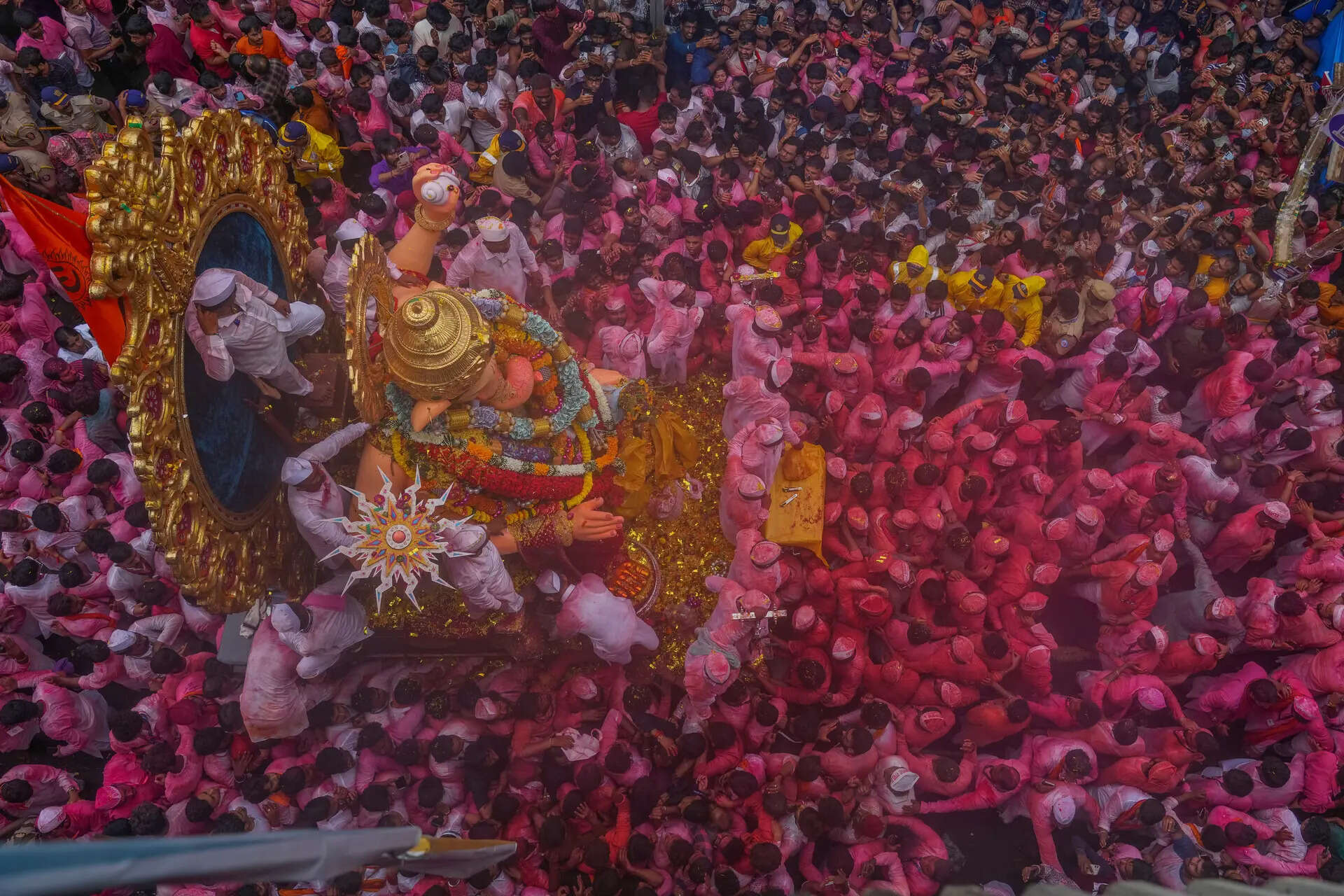
An idol of elephant-headed Hindu god Ganesha is taken for immersion on the final day of the ten-day long Ganesh Chaturthi festival in Mumbai, India, Saturday, Sept. 6, 2025. (AP Photo/Rafiq Maqbool)
Buddhists were the only major group to decline numerically, dropping by 19 million to 324 million and slipping to 4.1% of the global population. The global Jewish population grew by nearly 1 million to 14.8 million and remained about 0.2% of the world’s population, the smallest group in the study. All other religions combined account for 2.2% of the global population and grew in line with overall population expansion. As of 2020, 75.8% of the world’s population identifies with a religion, while 24.2% does not. In 2010, those figures were 76.7% and 23.3%, respectively.
Diversity among the world’s largest countries
Among the 10 most populous countries, each with at least 120 million people and together accounting for nearly 60% of the global population, the United States is the most religiously diverse. Christians make up 64% of its population, religiously unaffiliated people account for about 30%, and the remaining 6% are Muslims, Hindus, Buddhists, Jews and adherents of other religions, each representing roughly 1–2%. Nigeria is the second-most diverse among these large countries. Muslims and Christians each comprise more than 40% of its population, making it one of the most evenly split countries between two religious groups. Pakistan, by contrast, is the least diverse among the ten. Muslims account for 97% of its population, giving it an RDI score of 0.8, compared with 5.8 in the United States.
Regional patterns
The Asia-Pacific region is the most religiously diverse overall, with an RDI score of 8.7. No single group forms a majority there. The largest category, religiously unaffiliated people, represents roughly one-third of the region’s population. The region includes large populations of Muslims, Hindus, Buddhists, Christians and adherents of other religions; Jews have a relatively small presence. North America (6.0), sub-Saharan Africa (5.9) and Europe (5.6) are classified as highly diverse. In each of these regions, Christians form the majority. The second-largest group comprises at least a quarter of the population, religiously unaffiliated people in North America and Europe, and Muslims in sub-Saharan Africa. Latin America and the Caribbean fall into the moderate category, with an RDI score of 3.1. The region has a strong Christian majority and a smaller share of unaffiliated residents.