 Vinay Kumar
HyperWrite CEO Matt Shumer’s post ‘Something Big is Happening’ has generated a viral earthquake. The post was widely shared because it was not just speculation, but a report from the trenches. He has described how he gave a complex coding task to an AI agent, GPT-5.3 Codex. When he returned after four hours, the work was not just finished but was executed with “taste” and “judgment,” qualities we previously reserved for humans.
Comparing the present to the February 2020 pre-Covid moment, that brief, eerie calm before a global upheaval, Schumer shot off a blunt warning: AI has crossed a qualitative line: from “helpful tool” to “independent doer.” Whether it is coding, legal drafting, or financial analysis, execution that once took days now takes minutes.
This suggests a terrifying reality for the traditional white-collar worker: if your value lies in the ‘doing’ rather than the thinking/orchestrating/decision-making, you are increasingly redundant. Schumer is not alone. Anthropic.ai founder Dario Amodei predicts that AI could eliminate half of all entry-level, white-collar jobs within five years. Aneesh Raman, a senior leader in LinkedIn, sees “the bottom rung of the job ladder breaking”.

For every prophet of the AI apocalypse, there is a sceptic. AI luminary Gary Marcus argues that we are witnessing a massive “AI bubble” fuelled by statistical trickery. He says the post glosses over the boring but decisive issues: reliability, error rates, security and trust problems, especially when systems look convincing enough that humans stop checking.
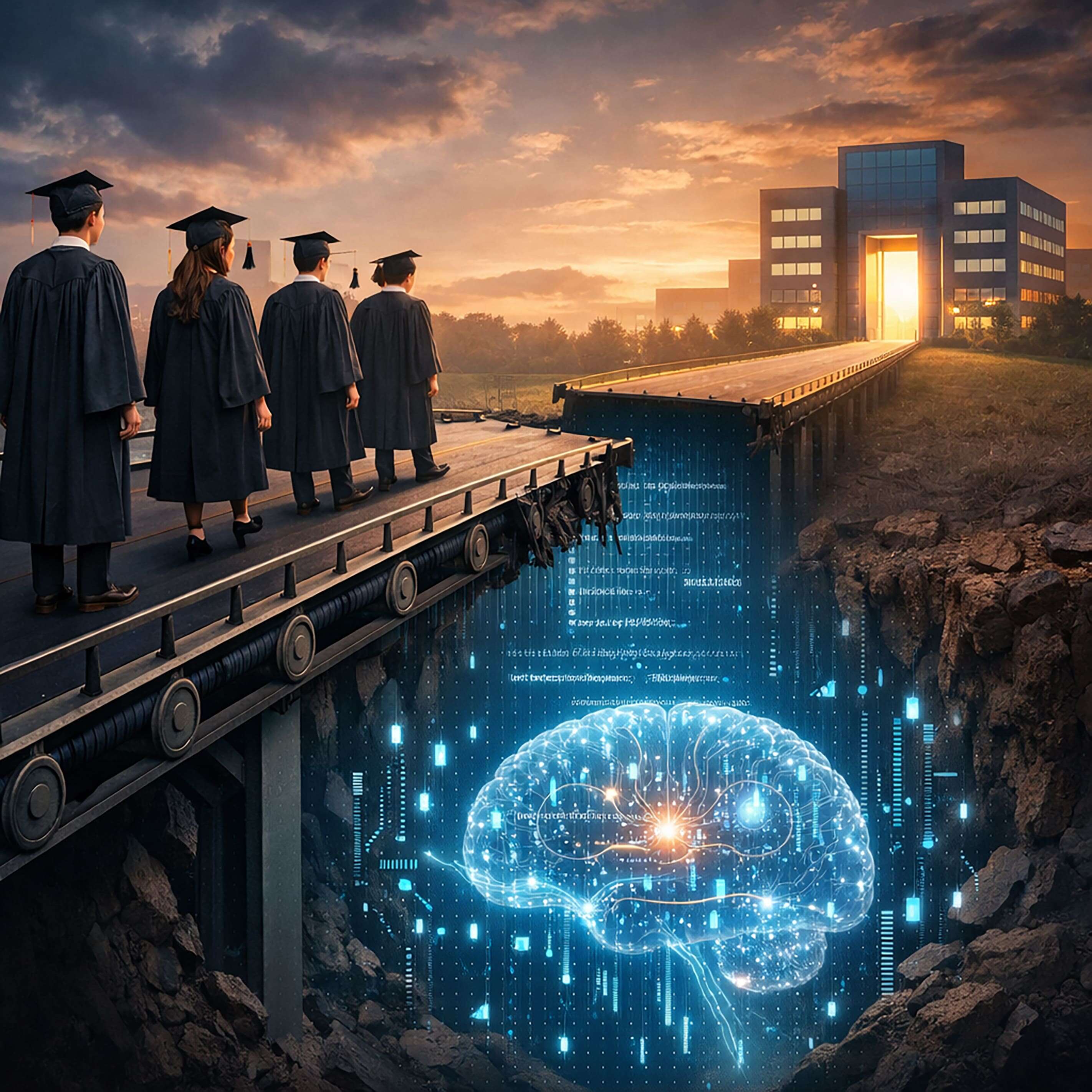
Marcus is right to be sceptical of the ‘God-like AI’ narrative. However, there is no denying that AI will cause a work and job disruption, the same way that the steam engine, the computer, or the internet did, if not more. Even if Shumer’s timelines are too aggressive, the direction of travel is hard to deny. I believe that the disruption is not simply that “jobs will disappear;” it is that the model by which millions used to get jobs is breaking. For instance, in urban India, for decades, we followed a rigid, almost sacred, liturgical path —a conveyor belt model from school to (usually) engineering degree to an MBA/postgrad to a management trainee, and then a long corporate climb. Another route was to skip the MBA, go to a big IT firm after engineering and then do years of project rotations and certifications, thus ensuring a lifetime orbit around IT.
This model is now dying. Debugging code, summarising reports, data entry — the bottom rung — is exactly what AI does best. If that rung disappears, the ladder becomes inaccessible. Because if AI can do the work of ten juniors, companies will no longer pay to train those juniors.
It might be cold comfort, but this is not the first time our model of work has shattered. Before the Industrial Revolution, the dominant model was around apprenticeship, where you lived with a master blacksmith or a weaver for years, sometimes paid him to teach you, and learnt the craft through proximity and manual labour. Then came the ‘factory model,’ where you went in as a child, and rose up the blue-collar ranks. We then shifted to the ‘specialisation’ model of the 20th century, where you learned a single skill and sold it to a single firm for 40 years. That, too, died with the advent of the PC and the internet. Now, as we enter the Age of AI, work will remain, but the model of work will break and change again.
If the model is breaking, what should we, especially the young, do? Rediscover Humanities. As answers become a commodity, the value shifts to the questions. Logic, ethics, philosophy, and literature provide the frameworks to understand human motivation and critical judgment—things AI can only mimic.
Aim for the ‘second rung.’ Do not wait for a company to teach you the basics. Use AI as your apprentice to teach yourself to do the work of a mid-level professional while you are still in college. Your goal should be to enter the workforce with a ‘portfolio career’ — a mix of technical skills and creative outlets. Be a coder who understands the ‘why’ of a business, or a designer who understands the ‘how’ of AI agents.
Become an entrepreneur: As every process in every company and industry gets disrupted, each of them is an entrepreneurial opportunity to set up a company ‘solving’ for it. The ‘safe’ corporate job is a myth now; the new safety lies in the ability to build things yourself.
Embrace AI literacy: The definition of literacy has changed from reading, writing to that and how to work with AI in everything you do. AI talent is just not AI and ML engineers, but HR, marketing, and salespeople who use AI to do their jobs better and faster.
Matt Shumer concluded his post by saying that this will be the most important year of your career. He is right, but not because the robots are taking over. It is because the ladder we were promised is gone; it is time to learn a new way to be a professional.
Disclaimer
Views expressed above are the author’s own.
END OF ARTICLE