 Vinay Kumar
For many students in India, CERN feels like a distant dream, tied only to the Large Hadron Collider and the Higgs boson discovery. In reality, while physics drives CERN’s mission, the lab is one of the world’s leading engineering and technology ecosystems. Nearly 77% of CERN’s personnel are engineers, technicians, and support professionals who build, operate, and maintain the accelerators, detectors, and infrastructure. Only 23% are physicists.
This opens structured, merit-based opportunities across fields and career stages. I walked this path myself, from studies in India and Italy to my current role building real-time data systems for the Future Circular Collider Digital Twin Project at CERN’s Mechanical Measurement Laboratory. The route is transparent and rewards preparation. Here is a practical, stage-by-stage guide with verified details.
- School Students (16 to 19 years)
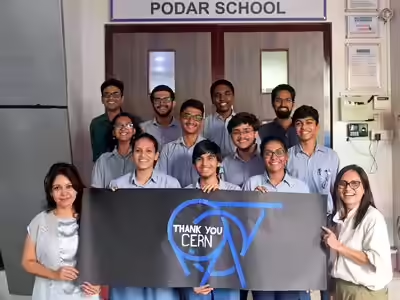
Beamline for Schools (BL4S)
An international competition in which high-school teams design a simple, feasible particle-physics experiment. Selected winning teams are invited to perform their experiment for about 10 to 12 days at a major research facility. Experiments are typically hosted at CERN using the T9 beamline of the Proton Synchrotron, or at DESY in Germany with an electron beam, or at the ELSA accelerator at the University of Bonn in Germany. Participation is free of charge. For winning teams, travel, accommodation, and local expenses related to carrying out the experiment are covered by the organisers.
- Key to winning: realistic, technically sound ideas that extend existing measurements; strict safety compliance; clear reasoning.
- All participants receive certificates. Indian schools are fully eligible and have succeeded before.
Deadline for 2026: 13 March 2026, 23:59 CET.
Apply at: beamlineforschools.cern

Undergraduate and Master’s Students
- Summer Student Programme (8 to 13 weeks, summer): Real project plus lectures and visits. Eligibility: At least 3 years of Bachelor’s or Master’s studies in physics, engineering, computer science, or mathematics; full-time student status. Allowance: About 94 CHF per day (net). Highly competitive, but many Indian students succeed annually.
- Technical Student Programme (4 to 12 months): Hands-on engineering or computing work. Eligibility: National of a Member or Associate Member State (India qualifies); at least 18 months of studies completed. Monthly stipend: 3,486 CHF (net). Often an easier entry than the summer programme for technical profiles.
- Short Term Internship (1 to 6 months): Flexible technical or administrative roles.
Tip for Indian applicants: the Technical Student Programme often sees higher Indian success rates due to its longer duration and engineering focus. Highlight any projects, internships, hackathons, even small lab work or coding, in your application. Apply via careers.cern. Deadlines are firm.
- PhD Students
Doctoral Student Programme
Conduct part of your PhD thesis at CERN. Duration: 6 months, renewable up to 3 years, spread over a maximum of 4 years. Eligibility: Enrolled in a relevant PhD; national of a Member or Associate State (India qualifies). Monthly stipend: 3,907 CHF (tax-free).
Many students from IITs, IISc, and NISER have completed 1 to 2 years here, gaining strong research exposure and networking.
- Early Career and Postdoctoral Candidates
Research Fellowships for recent PhDs: 6 to 24 months, extendable up to 36 months. Monthly stipend: 7,004 to 7,425 CHF net.
Early Career Programmes
- ORIGIN, Early Career Professionals: entry level programme for recent graduates with up to about 2 years of experience in technical, engineering, or administrative roles, focused on on the job learning.
- QUEST, Project Graduates: for more experienced graduates, time limited and results focused projects to deepen expertise.
Both offer 6 to 36 month contracts and skill building in a world class environment.
What I Learned From My Own Journey
When I joined CERN, I expected the biggest challenge to be advanced technology. Instead, the real shift was learning discipline, precision, and structured thinking. In high-stakes scientific environments, even small inconsistencies can have significant consequences.
Growing up in India, I was neither the top scorer nor from a prestigious institution. What opened doors was curiosity and perseverance. I built small hands-on projects, asked questions freely, and applied whenever I met the eligibility criteria, even when I felt only partially ready.
Good mentors played a defining role. They raised my standards, challenged my assumptions, and showed me that perseverance and teamwork matter far more than perfect grades. My journey has shown me that extraordinary outcomes are built through sustained effort, guided by strong mentorship.
What CERN Values:
- Strong fundamentals in your field
- Practical problem solving
- Clear and simple communication
- Comfort in diverse international teams
- Attention to detail and integrity
CERN seeks readiness and genuine interest, not perfection.
Practical Advice for Indian Applicants
- Read rules and deadlines on careers.cern carefully.
- Apply only via the official portal.
- Limit your CV to a maximum of 2 pages in English or French.
- Write a short and focused motivation letter explaining why the programme fits you.
- Highlight projects and hands-on experience, even modest ones.
- Respect deadlines strictly.
- Do not self reject. Apply and let the process decide.
Why This Matters for India
Skills developed at CERN, such as systems thinking, precise data handling, cross-disciplinary teamwork, and disciplined execution, are vital for India’s growth in space, semiconductors, advanced manufacturing, and AI infrastructure.
Time at CERN is about raising your standards and gaining world-class skills so you can contribute more powerfully to India and the world no matter where your journey takes you.
The pathway is clear, competitive, and real. For any Indian student who prepares steadily and applies thoughtfully, it is within reach.
The deciding factor is rarely marks, college, or background.
It is your consistent effort over time.
Note: Stipend figures from CERN’s official 2026 programme pages at careers.cern and subject to minor changes. All other details are current as of February 2026.
Disclaimer
Views expressed above are the author’s own.
END OF ARTICLE