Vinay Kumar
The desert sun beats down on the white gaddis facing the makeshift platform, glancing off the reddening bare scalp of the man seated before me and turning the sandstone of the looming Mehrangarh Fort a burnished rose.

In a nook cradled by boulders and dusty trees, my mother and I wait for the Ustaad to take the stage. I notice the curious glances directed at us from the other audience members, but my mother remains unperturbed. She wears her legend lightly, as if it were a cardigan she occasionally dons against unfavourable elements and then tucks away, unlike the straitjackets worn by many of her fellow actors. On this trip, along with my friends, she has embraced all the tourist rituals like gulping down onion kachoris and jumping into a rickshaw to tour tiny lanes with powdery blue homes.
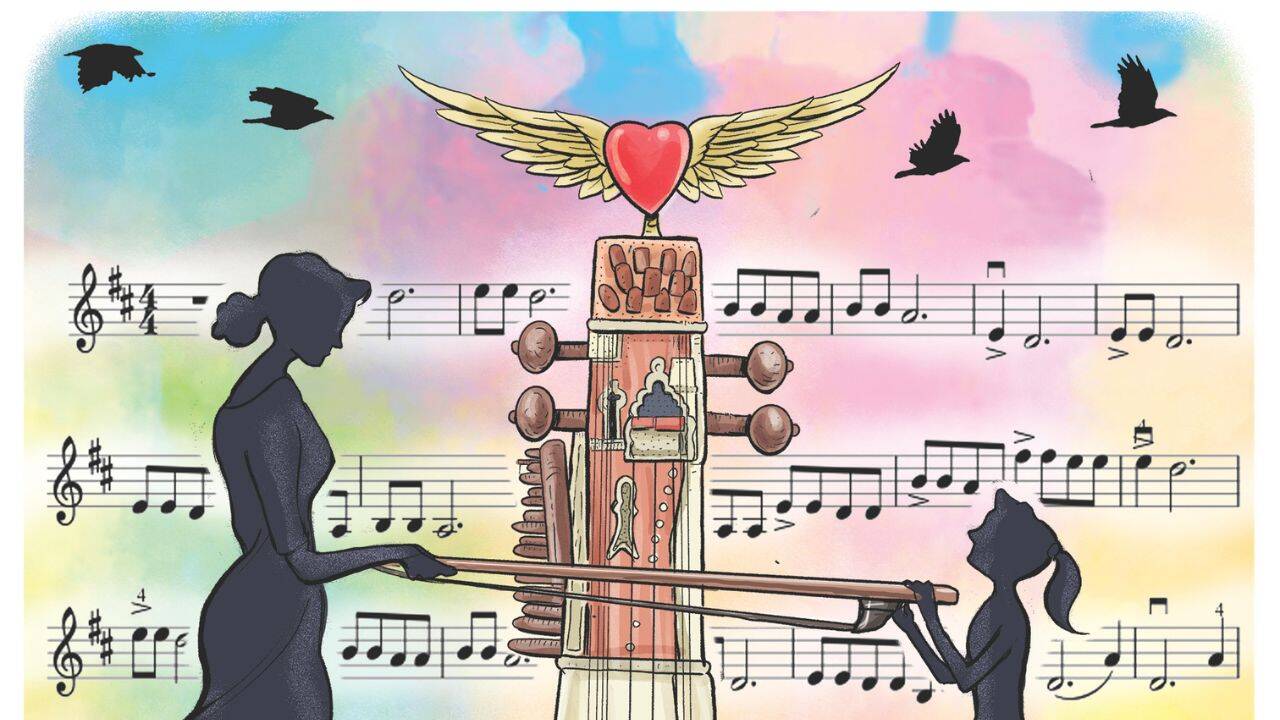
On stage, the Ustaad, in a silk kurta and mischievous mock belligerence, now cradles his sarangi. He jokes that his instrument is young. A mere 122 years old, it belonged to his grandfather. Sabir Khan’s chalked fingers coax his ancient beast. At first, the sharp notes and deliberate pauses sound faintly familiar. To someone like me, musically illiterate, they bring back memories of hotel elevators and old Doordarshan programmes.
The Sufi festival was suggested by a friend. I am unfortunately tone-deaf. Because words matter more to me than tunes, I am perhaps the only person who routinely tells Alexa to play a Swanand Kirkire playlist when I work out. On the other hand, I have also become acutely aware of the truncation of time. At one point, it felt as vast as the Arabian Sea stretched out in front of my bedroom window. Now, it feels the size of my building’s Sintex tank, at the mercy of the mercurial BMC. The other by-product of this awareness is the need to spend time with my mother. She has become part of my packing list. Sneakers. Washbag. Undergarments. Mother. All checked off.
I decided to take on this trip with the mindset that I would spend time with my friends, stuff myself with gatte ki sabzi, wander around Jodhpur and take in its history. The festival was incidental. My mother, by contrast, has a keen interest in music and is currently learning classical singing. I have an old black-and-white photograph of her playing the sitar and me sitting beside her, all of three or four, rounded cheeks and a mop of curls, solemnly patting a tabla.
We have flipped roles. Now, I want to be the one to give her experiences. To show her the world the way she once held my hand and showed me the Great Migration in Tanzania from a hot-air balloon; the underground tunnel from a hotel in Kashmir that opened into an apple orchard; how to tumble down the hills of Ooty without fear. I want to see her joy when she takes in the festival, the way she must have observed me when she bought me a Richie Rich comic or a box of lychees.
Though the word sarangi feels alien on my tongue, the music is drawing me in. The Ustaad’s flying fingers on the bow create motion like the flipbooks of my youth, one image on a page crashing into another.
Earlier that afternoon, sticky and cramped in our rented car, my mother had played her favourite Sufi song, ‘Aaqa,’ by Abida Parveen. My friends had leaned in appreciatively, but I put my AirPods into my ears. Irritated by the volume, by the fervour, by the way her enthusiasm took up space.
There are many times she offers marvellous things — an antique pair of South Indian silver heads, an intricately woven shawl, a hydrating night cream, a way to keep peace in the family. I usually rebuff her. There is no reason other than that it is coming from her. Autonomy can sometimes make for a petty adult.
A mother and daughter relationship is rarely straightforward. Even a good one like ours. It doesn’t matter that I am 52, old enough to have gathered wisdom along with my inclination for wisecracks. In my mother’s eyes, I will always be her bhola, bhondu child. Book-smart instead of street-smart. She is ever ready with a piece of advice. Puberty onwards, we build doors against our parents. There are peepholes and catflaps, yet the main entryway is rarely open. Until my older son entered his twenties, I did not understand how painful this fight for identity can be for the mother. The desire to hold on and the obligation to let go, even if it feels like a permanent rip, soothed only by the salve of text messages and shared holidays.
The maestro’s next set piece is a jugalbandi of skill and performance. He evokes a late husband and an irate wife, his sarangi taking on both arguments, rising and falling across scales. The audience titters and claps, entertained by the playfulness within the rigour of classical music.
My mother is moving her head in tandem with the rhythm. On stage, Sabir Khan’s fingers are a blur. One note joining another, a washing line where he hangs Raag Yaman and lets it flap in the wind. ‘Now he has shifted to Raag Bhairavi,’ she tells me, as he begins a new segment.
My mother and I are often at loggerheads in our approach to life. She is philosophical; I am pragmatic. She believes coincidences are messages, prayers are answered, and divinity resides in the mundane. I believe the human brain seeks patterns and remembers only the moments when belief is reinforced. She believes in swimming with the current. I am willing to enter the same river but with a motorboat, a life jacket, bottled water and snacks. Even on this trip, we have argued about fixed itineraries versus lazy afternoons.
The Ustaad now plays a medley of ragas that form the bedrock of Indian playback singing. The audience hums, sings, and claps along to familiar refrains. I want to look at my mother through the corner of my eye. To see her expression as she absorbs this moment, the way she must once have studied mine.
When I turn in her direction, I see that she is looking at me.
Her phone is raised. She is taking a video.
Later, she will show me the clip — my dupatta draped over my head to ward off the harsh sun, silver bangles flashing as I clap to the beat, a smile pulling at the corners of my mouth.
The mother and the maestro. We imagine ourselves generous, with our curated trips and lingering applause, but their devotion has never been occasional. His music has taken decades. Her mothering, a lifetime.
Four crows fly in a diagonal line across the evening sky. The Ustaad announces he must end his performance; his enthralled audience must climb to the main fort for the next session. ‘Otherwise, they will shoot me with a cannon from there,’ he jokes, pointing at the old edifice behind him.
He begins his final melody. Vande Mataram.
‘Raag Desh,’ my mother whispers.
As his fingers slide along the strings, my eyes hold damp reverence. My arms have gooseflesh beneath my black kurta. I do not understand octaves or ranges or sargams and shrutis. The music does not ask that of me. It asks only that I allow it to move through me. So does love.
Hesitantly, I put my head on my mother’s shoulder. It feels odd. I am taller, broader than her. For years, I have met her beliefs with argument, her guidance with correction, her ease with a checklist. I have mistaken agreement for closeness.
I do not have to decode her. Her faith in signs, her go-with-the-flow philosophy, her unsolicited guidance. I do not have to reshape her into something easier for me to hold. I only have to remain seated beside her. And to quiet the small, precise part of me that keeps trying to tune her.
If she is surprised by my gesture, commonplace when I was a child and infrequent now, she doesn’t show it. She pats my cheek. My neck protests against the bent angle. But I keep it there.
Disclaimer
Views expressed above are the author’s own.
END OF ARTICLE