
 Vinay Kumar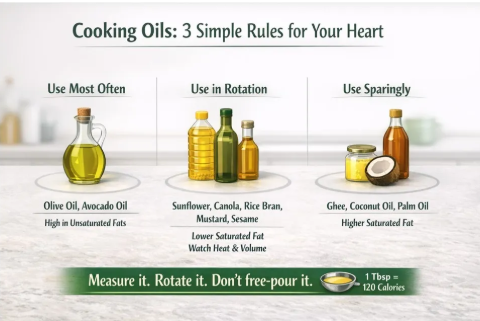
Cooking oils have become one of the most polarizing topics in nutrition. Depending on who you follow online, seed oils are toxic, coconut oil is ancestral medicine, ghee is sacred, and olive oil is liquid gold. In today’s post (#67), I dig into this topic from a variety of angles: what is the role of oils in our cooking and food, what is the composition of oil, what are the cardiovascular outcomes, and many others.
To help me unpack all these aspects, I hosted Dr Vijaya Parameswaran on the Longevity Circle community podcast. She is currently completing a research fellowship at Stanford focused on cardiovascular and metabolic health. Her work examines how to translate evidence-based dietary principles into real-world practice, especially in South Asian populations who carry elevated cardiometabolic risk. In addition, she used to be a coach at the South Asian Heart Center, where she helped thousands of people, including myself, through their nutrition and lifestyle plans. In fact, I give a lot of credit for my early nutrition strategies to Dr Parameswaran.
Let me try and provide a systematic breakdown of our conversation in a way that is practical and actionable.
What role do oils actually play?
Think of oil as doing two vital jobs in your diet: it is a nutrient delivery mechanism and a flavor booster, but with a catch – it adds calories very quickly.
Nutrition: Your body physically cannot absorb certain essential nutrients from your food, specifically vitamins A, D, E, and K, without fat. If you eat a bowl of dry spinach, you are missing out on a lot of its benefits. A little splash of oil ensures your body actually absorbs the nutrients you are trying to eat.
Flavor booster: Oil carries flavor and creates satisfying textures, like the golden crisp on roasted broccoli. This is practically important because if your healthy food tastes like cardboard, you will eventually quit eating it. Oil makes healthy eating enjoyable enough to stick with long-term.
The calories: Fat is the most calorie-dense nutrient on the planet. Just one tablespoon of olive oil has about 120 calories. It will keep you full, but those calories stack up incredibly fast if you are free-pouring it from the bottle.
Introduction to types of fats
This is an important time to provide a quick primer on fats because cooking oils are predominantly composed of them. There are four types of fats that show up in our food:
Saturated fats: Found in butter, ghee, coconut oil, palm oil, and fatty meats. Best used in moderation.
Monounsaturated fats: Found in olive oil, mustard oil, groundnut oil, and avocados. These are considered heart-friendly and help improve cholesterol balance when they replace saturated fats.
Polyunsaturated fats: Found in sunflower, soybean, rice bran, and corn oils, as well as nuts and seeds. These include essential omega-3 and omega-6 fats and are beneficial when not consumed in excess.
Trans fats: Found in some processed foods and repeatedly heated commercial oils. These are best avoided entirely.
Cardiovascular implications of oil choice and cooking style
From a cardiovascular standpoint, three markers dominate the conversation: LDL cholesterol, ApoB, and triglycerides.
LDL-Cholesterol and ApoB: Oils high in saturated fat tend to raise LDL cholesterol when consumed in significant amounts. Elevated LDL and ApoB are strongly associated with long-term cardiovascular risk; this is one of the most consistent findings in multiple publications. That does not mean a teaspoon of ghee will cause a heart attack; it means habitual high intake shifts lipid profiles in an unfavorable direction. Substituting unsaturated fats (like olive or avocado oil) for saturated fats improves lipid profiles in most populations.
Triglycerides and caloric density: Triglycerides are highly sensitive to overall caloric intake, as well as refined carbohydrates and alcohol. Because oil is so calorie-dense, excessive use easily drives total calories and triglycerides upward. When I audit my own food logs, oil frequently appears as the stealth calorie source. Even “healthy” oils contribute meaningfully to total intake.
Deep frying and trans fats: The bigger cardiovascular concern is often not simply the type of oil, but how it is used. Repeated heating, especially in commercial settings, produces oxidation products (which may promote inflammation and vascular damage when consumed in significant amounts) and trans fats. Restaurant fried foods are riskier largely because the oil is reused multiple times (occasional home frying in fresh oil is safer). Furthermore, while artificial trans fats have been largely phased out of the US food supply, labeling loopholes still allow products to claim zero grams if they contain less than 0.5 grams per serving. Always avoid products listing “partially hydrogenated oils” in the ingredients.
Analysis of oils
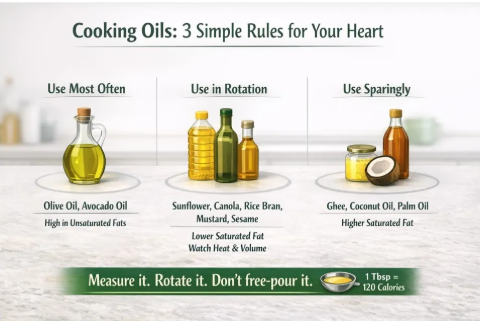

With that framework in mind, here is how individual oils stack up:
Extra virgin olive oil (EVOO): Remains one of the strongest default choices due to its monounsaturated fat profile and preserved polyphenols. Regular olive oil is still cardioprotective and more budget-friendly. I also want to address a common misconception: that olive oil cannot be used for Indian cooking because of its smoke point. In reality, extra virgin olive oil is stable for most home cooking methods such as sautéing, roasting, and making tadka. Its natural antioxidants help protect it during heating. Where it is less suitable is repeated deep frying at very high temperatures, especially when the oil is reused multiple times. For everyday cooking, olive oil works perfectly well. It is usually more expensive than other oils.
Avocado oil: High in monounsaturated fat and suitable for higher heat cooking.
Sunflower, canola, corn, and rice bran oils: Lower in saturated fat than ghee or coconut oil and generally preferable from an LDL perspective (provided they are not repeatedly overheated). Rice bran oil also tolerates higher heat well.
Mustard and peanut oils: Mustard oil can be part of a rotation but should not dominate in high quantities if lipid markers are elevated. Peanut oil is acceptable for occasional high-heat cooking at home with fresh oil.
Coconut oil, ghee, and palm oil: High in saturated fat and should be used sparingly, particularly in individuals with elevated LDL or ApoB.
Dr Parameswaran’s oil-related strategies
One of the most practical parts of our discussion was Dr. Parameswaran’s personal approach to oils:
Reserve the saturated fats: She does not keep ghee, coconut oil, or peanut oil as primary cooking oils. These are reserved for occasional use, often as flavor additions rather than cooking bases. In fact, she keeps them separate from her main cooking area to prevent habitual overuse.
Rotate daily oils: For daily cooking, she rotates among olive oil, avocado oil, sunflower oil, sesame oil, and mustard oil. The goal is to avoid relying too heavily on saturated-fat–rich oils while allowing some variety in flavor and cooking styles. However, if you end up primarily using olive oil because of its favorable fat profile, there is no requirement to rotate oils for health reasons.
Minimize overall volume: Flavor is built through spices, herbs, and cooking techniques (like using an air fryer) rather than a heavy reliance on fat. You can dramatically improve cardiovascular risk markers simply by reducing your volume of oil, even without changing the type.
Avoid the traps: Reduce restaurant fried foods, avoid partially hydrogenated oils, and store your home oils in airtight containers away from heat and light to prevent oxidation.
While I usually provide my own take in this blog, in this case, I simply follow Dr Parameswaran’s strategies, especially given that she coached me through this when I was looking for specifics.
Bottomline
For those of us on a mission to improve our health, the goal is not to eliminate joy from food. It is to align daily habits with long-term cardiovascular health. Oils are not heroes or villains; they are levers. Used thoughtfully, they enhance both flavor and nutrient absorption. Used excessively, even the best oil can quietly work against your arteries.
As always, I welcome your thoughts and would love to hear your experiences in the comments.
Nickhil Jakatdar is the CEO of GenePath Diagnostics and the founder of PreventiveHealth.ai, working to make advanced diagnostics and credible health guidance more accessible, affordable, and actionable. A PhD in EECS from UC Berkeley and the youngest recipient of the UC Berkeley Distinguished Alumnus Award, he has founded and led multiple tech companies. He holds 60 patents, and serves on several academic, healthcare, and innovation boards. To follow his thinking on preventive health, technology, and systems that scale expertise, join his private WhatsApp community and subscribe to his Substack.
Disclaimer
Views expressed above are the author’s own.
END OF ARTICLE