
 Vinay Kumar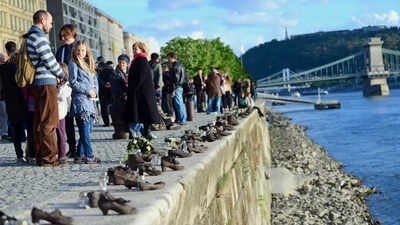
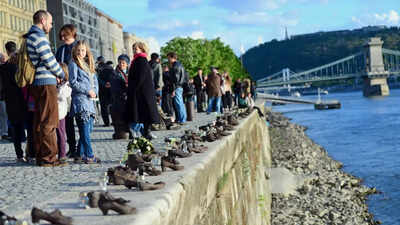
On the edge of the Danube River in Budapest, there is a memorial that often stops people in their tracks. Visitors walking along the riverbank near the Hungarian Parliament building suddenly notice dozens of old-style shoes scattered along the concrete embankment. Some look like men’s work boots. Others resemble elegant women’s heels. A few are small enough to belong to children. At first glance, it almost looks as though their owners stepped out of them and walked away. But the truth behind these shoes is far more disturbing. The installation, known as the Shoes on the Danube Promenade, commemorates Hungarian Jews who were murdered during the final months of the Second World War. Quiet and deeply personal, the memorial has become one of the most powerful reminders of the violence that once unfolded along this peaceful river.
Shoes on the Danube Promenade: The iron shoes that speak of history
The memorial consists of about sixty pairs of iron shoes fixed along the riverbank. Some stand upright, neatly placed near the water’s edge. Others appear toppled or abandoned, almost as if someone had hurriedly removed them. The designs resemble footwear from the 1940s. Visitors can see worn boots, sturdy men’s shoes, women’s pumps, and even tiny children’s shoes.The shoes look so real that many people instinctively imagine the individuals who once wore them. That reaction, experts say, is exactly what the creators intended.The memorial was conceived by Hungarian film director Can Togay and created with sculptor Gyula Pauer. It was installed in Budapest in 2005 on the Pest side of the Danube. Simple plaques nearby carry a short message in Hungarian, English, and Hebrew remembering the victims who were shot into the river by Arrow Cross militiamen during 1944 and 1945.
The dark past behind the shoes on the Danube Promenade
To understand the memorial, it helps to know what happened in Budapest during the winter of 1944. At that time, Hungary had fallen under the control of the fascist Arrow Cross Party, led by Ferenc Szálasi. The group was violently antisemitic and launched a brutal campaign against Jewish residents across the city.Arrow Cross militiamen attacked Jewish families in the streets, looted homes, and carried out public executions. Thousands of people were murdered during those months. One of the most horrifying methods took place along the banks of the Danube.Before being killed, they were often forced to remove their shoes. Footwear was valuable during wartime, and the attackers could reuse it or trade it on the black market. Once the shoes were removed, the prisoners were lined up along the riverbank and shot. Their bodies fell directly into the water. People living in the city reportedly began referring to the river as “the Jewish cemetery” during those dark weeks. It was a grim description, but many felt it captured the terrible reality.
Eyewitness memories of the horrors along the Danube
Some survivors later described the scenes they witnessed near the river. One account came from Zsuzsanna Ozsváth, a Hungarian woman who survived the war. She recalled hearing a series of gunshots one day and initially believing that Soviet troops had arrived in the city.Two Arrow Cross soldiers were standing on the embankment, firing at groups of men, women, and children who wore the yellow star that Jews were forced to display during the war. One after another they were shot and fell toward the river.She later wrote that the Danube did not look blue or grey that day. Her words remain one of the most chilling descriptions of what happened along the riverbanks during that period.
How the memorial keeps memories alive by the river
Today, the riverbank in Budapest is usually calm. Tourists walk past the Parliament building, boats move slowly along the Danube, and people stop to admire the city skyline. Some leave flowers. Others place candles or small stones inside the iron shoes as a tribute. Occasionally, scarves or ribbons appear there as well.Standing beside the river, it becomes easier to imagine the fear and confusion that victims might have felt during those final moments. The quiet setting somehow makes the history feel even more immediate.The Shoes on the Danube Promenade memorial does not try to explain everything about the past.