 Vinay Kumar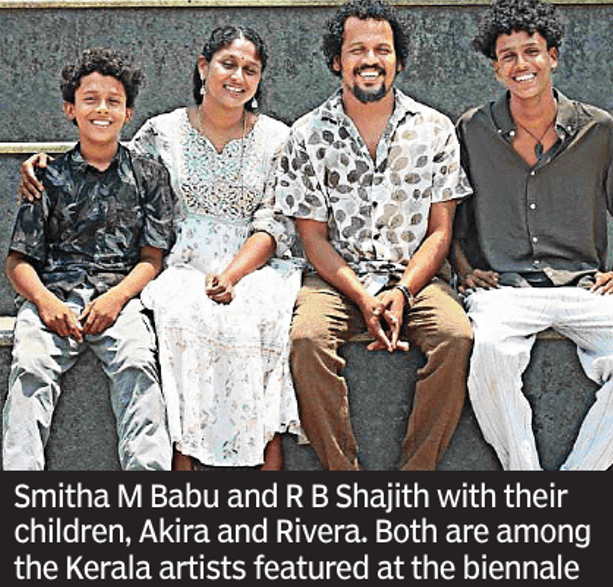
A couple’s art dwells in the world of coir workers and landscapes in retreat
They say coir once left Neeravil, a remote village in Kollam beside Ashtamudi Lake, by water—bundles of fibre loaded onto country boats bound for Aspinwall & Co. in Kochi. There is something quietly circular about what has followed: The coir that once travelled as commodity now returns transformed into image and performance. What was once material has become memory; what was once labour has become art. In a reversal that feels both poetic and precise, artist Smitha M Babu finds herself exhibiting at that very same Aspinwall—not as a point of export, but as a space of return.
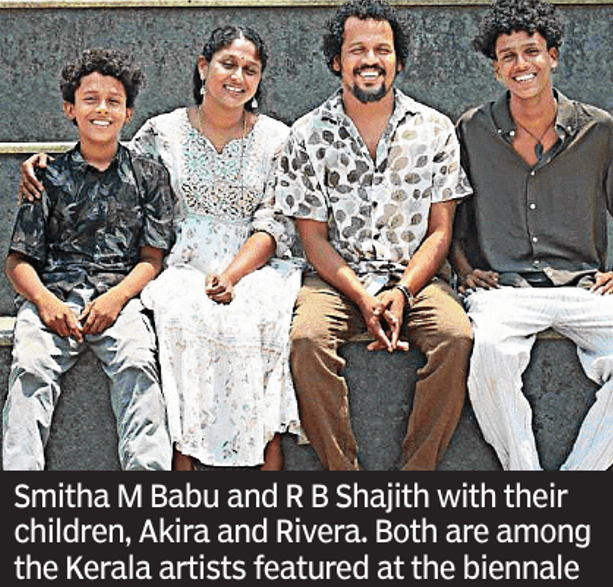

In a rare feat, Babu and her husband, RB Shajith, are both displaying work at the ongoing Kochi Muziris Biennale, their practices unfolding in quiet dialogue with each other. Joint winners of the Lalita Kala Akademi award for excellence in art in 2022, the couple have built distinctly different but deeply complementary bodies of work.
Babu’s installation, Paakkalam—the Malayalam word for a coir-weaving workspace—resists containment within a single form. It is at once painting, performance, memory, and reconstruction.
Her relationship with coir is neither distant nor academic. Growing up in Neeravil, encircled on three sides by water, the rhythmic clatter of the coir spinning machine marked her childhood as reliably as any clock. Coir-making was not merely an occupation; it was the pulse of the locality.
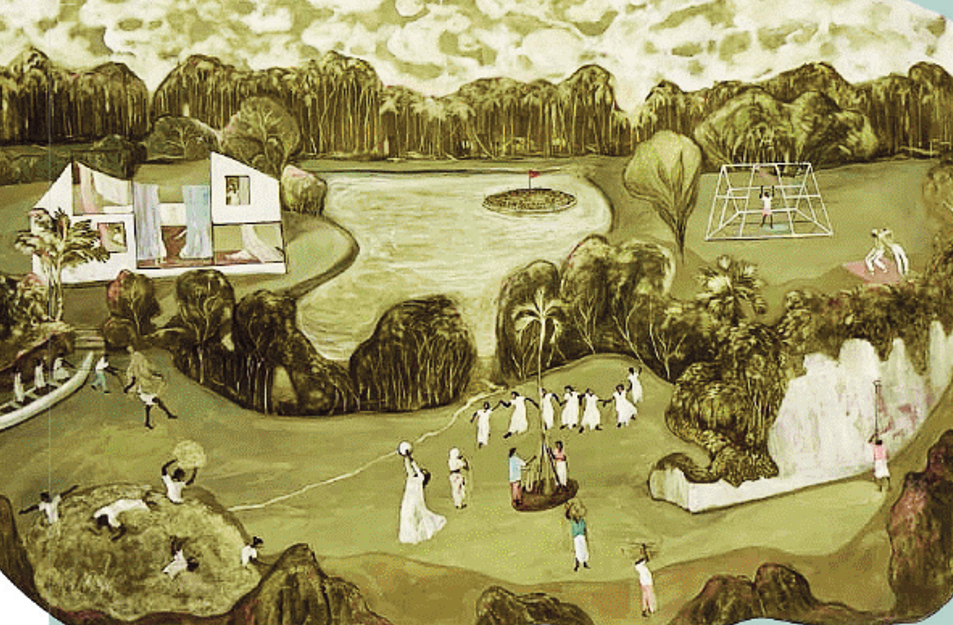

“Several members of my father’s and mother’s families worked at Paakkalam,” she recalls. What endures most vividly are not finished products but gestures of labour: A man walking past with a mound of coconut husk so large it obscures his face; bodies bending, lifting, twisting fibre into rope. These half-seen, half-imagined moments resurface in her canvases. Her figures are often fragmented or obscured, echoing the anonymity with which labour itself is so often rendered.
The performance component of Paakkalam extends the work into time. Developed with a theatre collective, the performance introduces movement, sound, and voice into the installation. The ensemble works with materials drawn directly from coir production: Coconut husk, fibre, spinning machine. The emphasis on women is central. “During that time, coir-making brought earnings to women,” Babu notes. “Women who didn’t have much freedom at home were free at Paakkalam. There was sharing, there was joy.”
Shajith’s work at the Biennale, titled Wiping Out, is an ongoing meditation on ecological erosion and the uneasy overlap between human habitation and a retreating natural world. Rendered in oil, acrylic, and watercolour on expansive canvases, the paintings carry a layered sensibility shaped by years of working across mediums.
Trained extensively in watercolour, Shajith speaks of its spontaneity—its capacity for accident and dissolution. Oil drew him for its density and history. “Watercolour gives a freedom for spontaneous abstract art,” he says. “My enquiry was how to bring that freedom into other mediums.”
The resulting works are expansive compositions that evoke dense landscapes without fully depicting them. Rooted in the sensory world of rural Malabar, his areca plantations hover between landscape and dreamscape. In the gaps between vertical columns of trees, apparitions of animals and birds surface and recede as if caught between presence and disappearance. Notably, human figures are absent. For Shajith, this is deliberate. “It is viewers who stand in front of these large canvases who complete the picture.” The viewer becomes a participant, implicated in the fragile worlds the paintings evoke.
Seen together, the works of Babu and Shajith form a subtle but powerful conversation. Hers is grounded in the rhythms of labour and the memory of a community shaped by coir-making. His engages with ecological absence and landscapes dissolving under human intervention. Both grapple, in different ways, with disappearance—of work, of environment, of ways of being.
Disclaimer
Views expressed above are the author’s own.
END OF ARTICLE