Vinay Kumar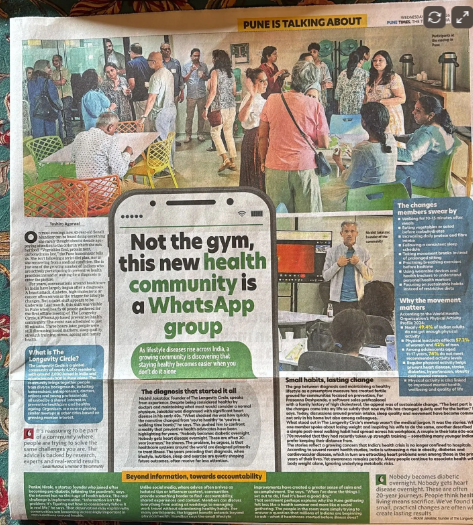
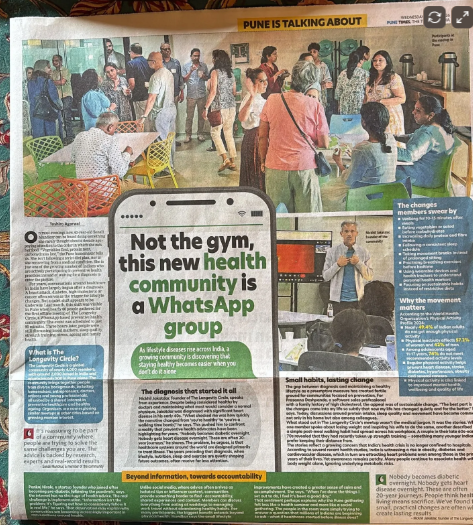
As many of you know, I run a free WhatsApp-based health community called The Longevity Circle. We bring together doctors, dietitians, physiotherapists, health experts, and community members who are trying to make sense of the increasingly complex world of health and wellness. Through weekly podcasts, expert Q&A sessions, and daily conversations, we try to answer a simple question: how can we help people stay healthy long before disease arrives? All of this has happened virtually….so far.
Last Sunday, we hosted the first-ever in-person Longevity Circle meetup in Pune. We planned for ninety minutes. Nearly three hours later, people were still talking. It struck me that something special was happening. (see the coverage in the local Pune Times edition)

The idea behind the community is straightforward. Most chronic diseases do not appear overnight. Heart disease, diabetes, fatty liver disease, osteoporosis, dementia, and many cancers often develop silently over decades. Yet most healthcare systems are designed to intervene after problems emerge. Doctors do extraordinary work, but healthcare systems are naturally designed to focus on people who are already sick.
That leaves a gap.
How do we learn to make better decisions before disease takes hold? How do we separate good advice from bad advice? And perhaps most importantly, how do we stay motivated long enough for healthy habits to become part of everyday life? What struck me most at the meetup was not the science. It was the stories.
Story after story showed how small, evidence-based changes, reinforced by a supportive community, can compound into meaningful improvements in health and quality of life.
One woman shared how the weekly podcasts had gradually changed the way she thinks about health. She wasn’t talking about a miracle supplement or a breakthrough treatment. Instead, she described picking up practical ideas from different experts over time. One of those ideas was keeping a gratitude journal before bed. At first, it seemed too simple to make much difference. But she explained how spending a few minutes each evening reflecting on positive moments from the day helped quiet her mind and improved her sleep quality.
Another woman shared a story that resonated deeply with many attendees. Her mother had died from breast cancer in her forties. Because of that family history, people had encouraged her for years to undergo genetic testing. Yet she delayed the decision for nearly five years. The reason wasn’t financial. It wasn’t logistical. She was afraid of what she might discover. What if the results increased her anxiety? What if she learned something she couldn’t change? Eventually, she decided to move forward with testing. Instead of creating fear, the results gave her clarity. She finally understood her actual level of risk and could focus on actions rather than uncertainty.
Her story highlighted something we often overlook. Sometimes the greatest barriers to better health are emotional rather than scientific.
Another member described how a continuous glucose monitor, combined with guidance from one of our community dietitians, helped him reverse Grade 2 non-alcoholic fatty liver disease over the course of a year. The device itself was not the solution. What mattered was the feedback. For the first time, he could see exactly how different foods affected his blood sugar. He experimented. He learned. He adapted. One year later, his fatty liver disease had reversed.
His story perfectly captured a principle we discuss often in the community: awareness frequently comes before action. When people can see what is happening inside their bodies, healthy decisions become easier to make and sustain.
Throughout the evening, I noticed something unusual. People weren’t trying to impress each other. They were openly discussing mistakes, fears, setbacks, and lessons learned. The conversations felt less like networking and more like old friends helping each other solve problems. At one point I looked around the room and realized that nobody was looking at their phones. In 2026, that may have been the most remarkable health metric of the evening.
One of the most emotional discussions centered around our podcast from the previous week with Sanjay Subramanian. Diagnosed with Stage 4 cancer and facing circumstances that would leave most people feeling hopeless, Sanjay shared a journey that went far beyond medicine. What resonated with listeners was his philosophy of hope. Not hope as wishful thinking. But hope as a conscious decision to keep finding meaning, purpose, and joy even in the face of uncertainty. Several attendees mentioned how deeply the conversation had affected them and how it changed the way they thought about adversity, relationships, and what truly matters in life.
Another theme that emerged throughout the evening was the role of doctors in the community. Doctors make up a meaningful portion of the Longevity Circle. Several attended the meetup and actively participated in the discussions. One young physician trained in internal medicine spoke about how topics such as genetics, wearable devices, preventive screening, and personalized health tracking are increasingly becoming part of mainstream medicine when supported by good evidence. Her comments were met with enthusiastic applause. The goal of the community has always been to help people become active participants in their own healthcare while learning from both experts and peers.
As the evening was winding down, one final conversation captured everything we are trying to achieve. A couple in their late sixties and early seventies came up to me before leaving. They told me they had started strength training because of something they had learned in the community. Not because of a diagnosis. Not because of a health scare. Simply because they realized it was never too late to get stronger. I found that incredibly inspiring. At an age when many people are told to slow down, they had chosen to invest in their future health. They spoke about feeling stronger, more capable, and more optimistic about aging.
In many ways, their story summarized the entire purpose of The Longevity Circle. Small actions. Evidence-based decisions. A supportive community. And the belief that it is never too early, or too late, to improve your health.
The thing I will remember most is not any particular story. It is the image of dozens of people who had started the evening as strangers and left with a sense of community. In a world where health information is abundant but genuine connection is increasingly rare, perhaps that was the most valuable intervention of all. If that mission resonates with you, I would encourage you to join us. Click here if you are interested in joining the Pune Longevity Circle.
If you are passionate about health and community building, we would love your help. Following the success of our first Pune meetup, we are exploring local Longevity Circle chapters in other cities around the world. If you would be willing to volunteer and help organize gatherings in your city, please reach out and let us know where you are.
Because after watching sixty people spend their Sunday evening learning from one another, sharing their stories, and refusing to leave when the event was supposed to end, I am more convinced than ever that the future of preventive health will not be built by technology alone. It will be built by supportive communities, working in conjunction with the healthcare providers who view them as partners in the health journey. Speaking about a sense of community, I would like to congratulate my friends Annie, Nils, Annette and Jim. So fun to be a part of your celebrations this weekend!
Nickhil Jakatdar is the CEO of GenePath Diagnostics and the founder of PreventiveHealth.ai, working to make advanced diagnostics and credible health guidance more accessible, affordable, and actionable. A PhD in EECS from UC Berkeley and the youngest recipient of the UC Berkeley Distinguished Alumnus Award, he has founded and led multiple tech companies. He holds 60 patents, and serves on several academic, healthcare, and innovation boards. To follow his thinking on preventive health, technology, and systems that scale expertise, join his private WhatsApp community and subscribe to his Substack.
Disclaimer
Views expressed above are the author’s own.