Vinay Kumar


Hello and welcome to another edition of the Weekly Vine. This week we look at the Telegram ban, explain why Elon becoming a trillionaire isn’t the real headline, ponder the Mamdani Effect and why the US treated an AI model like a missile.
The Telegram Ban
Brevity, they say, is the soul of wit. Thankfully, my wife didn’t agree, or she would have said aye to the digital suitor who wrote to her on a dating app: “U me wknd.” Wit so divine that it needs no vowels or even punctuation marks. Thankfully, like you Vine readers, she preferred a more loquacious approach when it comes to the written word.
Now, dating horrors apart, in the pre-ChatGPT days, most messages were much shorter. Brevity in writing might seem like a habit created by SMS language or Twitter, back when it had a 140-character limit, but the original messaging app for people allergic to adjectives and vowels was the telegraph, where you sent a telegram and every extra word could cost you money.
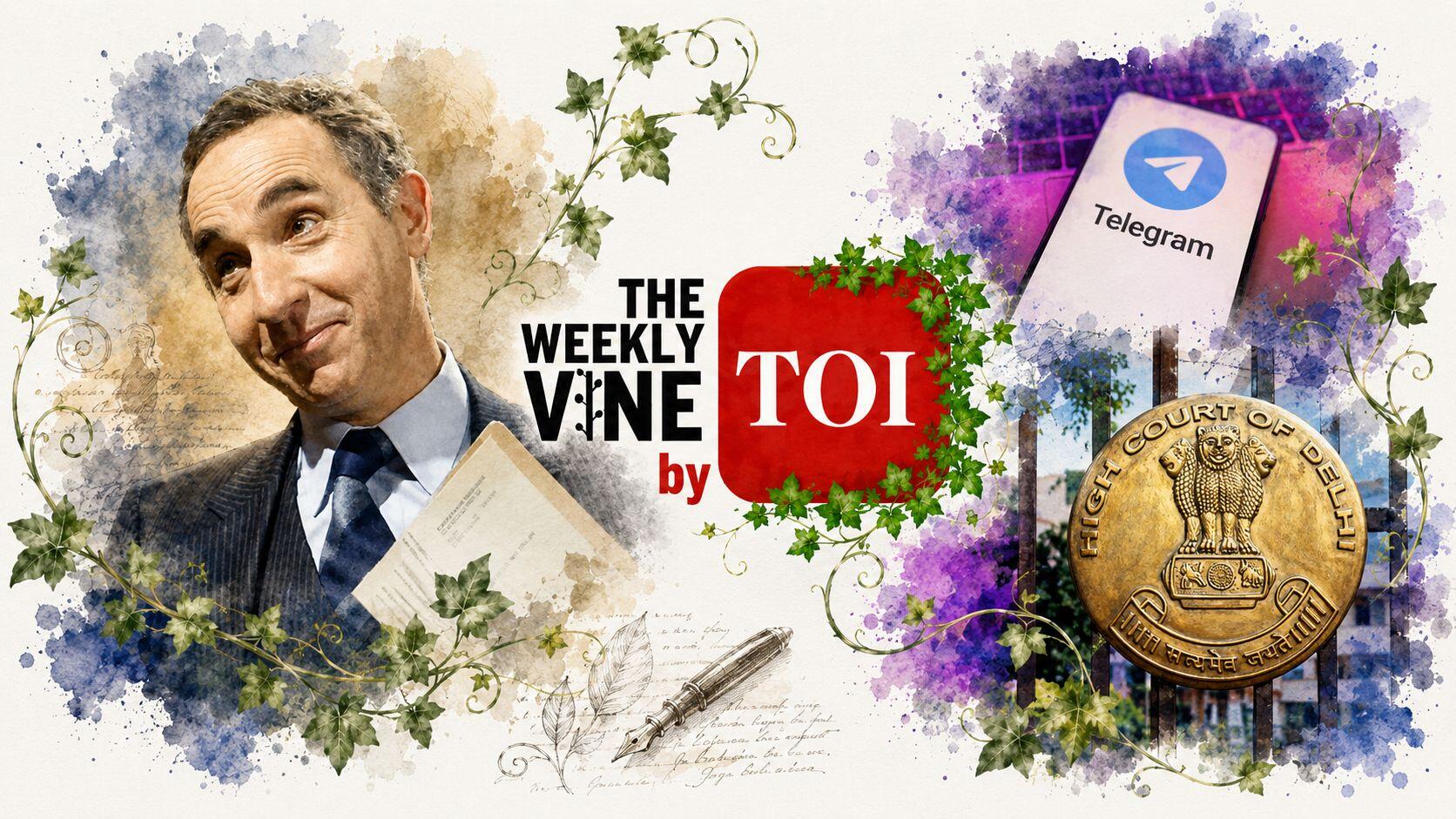
Today, Telegram is the exact opposite: a messaging app that can be used for anything but which the government thinks will help future doctors cheat and the government of India has banned the app till June 22 and its message editing feature till June 30.
The government has given three reasons for this:
1) Telegram is built for scale and can broadcast to an unlimited audience which means it can spark anxiety for millions in an instant.
2) Telegram allows messages to be edited after posting which makes it perfect for digital Ashwathama Hatha Iti and Trojan Horses.
3) The app has massive file-sharing limits running into GBs which will make it easy to circulate fake question papers, answer keys, screenshots and PDFs.
Telegram was founded by Pavel Durov and his older brother Nikolai Durov and has been in trouble with authorities in the past. Pavel has been in trouble with the authorities in the past and was arrested in France. Post the ban, Durov claimed the “leaks just moved to other apps” and would affect India’s 150 million users. Telegram has also moved Delhi High Court against the ban. But the real issue isn’t just the ban, but what it represents.
Sir Humphrey Appleby, the fictional bureaucrat would argue that there’s an unwritten rule of government decision-making: “Something must be done. This is something. Therefore, we must do it.” So, when the government ropes in the Indian Air Force or bans a messaging platform, it’s simply trying to remind its voters that it’s doing something, anything. Civil servants on the other hand, know better: doing something is always worse than doing nothing. But then again, they just have to clear an exam, not seek votes. The worst thing that can happen a civil servant is they get transferred. Politicians on the other hand have to face a far worse outcome when people become dissatisfied.
Why Elon the trillionaire isn’t the real headline

While Elon Musk is keeping socialists awake at night, a man amassing so much wealth isn’t the real heading. The harder, stranger story is whether SpaceX is being valued not merely as a rocket company, but as the base layer of the next economy. Because that $1.1 trillion may still be the tip of the iceberg.
Most space companies are still stuck at the transportation stage. They are all trying to solve one problem: can we reduce the cost of moving mass into orbit? That is the whole game. The Space Shuttle cost roughly $54,000 per kg to low Earth orbit. Falcon Heavy brought that down to roughly $1,500-$2,000 per kg. Starship’s ambition is to push that below $100 per kg.
If that happens, the economics of space change completely. Things that were once the preserve of science fiction quickly become plausible: lunar industry, orbital construction, space solar power, asteroid mining and space habitats. That is step one.
Step two is orbital infrastructure. Bezos often argues that Earth should be zoned for living and nature while heavy industry ought to move to space. To the modern mind, it sounds absurd, but so did the idea of splitting the atom or sending a man to the Moon a century ago. In space, solar energy is constant, and there is no atmosphere, no weather, no monsoon and no pesky NIMBY objecting to orbital parking.
Then comes stage three: resource extraction. Asteroid mining still sounds like Armageddon with accountants, but if cheap launch changes the cost curve, the dream starts looking less ridiculous. The real resource in space may not be platinum or gold, but what Jesus turned into wine: water. It can support life, shield against radiation and be split into hydrogen and oxygen for rocket propellant. A water-rich asteroid is a floating fuel station, oxygen cylinder and settlement starter kit.
That is why the valuation is not just about rockets. It is about whether SpaceX becomes the AWS of space: launch, satellites, internet, orbital construction, lunar logistics, asteroid resources, space solar power and habitats. If Starship becomes a reusable interplanetary freight system, SpaceX does not have to mine every asteroid or build every habitat. It only has to make those things economically viable for others.
And if SpaceX builds the road, Musk’s other companies may be waiting at the toll gate: Tesla for vehicles, batteries, robotics and energy; xAI for artificial intelligence; Starlink for communications; Neuralink for human-machine interfaces; and The Boring Company for the underground habitats that may one day matter on the Moon or Mars.
Many of Musk’s earlier bets have already changed ordinary life. Zip2 foreshadowed digital mapping and location services. PayPal helped reshape digital payments and modern fintech. Tesla made EVs and self-driving cars feel less like sci-tech fantasy. Starlink provides internet in remote corners of the world. Neuralink has allowed a quadriplegic to interact with a computer using his thoughts.
Musk may be many things, not all of them pleasant, but he is certainly someone who could ensure that science fiction no longer remains fiction.
The Mamdani Effect

Bengal has two poets whose vintage is considered above all others: Rabindranath Tagore and Kazi Nazrul Islam. Now, with full awareness of the absurdity involved, one may have to add a third name to the footnotes: MD Ahnaf Hossain.
Hossain, a Bangladeshi-origin New Yorker, became a social media sensation after his chant: “My mayor’s Muslim, my bagel’s Jewish, my Christian Dior, Knicks in four.” Now that’s no Gitanjali or Bidrohi, but it certainly united New Yorkers and, by extension, all members of the global order who feel they already live in New York because they have memorised every Friends and How I Met Your Mother episode.
Except it didn’t quite become Knicks in four, with superstitious sports fans blaming Donald Trump’s attendance at Madison Square Garden for Game 3, so the chant had to be updated: “My mayor’s still Muslim, my bagel’s still Jewish. The Pope is on our side, Knicks in five.”
Now, while that might seem like poetic licence, the first American pope was seen giving a thumbs up when a fan screamed: “Pope Leo, go Knicks.” The pope, who shares an alma mater with three members of the current Knicks line-up, also signed a jersey for Knicks superfan Spike Lee which had “Pope Leo” written on the back, which led some to wonder if the Knicks had a divine assist, more so since Game 4 of the Finals featured a miraculous 29-point comeback.
But now talk has turned to another sort of sporting superstition: the Mamdani Effect. While the Mamdani Effect might sound like a boost for progressive causes since the election of New York’s first Muslim mayor, it’s actually what The Athletic called a Zohran Mamdani sports summer, after two of his teams, Arsenal and Knicks, ended historic trophy droughts.
Postscript by Prasad Sanyal

For years, technology export controls meant things that arrived in wooden crates. Advanced chips. Lithography machines with German optics and Dutch precision. Missile guidance systems. Cryptography hardware. Physical objects with heft and serial numbers, moving through ports and customs declarations and the comforting paperwork of the material world. The entire legal architecture of export control was built on the assumption that dangerous technology has mass.
On 13 June 2026, the United States effectively declared that a sufficiently capable AI model belongs in the same category as all of the above. No crate required. Anthropic was directed to disable its two most capable AI models, Fable 5 and Mythos 5, for any foreign national — whether located inside or outside the United States, including the company’s own non-citizen employees.
The directive came from Commerce Secretary Howard Lutnick in a letter to CEO Dario Amodei. Anthropic, finding it operationally impossible to screen hundreds of millions of users by nationality in real time, did the only mathematically coherent thing available: it disabled both models for its entire global customer base and defaulted everyone to the older Claude Opus 4.8.
Disclaimer
Views expressed above are the author’s own.