Vinay Kumar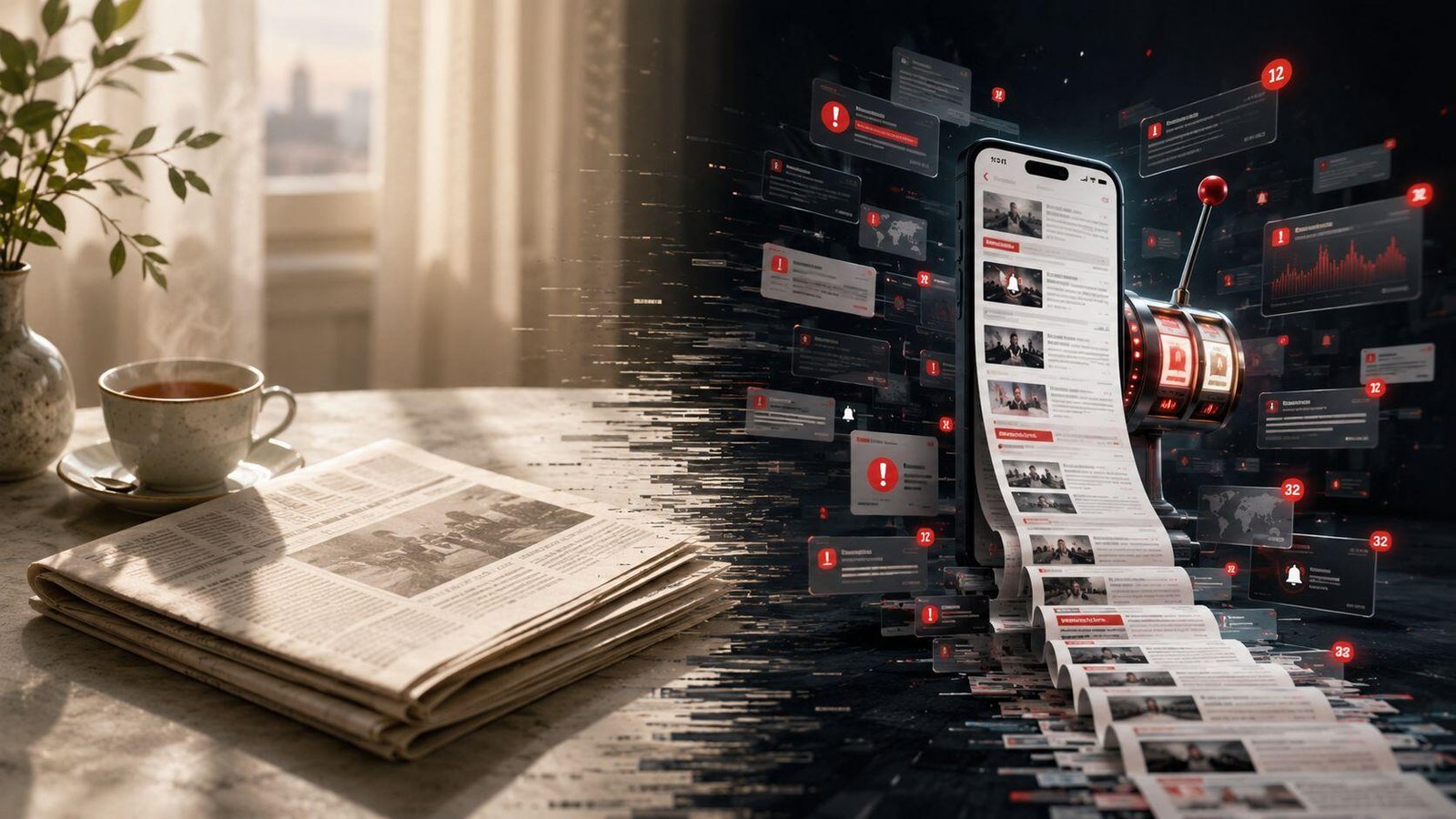
There was a time, recent enough that most of us remember it without the assistance of nostalgia, when a newspaper understood something fundamental about its relationship with its reader. It was there before breakfast with the quiet punctuality of a government clerk who still believed in public service, interrupted your morning for twenty to thirty civilised minutes, informed you that governments had fallen, markets had risen, and England had once again found an imaginative way to lose a Test match, stained your fingers with ink that refused to leave until lunchtime, and then, with the impeccable manners of an elderly Bengali uncle who knew precisely when his visit had run its course, folded itself into yesterday. It never imagined that its purpose was to accompany you into meetings, interrupt dinner because an actor had posted an “emotional message,” or ask through a product dashboard whether your dependence on it had grown another three per cent this quarter.
Somewhere along the way, journalism wandered into the attention economy, where every business eventually discovers that informing people is respectable but retaining them is considerably more lucrative. From that moment, the incentives changed, disastrously for readers and marvellously for quarterly presentations. Newspapers once competed to explain the world before your second cup of tea. News apps compete to ensure you never quite leave.
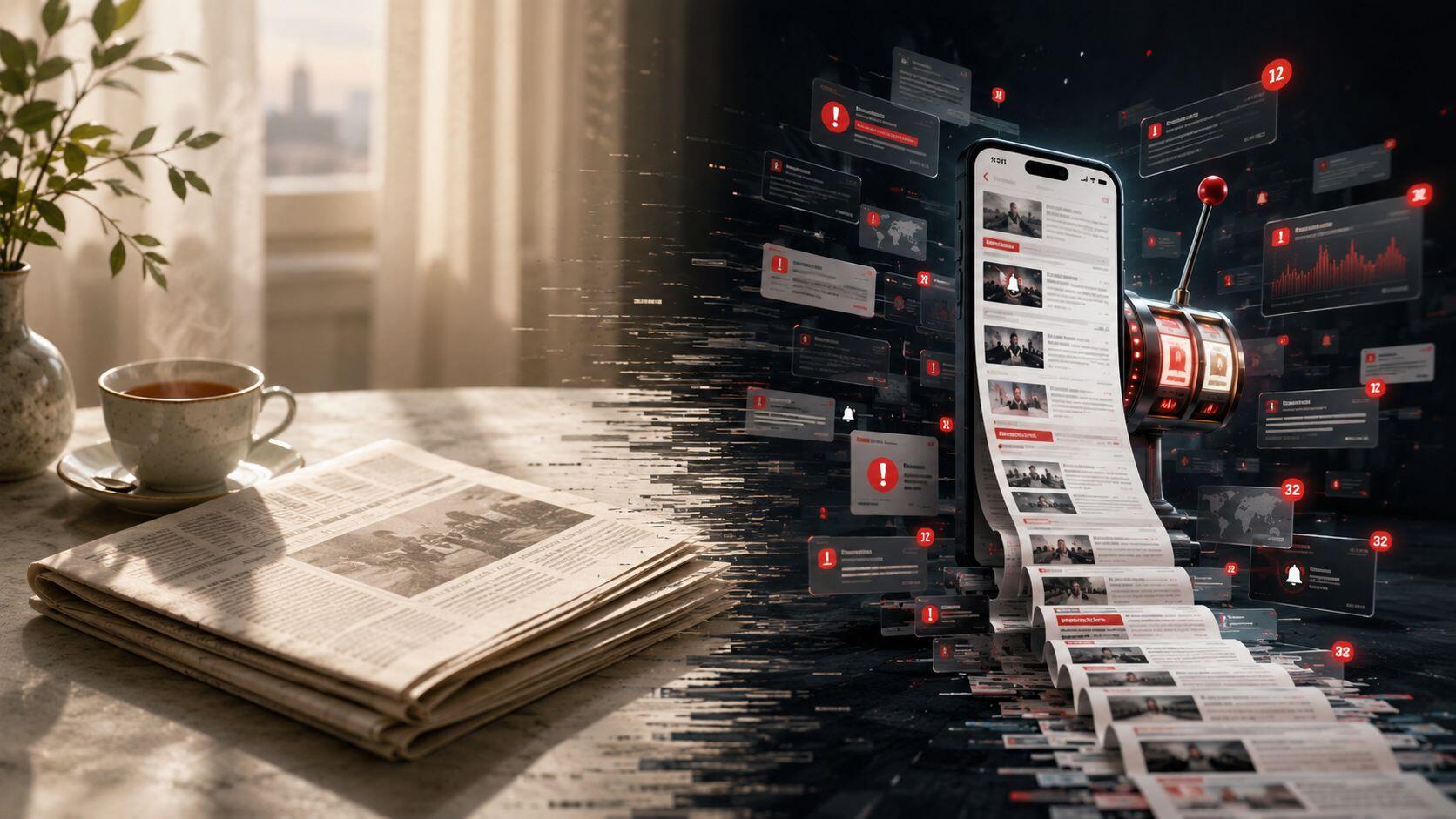

The distinction seems academic until you notice that the first job ends when you understand what happened, while the second ends only when your battery does.
The modern news app has confused urgency with importance, two concepts that coexisted peacefully for centuries before somebody in a product meeting decided they ought to share accommodation. Everything is now breaking. The markets are breaking. Somebody’s airport look is breaking. An actor’s cryptic Instagram caption has broken with such force that your phone must interrupt breakfast to tell you. The word has been stretched, kneaded and emptied with such industrial efficiency that when something genuinely extraordinary happens — a war begins, a bridge collapses, a bank evaporates before lunch — the exhausted adjective has nothing left to offer except another identical red rectangle, indistinguishable from yesterday’s recipe for paneer lababdar. We have industrialised the boy who cried wolf and put him to work in machine learning.
Language is only the beginning. The larger deception is that the modern news app no longer seems particularly interested in whether you have read the news — only that you engage with it, a word that has suffered a remarkable decline in respectability. Once it meant a conversation, perhaps even a marriage. Inside technology companies, it now describes a relationship with the emotional balance of a hostage negotiation.
You open the app to check whether the Reserve Bank has changed interest rates. Forty-three minutes later, you emerge with detailed knowledge of a reality contestant’s cosmetic procedures, eight foods quietly plotting against your liver, a celebrity wedding documented from seventeen angles, and the growing suspicion that mangoes have become controversial. You came looking for information. You left as inventory — which is not an accident, but the business model expressing itself exactly as designed.

The most ingenious invention in this ecosystem is not artificial intelligence or predictive notifications. It is the infinite scroll, which performs a trick elegant enough to demand grudging admiration. Every civilised object invented before it had an ending. Newspapers ended. Magazines ended. Books, despite the odd Russian novelist, ended. Completion was built into their architecture because completion was understood to be part of the pleasure. The infinite scroll abolished completion, because the bottom is where you would close the app, look out of a window, speak to another human being, or, in an act of reckless optimism, get on with your day. A reader who puts the phone away is, in the accounting language of modern software, a regrettable outcome. Somewhere, a graph slopes gently in the wrong direction.
The news app has quietly stopped resembling a newspaper and started resembling a slot machine that occasionally, almost apologetically, dispenses journalism.
None of this is unique to journalism. Every corner of the internet competes for the same finite resource. Streaming platforms insist that one episode naturally deserves another. Social media believes every opinion requires an immediate counter-opinion. Shopping apps are convinced you are one notification away from the air fryer that would finally complete your personality. We have surrounded ourselves with software that behaves like an overenthusiastic Labrador, following us from room to room, delighted beyond reason that we haven’t yet escaped. It is an odd civilisation that measures success by how difficult it has become to leave.
Which brings me to an awkward confession. Having spent this article prosecuting the category, recommending another news app resembles escaping a burning building and complementing the neighbouring property’s fire exits. I’ve noticed the contradiction myself.
But every industry deserves to be judged not only by its worst instincts but by its occasional attempts to recover its better ones, and the new TOI app appears, at least to me, to belong to that second category, not because it has discovered some miraculous new technology (every launch promises that), and not because it claims more content, more videos, more alerts, more reasons to stay trapped inside your screen until your family circulates a missing-person notice. Its ambition is considerably smaller, and therefore considerably more interesting.
It begins with a proposition that would have sounded ordinary fifteen years ago and therefore feels almost revolutionary today: perhaps the purpose of a news app is not to occupy your day but to prepare you for it. Tell me what matters, and why. Organise the noise into something resembling understanding. Then, with impeccable manners, get out of the way. That means a morning briefing that behaves like a briefing rather than an obstacle course, news organised by significance before sensation, notifications deployed sparingly enough for the colour red to recover its dignity, and an experience that expects to be closed after use rather than treating your departure as a product failure.
Will it always succeed? Probably not. Human beings edit newspapers, software is built by human beings, and both professions have spent centuries demonstrating that perfection is not among our core competencies. There will be features that improve, habits that need unlearning, decisions readers disagree with, experiments that deserve retirement. That isn’t a weakness. It’s the natural condition of any living product that still believes readers are worth listening to.
That’s why I recommend you download it. Not because the world needs another icon on your home screen; heaven knows it doesn’t and most of us already carry enough applications to occupy three lifetimes and enough notifications to reconstruct a Monet painting.
Download it because products get better only when thoughtful readers use them, criticise them, ignore the wrong things, celebrate the right ones, and remind the people building them that attention is borrowed, never owned.
Explore it for a week. Read the morning briefing. Turn on the notifications if you wish, and hold us to a standard the industry seems to have forgotten: interrupt me only when you have earned the interruption. If we succeed, you will spend less time inside the app than you do inside most of its competitors. That, oddly enough, is exactly the point.
The highest compliment a news organisation can receive is not that you never left. It is that you arrived, understood the world a little better than you did ten minutes earlier, folded the experience away as neatly as yesterday’s newspaper, and got on with the infinitely more important business of living your life. Come back tomorrow. We’ll try to earn it again.
Disclaimer
Views expressed above are the author’s own.