Vinay Kumar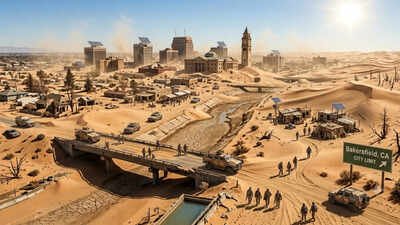
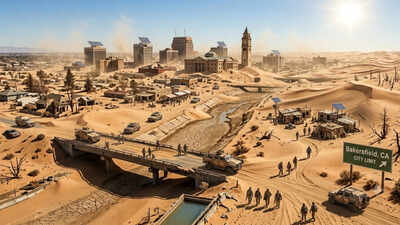
By the time today’s American toddlers reach retirement age, the ground beneath some of the major cities in the United States will look nothing like it does now. A new study published in the journal PeerJ found that climate change is transforming the natural geography of the US.Researchers working with the Open Earth Monitor Cyberinfrastructure project mapped how the country’s natural vegetation zones (biomes) will shift by 2080. The results, drawn from high-resolution satellite data and machine-learning models, suggest that part of the American West and Southwest is turning into desert.
US cities may dry out and become deserts
In the study, the researchers looked at how biomes will shift by 2080 under different climate scenarios. The projections suggest that some of the major cities in the US are on track to change into full desert biomes within the next half-century. Climate change would reshape the land, vegetation and habitability of entire communities.The researchers found that the central US will become hotter and drier over the years. The grasslands will turn into more desert-like vegetation, with fewer wildflowers and more tumbleweeds. On the East Coast, wetter forest types are projected to thin into drier plant communities better suited to heat stress. Meanwhile, the deserts of Arizona, New Mexico and southern California are forecast to push outwards into Texas and Colorado.According to the findings, the categories classified as cool mixed forest, cool evergreen needleleaf forest and temperate evergreen needleleaf open woodland are predicted to decline faster. The drier, arid ecosystems, on the other hand, will expand. The desert biome is set to grow by roughly 182,000 square miles, moving from 6 per cent to nearly 12 per cent of total US land area, affecting some of America’s largest cities. The data reveal that major cities will become deserts in the next 50 years.
Cities expected to take the fall
To identify which cities sit in the path of that expansion, Climate Crisis 247 examined spatial data from the April 2023 PeerJ paper “Current and future global distribution of potential biomes under climate change scenarios.” The cities where the dominant biome type is projected to flip to desert between 2061 and 2080 (measured against a 1979–2013 baseline) were sorted using the BIOME 6000 classification system and ranked by current population. The forecast changes to biome landscape classification are based on the RCP 8.5 scenario, or high emissions. The mapping itself was done in QGIS using raster data and zonal statistics.Bakersfield, California, home to more than 400,000 residents, tops the list. Reno, Nevada, and Lancaster, California, follow. Take a look.Current biome classification: Temperate evergreen needleleaf open woodlandProjected biome classification, 2061–2080: DesertCurrent population: 404,3212. Reno, NVCurrent biome classification: Temperate evergreen needleleaf open woodlandProjected biome classification, 2061–2080: DesertCurrent population: 265,1963. Lancaster, CACurrent biome classification: SteppeProjected biome classification, 2061–2080: DesertCurrent population: 171,4654. Pueblo, COCurrent biome classification: Temperate evergreen needleleaf open woodlandProjected biome classification, 2061–2080: DesertCurrent population: 111,4305. Sparks, NVCurrent biome classification: Temperate evergreen needleleaf open woodlandProjected biome classification, 2061–2080: DesertCurrent population: 108,0256. Rio Rancho, NMCurrent biome classification: Temperate evergreen needleleaf open woodlandProjected biome classification, 2061–2080: DesertCurrent population: 104,3517. Kennewick, WACurrent biome classification: Temperate evergreen needleleaf open woodlandProjected biome classification, 2061–2080: DesertCurrent population: 83,8238. Pasco, WACurrent biome classification: Temperate evergreen needleleaf open woodlandProjected biome classification, 2061–2080: DesertCurrent population: 77,2749. Grand Junction, COCurrent biome classification: Temperate evergreen needleleaf open woodlandProjected biome classification, 2061–2080: DesertCurrent population: 65,91810. Richland, WACurrent biome classification: SteppeProjected biome classification, 2061–2080: DesertCurrent population: 60,867