
 Vinay Kumar

For years, the political and intellectual class assumed that X, formerly Twitter, was where serious politics happened, and that Instagram was a nursery for people who had not yet discovered seriousness. Then, one night last week, in the middle of student protests, the Prime Minister picked up his own phone, turned the camera on himself, and uploaded a reel at 11:52 in the night, a time window no professional in the business of attention would ever recommend for posting content. Within days, ministers were reportedly told to make more reels and spend time on Instagram, a move that promises some uniformity in the screen time of Gen Z and Boomers alike, and edges the nation closer to a one-nation, one-screen time era.
The real question is why Instagram, of all places, has become this urgent to the people who run the country. It is worth remembering that in Feb 2024, Instagram’s head, Adam Mosseri, announced the platform would stop proactively recommending political content from accounts users did not follow, a policy that shrank the political reach of the platform. And yet, despite that policy, Instagram went on to become the staging ground for political mobilisation in Bangladesh, Kenya, Nepal, Serbia and more. Meta eventually reversed the decision, conceding what its own users already knew, that politics could no longer be separated from content. In an age of discontent, everything is content.
But the question remains: how does a generation raised on irony reels and brain rot content end up on the street? The answer, it turns out, has less to do with what is on the platform than with the form the platform gave it.
It is an established fact that meme references have become the shared vocabulary of our times. If someone instantly understands the meme you send them, there is a good chance they have been fed a similar cultural diet. They have drifted through the same algorithmic river without ever meeting. The shared laughter becomes its own kind of therapy for individuals and its own kind of headache for govts. Even in my own life, I enjoy spending time with people who understand the same meme references. There is a strange thrill in repeating the same dialogue or audio clip because it fills a void that modern language has left behind. The core character of memes is relentless repetition, and that repeatability is what allows them to lodge themselves in another person’s subconscious. Around these endless loops, an unusual and enormous kind of community slowly takes shape.
This ‘algorithmic glue’ is the part people have largely failed to understand. These communities look, from the outside, like they are built entirely out of nonsense, irony reels and brain rot, but underneath the noise they are, in a very bizarre way, manufacturing solidarity, a certain sameness that holds strangers together in a very non-conventional sense. The test comes when the news turns serious, when it lands directly on their rights. During such moments, the youth close ranks under one umbrella, bypassing class, caste and regional contradictions that usually splinter ‘Gen Z’ as a category, and the same networks that were trading jokes earlier begin to turn into ‘call to action’ mode, still speaking in the ironic language.
This is why we often analyse memes for what they say and pay far less attention to what they build. At Jantar Mantar, there was what I would call a ‘meme spillage’, viral brain-rot references made into slogans, graffiti and placards that made sense only if you had spent enough time doomscrolling to decode them. This generation, across the world, has finally made it seem that even doomscrolling is a political act.
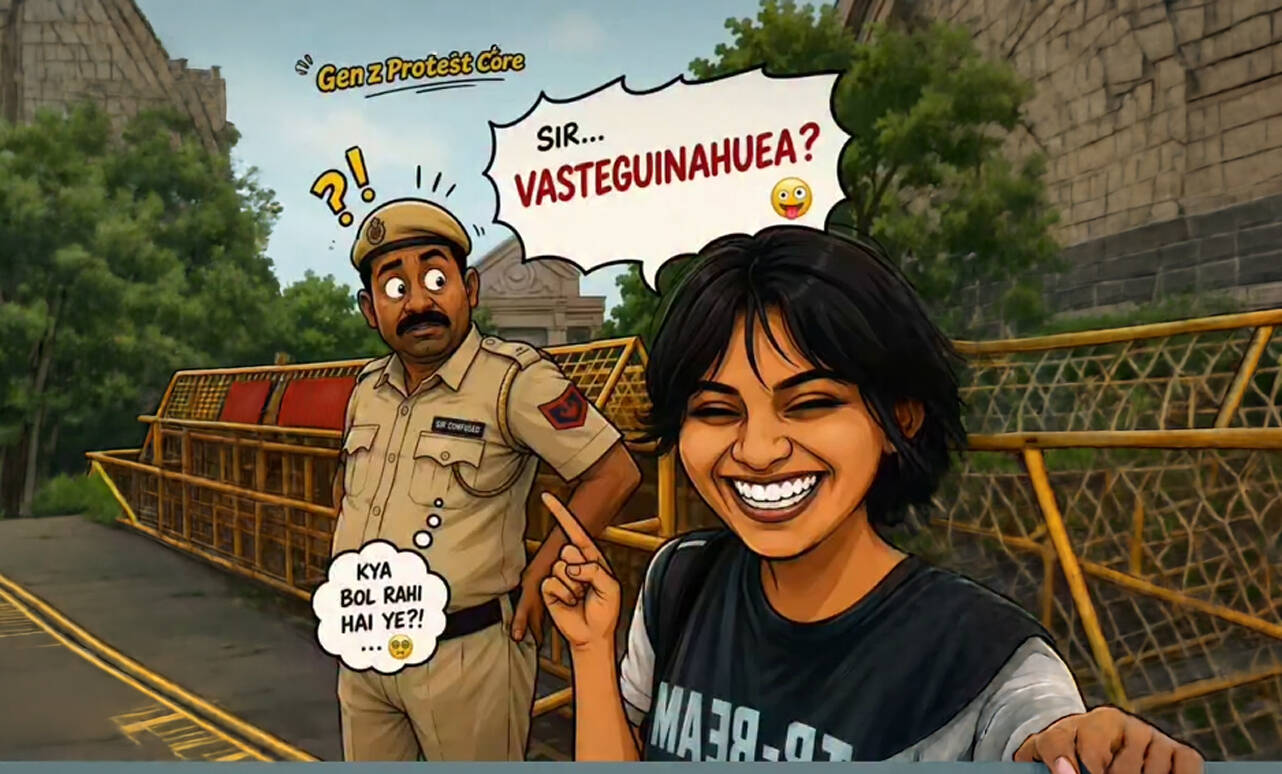
The power of communities built through shared ‘nonsense’ is something the political class is only now beginning to take seriously. Only the other day, Congress MP Deepender Singh Hooda used the phrase ‘Vaste-guna-Huiya’ on the floor of the Lok Sabha, a nonsensical Gen Z catchphrase that had spread through Instagram prank videos and was later hurled, in jest, at a policeman who had no idea what it meant. Those outside the meme ecosystem were completely lost. Those inside understood instantly. Or, as the internet would put it, IYKYK.
In Parliament, ruling party MP Bansuri Swaraj credited Modi with having ‘clocked it’, borrowing the Gen Z line for recognising something instantly, while Shiv Sena MP Shrikant Shinde dismissed the Opposition as MIA (missing in action), then FOMO, then finally delulu. Everyone, from the press to the political class, has now discovered the power of Gen Z and wants to land a helicopter on its subconscious. At the moment, most of them are still working out what exactly they want and how to execute this mission of appeasing a community whose scale they had barely registered until now. But they will grow serious about winning its affection soon enough, because even politicians have begun to understand something the students already knew. Tear gas can make a protester cry. Laughter gas by this generation can make a govt cry harder.
Verma is a podcaster and author of ‘The Great Indian Brain Rot’
Disclaimer
Views expressed above are the author’s own.


