
 Vinay Kumar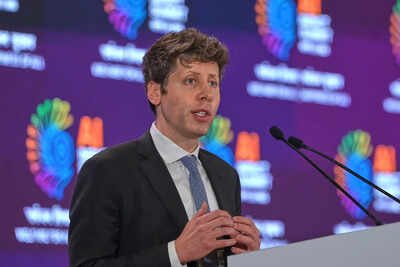

NEW DELHI: OpenAI CEO Sam Altman placed India squarely at the centre of global AI map, arguing that the world’s largest democracy is not merely adopting AI at scale but shaping its trajectory. “More than 100 million people in India use ChatGPT every week,” he said at the AI Impact Summit on Thursday, adding that “more than a third of them are students”. India, he noted, is now the fastest-growing market for Codex, OpenAI’s coding agent. “The world’s largest democracy is well positioned to lead in AI. Not just to build it, but to shape it and decide what our future is going to look like.” He also noted that it is becoming increasingly more affordable for countries in the Global South to use AI. The cost of OpenAI’s models, he said, had come down by more than 1000x in 14 months, adding costs would continue to reduce dramatically in the coming times. High AI infrastructure costs make it difficult particularly for smaller companies and startups to generate returns on investment quickly. Altman said AI models in past few months had become so powerful that they are even discovering new knowledge. “There was a recent physics result that really seemed to amaze a lot of physicists,” he said. Altman’s most arresting claim was that humanity may be only a couple of years away from early versions of true super-intelligence. If that proves correct, he said, “by the end of 2028, more of the world’s intellectual capacity could reside inside of data centres than outside of them”. He conceded he could be wrong, but noted that it was an issue that bears serious consideration. A super-intelligent system, he suggested, could one day do “a better job being the CEO of a major company than any executive” or outperform the best scientists in research. However, he cautioned increasingly capable systems can be misused, noting in particular open-source bio models can be misused to create dangerous new pathogens. He acknowledged concerns about concentration of AI in the hands of select companies and countries. The only path forward, he said, is to have democratised AI and put these tools in hands of people, even if it comes with some downsides. “All of my study of history suggests that concentrating AI power in the hands of one company or country, even if it was in the name of safety, would be a disastrously bad thing to do,” he said. Asked about fair compensation for traditional new media, Altman cited the US fair use principle to defend their use. “Our stance is that when we’re displaying a quote from a news article or an opinion piece or something like that, we want to do that in a way where we can explore new business models with creators for training.”