Vinay Kumar
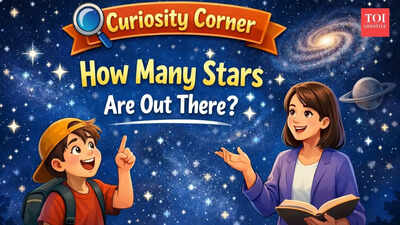
On a clear night, the sky looks crowded with tiny lights. Some twinkle. Some glow steady. They look close enough to count, but they are not. That question pops up in curious minds: How many stars are there in the universe? The answer is big, exciting, and still growing as science learns more.
What exactly is a star?
A star is a huge ball of hot gas. It shines because it burns energy deep inside. The Sun is also a star. It feels special because it is close to Earth. Other stars are much farther away, which is why they look like dots. Some stars are bigger than the Sun. Some are smaller. Each one has its own story.
Counting stars is not like counting toys
The stars in the sky cannot be counted individually. Many are too distant to be clearly. Some have been hidden by dust clouds. To examine small areas of the sky, scientists employ powerful space telescopes. They then estimate the potential total number of stars using mathematics. Though slow and cautious, this approach is effective.
How many galaxies are there ?
A galaxy is a huge family of stars. The Milky Way is the home galaxy of Earth. For a long time, scientists thought there were about 100 billion galaxies. New observations from space telescopes, including NASA and ESA missions, suggest there may be around 2 trillion galaxies in the observable universe. Each new discovery adds to the wonder.
So, how many stars are there really?
The Milky Way alone has about 100 to 400 billion stars. If many galaxies have a similar number, the total becomes mind-blowing. Scientists estimate the universe may hold between 10²² and 10²⁴ stars. That means there could be more stars than grains of sand on all Earth’s beaches. This number is not final. It is the best estimate based on current science.
Why this number keeps changing
Science is always learning. Better telescopes see farther. New data fills in missing pieces. As tools improve, the estimate of stars may grow or shift. That is not a mistake. It shows how curious humans keep asking better questions. The universe does not give all its secrets at once.Every tiny point of light in the sky is a massive star, burning for millions or billions of years. Thinking about so many stars can make Earth feel small, but it also makes curiosity feel big. Questions like this help young minds learn how vast and amazing the universe truly is.Disclaimer: The numbers shared here are scientific estimates based on data from credible space research organisations like NASA and the European Space Agency. As technology improves and new discoveries are made, these estimates may change. Science keeps updating its answers as understanding deepens.