 Vinay Kumar

Dog’s Day Out

Ever since generative AI burst onto the scene with the arrival of ChatGPT, capitalists of every persuasion have nurtured the same dream: replace employees with algorithms and watch the profits roll in. The vision is sleek, frictionless, and very futuristic. The reality, as it turns out, is still capable of tripping over its own leash.
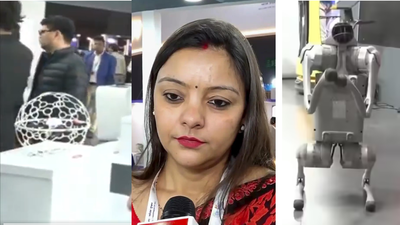
There were many stories, both inspiring and embarrassing, from the AI Impact summit. But the one that truly stole the show involved a robo-dog whose brief walk across an expo floor managed to cause considerable public embarrassment for a private university and gave Chinese social media ample material for mockery. The robot, displayed under the name “Orion,” was quickly recognised by observers as the Unitree Go2, a commercially available quadruped robot sold globally and available in India for a few lakh rupees.
What followed was less a technical demonstration and more a crisis-management theatre production. The institution first attempted to pass off the robo-dog as an in-house innovation, only to issue a series of increasingly convoluted clarifications when the truth became impossible to conceal. It was rather like bolting the stable doors after the horse had already trotted off and posted selfies from the neighbour’s farm.
The memes arrived swiftly and mercilessly. The irony was particularly sharp. China, a country often accused of reverse-engineering technologies created elsewhere, found itself witnessing something akin to burgling from the burglar’s house. Or, as the Hindi idiom puts it more succinctly, chor ke ghar mein chori.
Predictably, the incident quickly became a convenient symbol to mock Indian AI ambitions. Yet it would be a mistake to confuse a noisy spectacle with the underlying reality. One swallow does not make a summer, and one robo-dog certainly does not define an ecosystem. Much of India’s most important AI work is happening far from expo lights and viral demos, in laboratories that lack LED screens but contain something far more valuable: patience.
Consider language AI. Organisations such as AI4Bharat are developing systems that allow computers to understand and translate Indian languages at scale. In practical terms, this means ensuring that AI can function not just in English but in Tamil, Hindi, Bengali, Marathi, and dozens of other languages spoken by ordinary citizens. Alongside this effort, the government’s BHASHINI platform aims to make digital services accessible in multiple languages, so that participation in the digital economy does not depend on fluency in English.
Beneath these visible applications lies an even less glamorous but indispensable layer: computing infrastructure. Through the IndiaAI Mission, efforts are underway to provide researchers and startups access to expensive computing power and data resources. Without such foundations, building advanced AI is rather like opening a modern factory without electricity. The machines may look impressive, but nothing actually runs.
At the research frontier, initiatives such as BharatGen are working on foundational AI models tailored specifically to Indian conditions. These are the large, complex systems capable of processing text, speech, and images simultaneously, forming the underlying architecture upon which future applications will be built. They are, in essence, the plumbing of the AI world: rarely visible, absolutely essential.
This brings us to the applied ecosystem. Institutions like ARTPARK at IISc focus on translating academic AI research into practical deployments in fields such as robotics, healthcare, and logistics.
Meanwhile, startups such as Sarvam AI are attempting something even more fundamental. Their work centres on building foundational AI models designed specifically for India. In technological terms, these are the base “brains” that power all higher-level AI applications. In everyday terms, they are comparable to an operating system that quietly runs every function on a smartphone.
Most global AI models today are trained largely on English-dominated internet data. As a result, they often perform impressively when discussing Shakespeare but falter when confronted with a multilingual conversation involving Hindi, English, and regional slang in the same sentence. Sarvam’s approach seeks to address precisely this gap by training AI systems on vast datasets drawn from Indian languages, speech patterns, and cultural contexts.
A major focus of this effort is voice technology. For millions of Indians, interaction with digital systems occurs through speech rather than typing. Building AI that can accurately understand diverse accents and languages therefore has the potential to expand access dramatically, bringing advanced technology to users who may never interact comfortably with text-based interfaces.
Equally important is the question of affordability. Sarvam is working to develop AI models that can operate efficiently without relying entirely on massive foreign data centres. This approach aims to enable Indian businesses and public institutions to deploy AI locally and at lower cost, contributing to what policymakers increasingly describe as “sovereign AI,” technology that can be controlled and customised domestically rather than imported wholesale.
If global AI systems can be compared to luxury cars designed for smooth European highways, Sarvam’s ambition is to build vehicles suited to India’s crowded streets, unpredictable terrain, and multilingual drivers.
In the end, a robo-dog may dominate headlines for a day, its mechanical trot amplified by cameras and social media. But genuine technological progress seldom arrives with flashing lights. It moves slowly, often invisibly, through lines of code, datasets, and infrastructure that rarely attract applause.
The loudest barking, after all, tends to come from the stage. The real work is happening quietly, somewhere off-camera, where the engineers are still busy building the kennel.
Rubio’s Civilisational Erasure Warning
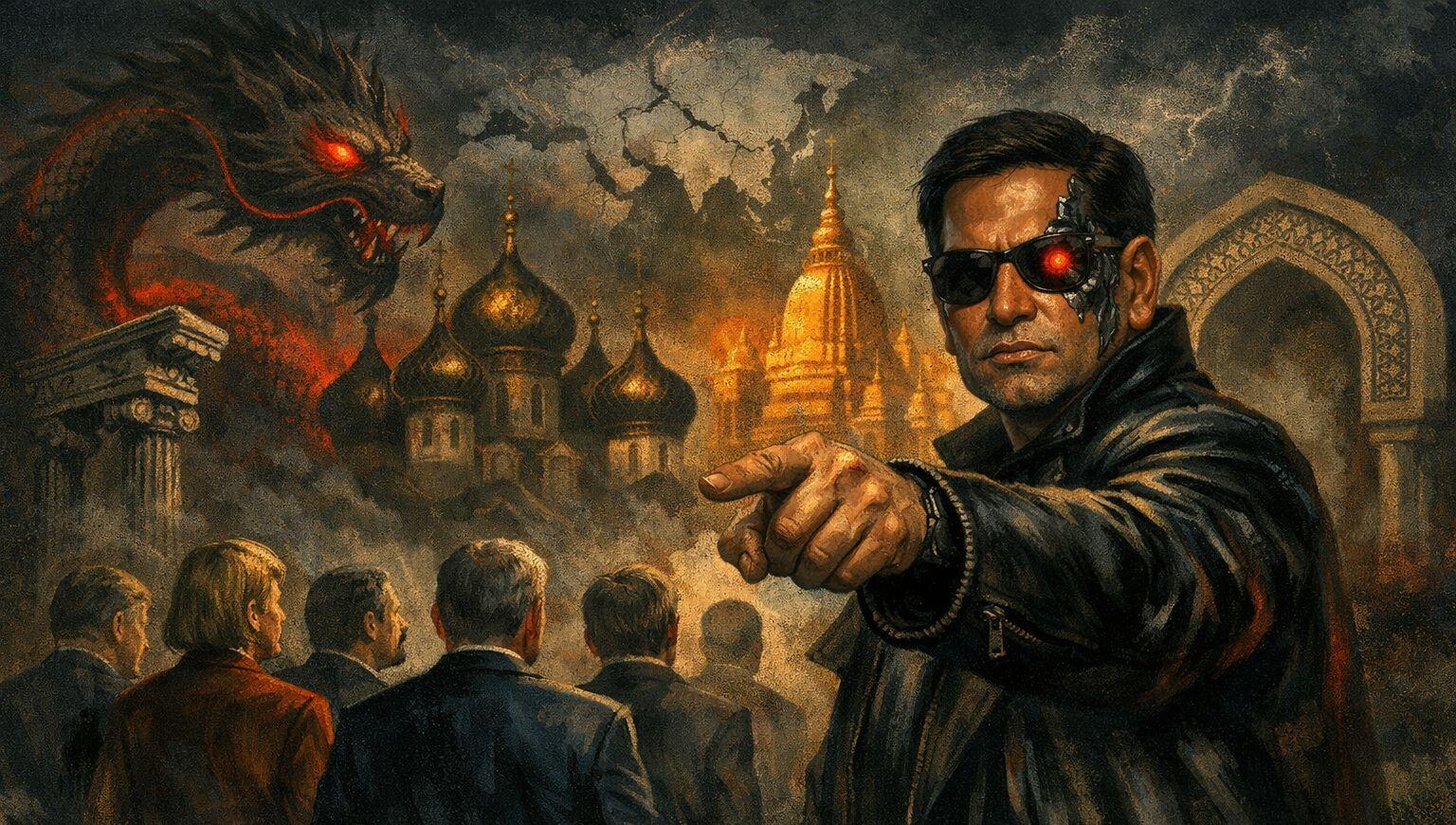

A few days ago, Marco Rubio – the only NeoCon amid Trump’s bunch of MAGA men and women – gave a speech at Munich Security Conference where he warned Europe of civilisational erasure. The speech caused much consternation in said WENA countries but to any student of international relations would evoke the Fukuyama vs Huntington debate which is to international policy what Salman vs Shah Rukh is to Bollywood, Orwell vs Huxley in dystopian literature, Messi vs Ronaldo in football, and Rohit vs Virat among Indian cricket fans.
At its core, the Fukuyama vs Huntington divide is about how the world evolves after major ideological conflicts end.
Francis Fukuyama, writing in the early 1990s after the collapse of the Soviet Union, argued that liberal democracy had effectively won the grand contest of political systems. Fascism had fallen in 1945, communism collapsed in 1991, and no rival ideological model seemed capable of challenging the combination of free markets, political pluralism, and global integration. In Fukuyama’s view, history had not stopped, but its ideological direction had stabilised. Nations might progress at different speeds, but they would ultimately move toward the same liberal democratic framework.
Samuel Huntington disagreed sharply.
He argued that the Cold War did not end conflict but merely shifted its axis. The defining struggles of the future would not be ideological, but civilisational. Instead of capitalism versus communism, the world would witness competition between large cultural blocs shaped by religion, history, and identity. Huntington believed Western dominance would be challenged by a rising China rooted in Sinic civilisation, a resurgent Orthodox Russia, an increasingly assertive Islamic world, and a civilisationally conscious India.
Three decades later, global realities seem closer to Huntington’s predictions than Fukuyama’s optimism. China has risen without embracing Western political norms, Russia frames its power through historical and cultural narratives, and many societies increasingly define themselves through identity rather than ideology. Rubio’s warning about “civilisational erasure” essentially echoed Huntington’s core idea: that the defining struggles of the twenty-first century are not about political systems alone, but about whose civilisation endures, adapts, and ultimately shapes the global order.
Dhuran(Dhar) Derangement Syndrome

That Dhurandhar and Aditya Dhar live rent-free in the heads of our liberal brethren would be an understatement, like saying that Babar Azam could improve his T20 strike rate.
That much was evident from the glee with which Dhar was hysterically attacked on social media after an Indian national pleaded guilty to murder-for-hire charges against a Khalistani living in America. For those unplugged from the hellish news cycle that we call reality, here’s a small recap: an Indian national named Nikhil Gupta pleaded guilty in an American court to a plot to assassinate an American citizen and bona fide Khalistani named Gurpatwant Singh Pannun. The latter also happened to be the lawyer of a Canadian terrorist named Hardeep Singh Nijjar, who was gunned down by unknown gunmen in Canada.
The public records claim that Gupta was ostensibly hired by a RAW agent or affiliate named Vikash Yadav and, quite frankly, if you believe a word about this case that is in the public domain, then I have a tomb to sell you in Agra, because it’s hard to believe our intelligence apparatus is that incompetent.
But the real question isn’t about Pannun, Gupta, Yadav, or even the American legal system, but why there is so much vitriol against Dhar over Nikhil Gupta’s case. After all, blaming a filmmaker for a bungled real-world assassination plot is like blaming me for Manchester United’s current plight.
The real reason, to borrow a phrase from Marco Rubio, is civilisational erasure, which in this case is the erasure of a world that existed some time ago.
For a long time, polite society in India had a few universal truths that everyone had to agree on, and voicing any opposition to that was to signal one’s desire to become a social pariah.
Like Indians and Pakistanis are long-lost brethren who only have proper amour for each other. That sports, art, and politics should be separate. That the Indian state should do everything possible to normalise relations with our neighbour. That Fuwad Khan’s cheekbones are so nice that he ought to be cast in every movie. Sadly, that vision has long since collapsed.
Too many terror attacks, from 26/11 to Pulwama to Pahalgam, have robbed us of that delusion.
The anger against Dhurandhar is the anger against the notion facing civilisational erasure, from a class of people used to calling the shots earlier. The anger is also compounded by the popularity of the movie and its overbearing presence on every social media platform. Every Instagram reel has a Dhurandhar song. Every meme is about one’s first day as a spy in Pakistan or Aditya Dhar’s focus on hyper details.
The democratisation of that space is just a tad too much for a class who could long control the channels of communication and dictate what’s art and what isn’t.
To paraphrase Karl Marx – another popular Abrahamic deity – Dhurandhar Derangement Syndrome is just a sigh of the former oppressor, who is aghast to learn that what they care about means very little in this day and age.
Postscript by Prasad Sanyal: What got you here won’t get you there


‘What got you here won’t get you there.’ It is one of those sentences that arrives wrapped in concern and delivered with kindness, yet leaves behind a faint residue of reproach, as though one has been gently informed that one’s present life, however competent and respectable, has begun to fall slightly out of fashion. It is usually said with a sympathetic tilt of the head, often after a seminar or an offsite, sometimes over lunch, and almost always with the unspoken implication that lingering is a form of moral failure.
I have heard it repeatedly in recent weeks, in different accents and different disguises, in corporate corridors and polite conversations, in the slightly breathless language of people who have recently discovered productivity podcasts. One must evolve, one must pivot, one must reinvent, one must disrupt oneself before someone else does.
Nobody ever says, “You seem settled.” Because settled, in our times, is dangerously close to stagnant.
Disclaimer
Views expressed above are the author’s own.
END OF ARTICLE