Vinay Kumar
Festivals in our tradition are rarely external events alone. They are invitations to inner transformation. Holi, often seen as a celebration of colours, carries within it a deeper spiritual message — one that reveals itself when we pause to contemplate the word itself.
In Sanskrit, a word is not merely sound; it carries layers of meaning. Through Vyutpatti (etymology), Nirukta (interpretation), Sandhi-Viccheda (grammatical splitting), and Vigraha (analytical expansion), we attempt to uncover its essence. When viewed through these lenses, Holi becomes far more than a festival.
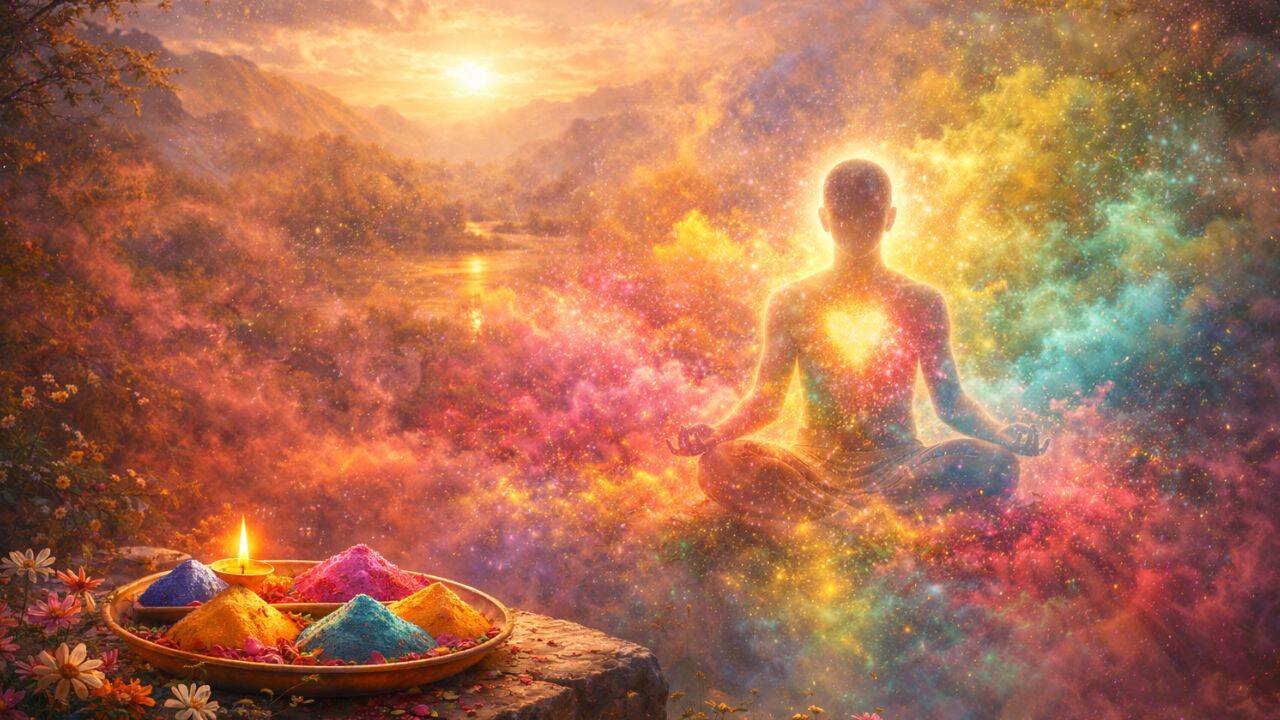

In spiritual contemplation, Holi may be divided into “Ho” and “Li.” “Ho” suggests that which has happened. “Li” suggests dissolution — to merge, to absorb, to let dissolve.
From this perspective, Holi becomes a reminder to dissolve what has already happened. The past, with its grievances, attachments, pride, and regrets, need not bind the present. Holi invites us to release what has been and merge into what is. It is the quiet art of letting go — not only of yesterday’s pain, but of yesterday’s ego.
The sound “Ho” also resonates with the act of offering. Every sacred fire ritual begins with conscious release. Holi, beginning with Holika Dahan, symbolises that very act.
The bonfire is not merely ritual. It is reflective. What do we place into the flames? Anger, resentment, jealousy, arrogance — these are the true offerings. The fire does not destroy; it purifies. What is offered consciously returns refined.
Holi, then, is an inner yajna — the offering of the lesser self into the fire of awareness. Within the Bhakti tradition, Holi can also be felt as “Ho Li” — I have become Yours.
In devotion, surrender is not defeat; it is fulfilment. To say “I am Yours” is to allow oneself to be coloured in the hue of the Divine. In Vrindavan, Holi is not merely about throwing colours; it is about being coloured by Krishna’s grace. The soul sheds its isolated identity and participates in something eternal.
From a contemplative perspective, the colours of Holi represent the Navarasas — the spectrum of human emotion. Joy, compassion, courage, love, even sorrow — each emotion has its place in the drama of life.
Spiritual maturity does not deny emotion; it refines it. When Krishna plays Holi, it is not mere play. It is divine participation in the fullness of existence. The colours remind us that life is vibrant and layered. The task is not to escape emotion, but to sanctify it.
Holi, therefore, is not only a social celebration. It is a spiritual reminder:
Let go of the past. Offer the ego into fire. Surrender to the Eternal. Allow life to colour you with awareness.
When the colours fade from the skin, their deeper meaning should remain in the heart. And perhaps that is the true celebration.
Disclaimer
Views expressed above are the author’s own.
END OF ARTICLE