Vinay Kumar

Children being distracted by phones is a real concern, with links to weaker academic performance and mental health problems. A recent study by Hungarian researchers Eniko Pozsonyi, Tunde Lengyelne Molnar and Reka Racsko reviewed international experience and Hungary’s own school policy restricting connected devices. Several countries, including France, China, Canada, Denmark, Sweden and England have introduced limits on phone use in schools.In Hungary, mobile phones, tablets, laptops, and smartwatches are banned in schools unless a teacher or principal gives explicit permission. The policy is based on the idea that such devices distract students from learning and can enable cyberbullying. To examine its effects, researchers surveyed 1,198 secondary school teachers after one year of restricted device use.The findings showed that the policy sharply reduced phone use. Before the restrictions, 37% of students were frequent users during school time and that fell to just 4%. Around two-thirds of schools still allowed limited device use for educational purposes, while nearly 28% imposed a total ban. Teachers also noticed changes in student behaviour: More face-to-face conversation, more outdoor activity, and greater participation in games such as chess and cards. Improvements in reading books and preparing for class, however, were only modest.
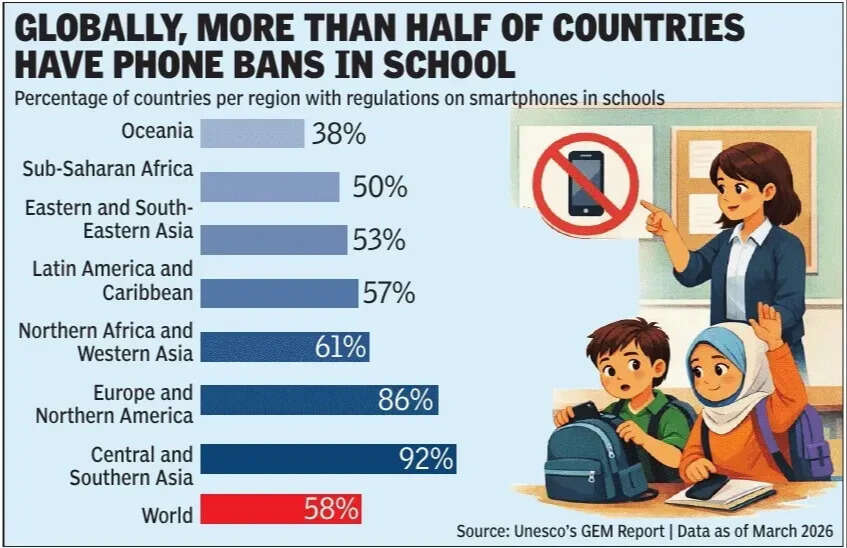
Classroom experiences were mixed. About one-third of teachers reported positive changes, including better attention, stronger participation, and improved recall. Yet 64% saw no noticeable difference, and a small minority reported negative effects. Some students, for example, tried to make up for lost phone time by staying up late at home. Teachers also faced practical challenges, as some students hid devices, while others lost quick access to information that phones can provide.These results suggest that bans can reduce distractions and encourage social interaction, but they do not automatically improve academic outcomes or reduce total screen time, since students still use devices outside school.UNESCO’s 2023 Global Education Monitoring Report similarly noted that even seeing a phone notification can disrupt concentration, with students needing up to 20 minutes to refocus.The Hungarian researchers concluded that bans alone are not enough. Although restrictions reduce distractions, they can also limit constructive digital learning. Students still need opportunities to use technology to explore new ideas, including Artificial Intelligence.A second study from South Australia by Stephanie Baggio, Tracey Waden and others, involving more than 1,000 secondary students, found that phone bans were linked to modest but significant mental health benefits. Psychological distress fell by 2.4%, and negative emotions such as sadness, fear, and misery dropped by 5.2%. Positive effect did not improve significantly. Together, the studies suggest that school phone bans can support well-being, but balanced policies, responsible technology training, and teacher support are essential.