
 Vinay Kumar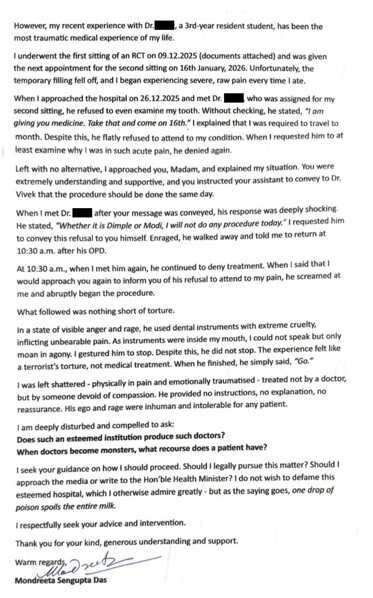
There was a time when my faith in government institutions was deep and unwavering. I used to regularly visit the Indian Tourism Tourist Office to gather information on travel destinations. Every visit filled me with warmth. I would often tell the officers how closely knit and welcoming the office felt, and how much I wished to be a part of it.
One day, an officer called and encouraged me to apply for a position advertised in the newspaper. I applied, appeared for the All-India examination, participated in a group discussion, cleared the interviews, and was selected for a Tourism Course conducted by the Ministry of Tourism and Culture, Government of India. We were only twenty-six in the Priyadarshani batch, chosen from forty thousand applicants across the country. I felt blessed and honoured to belong to such an esteemed institution.
From that day onward, my perception of the government sector transformed completely. I was proud to be associated with the Indian government. I felt connected to every sister concern of the system. I consciously chose Speed Post over private courier services. I chose government doctors over private practitioners. And I was not wrong. I had the privilege of being treated by one of the finest neurosurgeons in the country, Dr Vernan Velho, who is not only brilliant professionally but also kind, considerate, compassionate, sensitive, understanding, and deeply supportive as a human being.
Gradually, when I became disillusioned with the increasingly commercial approach of private doctors, physicians, dentists, and dental surgeons, whose focus often appeared centred on financial gain, I shifted to the Government Dental Hospital in my city. Though the process required patience and multiple visits, I found most of the doctors understanding and sincere. They were well trained and dedicated. Handling thousands of cases ranging from routine to critical, they possessed immense practical experience. At any time, they seemed far superior to private practitioners, for whom the medical profession had, in many cases, become more business than service.
Today, it is no secret that many private hospitals, clinics, pathology laboratories, and even insurance companies function as corporate entities where profit is the primary objective. Doctors, nurses, medical stores, and labs are assigned monthly targets. In such an environment, one must ask how genuine healthcare can truly flourish. As patients, we often surrender with blind faith, spending exorbitant amounts and sometimes even selling jewellery or property to afford treatment. It is easy to blame institutions, but we too must accept responsibility for encouraging and sustaining systems that prioritise revenue over humanity.
Yet this article is not about institutions alone. It is about something far more disturbing. It is about how individual character can falter even within a noble profession.
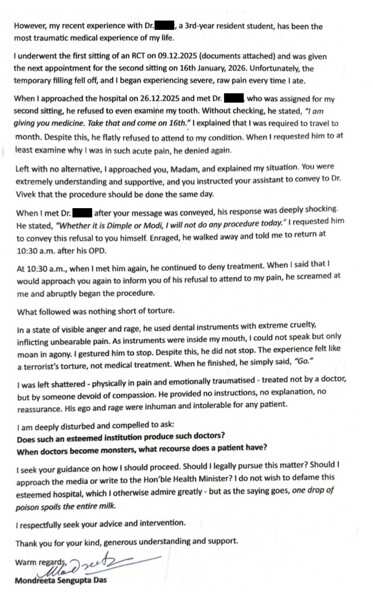
I was advised to undergo a root canal treatment for a critical tooth condition at the Government Dental Hospital in Mumbai. The first sitting was completed, and the second appointment scheduled a month later. Soon after the procedure, I began experiencing severe pain whenever I ate. I waited patiently for a week, hoping the discomfort would subside. It did not.
When I returned to the hospital seeking help, the doctor who was to treat me insisted that I come back on the assigned date. I explained that I was in significant pain. He refused to examine me before the appointed date, despite my mentioning that I was suffering. His tone was rude and sharp. Left unheard and helpless, I approached the dean. The dean instructed that I be examined and necessary treatment be given. Her assistant conveyed the message. Yet the doctor refused to attend to me before the scheduled date. He bluntly said, “Whether the dean says it or the Prime Minister, I don’t care. I will not do your treatment today!”
I was stunned. After repeated refusal, I informed him that I would return to the dean and report his non-compliance. Only then did he ask me to sit.
Without assessing my condition, he began the procedure. He picked up the drill and worked aggressively inside my tooth. The pain was excruciating and unbearable. I could not scream because my mouth was wide open and filled with instruments. I raised my hand desperately, shaking it to signal him to stop. He did not pause. His movements were forceful and charged with visible anger. In that moment, the agony felt deliberate. I endured it helplessly, like James Bond being tortured by criminals.
After what felt like an eternity, he stopped and curtly declared the procedure complete. He gave no explanation, no reassurance, and no instructions.
I walked out in shock and trauma, physically wounded and emotionally shaken.

A few days later, I returned to narrate the incident to the dean. The same dean who had once been warm and gracious, especially when she learned of my media connection and requested me to write about her after she won the title of Mrs India, now refused to meet me once she knew I had come with a complaint. Another senior doctor heard my account but initially defended both the concerned doctor and the institution strongly. When I expressed my fear that a doctor who loses control in anger could endanger lives, he summoned the concerned doctor.
The transformation was astonishing. The same man who had behaved harshly during my treatment now appeared shy, obedient, and soft-spoken. As a psychologist, I could clearly perceive the stark duality in his behaviour. I narrated what he had done in front of the senior doctor, which he could not deny.
I was asked what action I desired. I did not demand suspension or harsh punishment. I requested only that he be reminded of professional ethics and that I receive a written apology assuring that such misconduct would never recur.
Three months have passed. No apology has been received. No acknowledgment has been offered. I can only assume that no meaningful action has been taken.
This compels me to ask a painful question. Do individuals who allow anger to overpower compassion deserve to hold the sacred title of doctor? How will hospital doctors treat patients who complain?
The medical profession has long been regarded as a noble human service—a calling built upon empathy, patience, and ethical responsibility. When these qualities are compromised, the damage extends beyond one patient. It shatters trust. And when trust in healing hands is broken, society itself begins to bleed.
I would never have written this article had my suffering been acknowledged with dignity. Silence forces expression. But we should not forget—government employees, whether hospital doctors, post office staff, or police personnel, are paid salaries by the public. They are all accountable to the public.
Disclaimer
Views expressed above are the author’s own.
END OF ARTICLE