Vinay Kumar
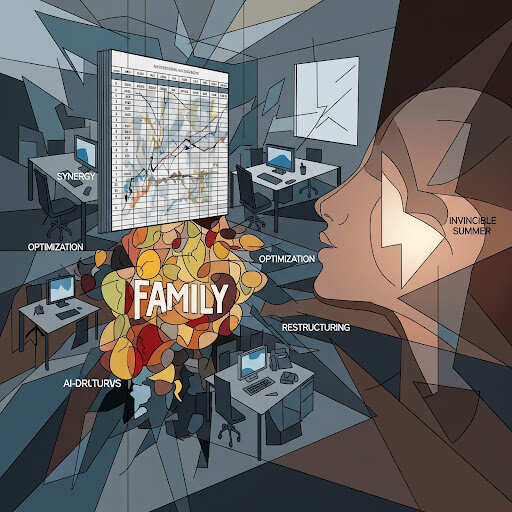
Somewhere between your third weekend review call and your fifth performance calibration, you began to believe something rather tender: that work notices, it keeps score, and it has memory. It does keep score. It just does not keep you. When layoffs arrive, they do not come with thunder. They come with vocabulary.
“Restructuring.” “Operating model reset.” “Strategic realignment.” “Rightsizing.”
The last one is my favourite. It suggests that for years the organisation was badly tailored and suddenly, like a Savile Row epiphany, it has discovered correct proportions. You, unfortunately, were excess fabric.

We must admire creativity. The corporate dictionary now has more euphemisms than a Victorian novel about fainting ladies. A hundred thousand people can lose jobs in a month and the headline will still read “efficiency drive.”
Efficiency, you see, is a holy word. It absolves. It sanitises. It allows a CEO to say, with a straight face, “This was a difficult but necessary decision,” which is corporate Latin for “the spreadsheet won.”
Marcus Aurelius, who had the good sense to be the Roman emperor and philosopher simultaneously, wrote: “You have power over your mind, not outside events.” He did not add, but clearly implied, “especially not outside events governed by quarterly earnings.”
Yet we persist in confusing metaphors. Offices call themselves “family.” There are team lunches. There are birthday cakes and Slack emojis that look like hugs.
And so when the email lands, the adult professional momentarily turns into a wounded Shakespearean character: Is this how family behaves? To which the P&L replies, coolly: “Family is not a line item.”
Let me be serious for a paragraph before I return to my merry ways. Recent months have seen thousands of roles cut across sectors under the twin banners of cost discipline and artificial intelligence. AI, incidentally, is the perfect corporate deity. It is invisible, inevitable, and slightly terrifying. If management says, “We are accelerating AI adoption and therefore must streamline,” the room nods as if Moses has returned with updated tablets in PDF form.
Friedrich Nietzsche once observed, “He who has a why to live can bear almost any how.” Corporate life has improved this. It says, “He who has a why to cut can justify almost any how.” AI is the new why. The how is you.
And yet, the injury is not merely financial. It is emotional arithmetic. The more you invested identity into work, the more catastrophic the subtraction feels. You did not merely lose a job; you lost a story about yourself.
The mistake is subtle. Effort is noble, excellence is admirable. But somewhere along the way we smuggled in an expectation. If I give more, I will be shielded more. If I sacrifice enough, the system will remember.
The system remembers revenue. It does not remember your child’s annual day that you missed.
The Buddha, in a moment of devastating simplicity, said: “Attachment is the root of suffering.” He was not speaking about employee stock options, but the principle holds. Attachment to outcomes. Attachment to recognition. Attachment to the idea that the organisation loves you back.
Work is not a lover. It is a contract.
This does not mean cynicism. It means clarity. You can care about your craft without believing your company is your destiny. You can build something meaningful without imagining it will build a shrine for you.
In fact, the healthiest professionals I know treat work like good cuisine. Savour it. Learn from it. Contribute to it. But do not mistake the restaurant for your home.
Because here is the philosophical joke of our times: the macro data may say the economy is stable, that unemployment claims are moderate, that the system is functioning. And yet in living rooms across cities, individuals are experiencing quiet earthquakes. Stability at scale, volatility at the level of the soul. Statistics are calm; humans are not.
Albert Camus wrote, “In the midst of winter, I found there was, within me, an invincible summer.” He was not referencing a severance package, but one suspects he would approve of the sentiment. Your invincible summer cannot be outsourced to HR.
So let us rewrite the contract with ourselves.
Give your best, but do not mortgage your identity. Work late if you must, but do not worship the office lights. Build skill, not illusion. Build networks, not dependency. Build savings, not fantasies of corporate gratitude.
And when someone says, with theatrical betrayal, “How could they do this to me?” answer gently: They did not do it to you. They did it for survival. Business is a calculation, not a covenant.
The day you understand that, the layoff email will still hurt. But it will not shatter you, because the only family you truly have is not the one that sends calendar invites. It is the one that remains when the invite is revoked.
Disclaimer
Views expressed above are the author’s own.
END OF ARTICLE