
 Vinay Kumar
Introduction
A patent pool, in simple terms, is a contractual arrangement by which several patent owners/holders license one or more of their patents to one another or to third parties.
The major reason for the formation of patent pools is the presence of complementary patents. Therefore, these patents, rather than creating barriers, must be implemented together to achieve the desired effect. On the other hand, two patents are called substitutes if they cover alternative technologies. These patented technologies may compete.
Whether patents are complementary or substitutes is determined based on their impact on market competition. Generally speaking, in the case of complementary patents, actual or potential market competition remains unaffected. Moreover, patent pools with complementary patents allow organisations to license all the necessary rights in a single transaction efficiently. For these reasons, these pools are usually considered to be pro-competitive. Still, patent pools are not considered a one-size-fits-all solution. For example, forming a patent pool may take several years to establish, especially if extensive negotiation is required among participants. Additionally, it often involves engaging independent experts to assess the essentiality of patents licensed by the pool, further increasing the administrative burden. Thus, in some scenarios, bilateral negotiations or other licensing platforms are preferrable.
Sovereign Patent Funds (SPFs)
Building on the success of pools, governments have attempted to create what they perceive as a similar licensing platform, i.e., Sovereign Patent Funds or SPFs. While SPFs and patent pools are both mechanisms related to the strategic use and management of patents, they differ significantly in structure, purpose, and governance.
SPFs are investment tools designed to acquire, manage, and commercialize patents for national benefit. They are government funded, either fully public or via public–private partnerships. They concentrate on building portfolios in key industries by purchasing and/or licensing patents from universities, corporations, or distressed entities.
Patent pools are collaborative agreements among multiple patent owners, typically, private companies. Pools often arise around standardised technologies, such as video codecs or wireless communication protocols. Their primary goal is to reduce transaction costs, simplify licensing agreements, and accelerate market adoption of technologies. Patent pools offer standardized, non-exclusive licenses under uniform terms, and allow participating patent owners to continue to license their patents bilaterally outside of the pool with those prospective licensees who find the pool unattractive. SPFs, on the other hand, frequently assert patents aggressively, potentially disrupting the market. As highlighted by the European Centre for International Political Economy (ECIPE), the rise of SPFs has raised concerns about the politicization of patent enforcement. This is because it can be used by states as trade or policy weapons.
Mandatory Patent Pools
Another proposal is to create a mandatory patent pool, i.e., a government-mandated system. Accordingly, all patent owners with respect to a specific technology or standard should license their essential patents through a single, centralized pool. This differs from an SPF. SPFs are not a regulatory mandate, but instead are government backed. They merely acquire and manage patents to meet national goals of the respective country. Mandatory patent pools, on the other hand, would be compulsory and enforced by state authority.

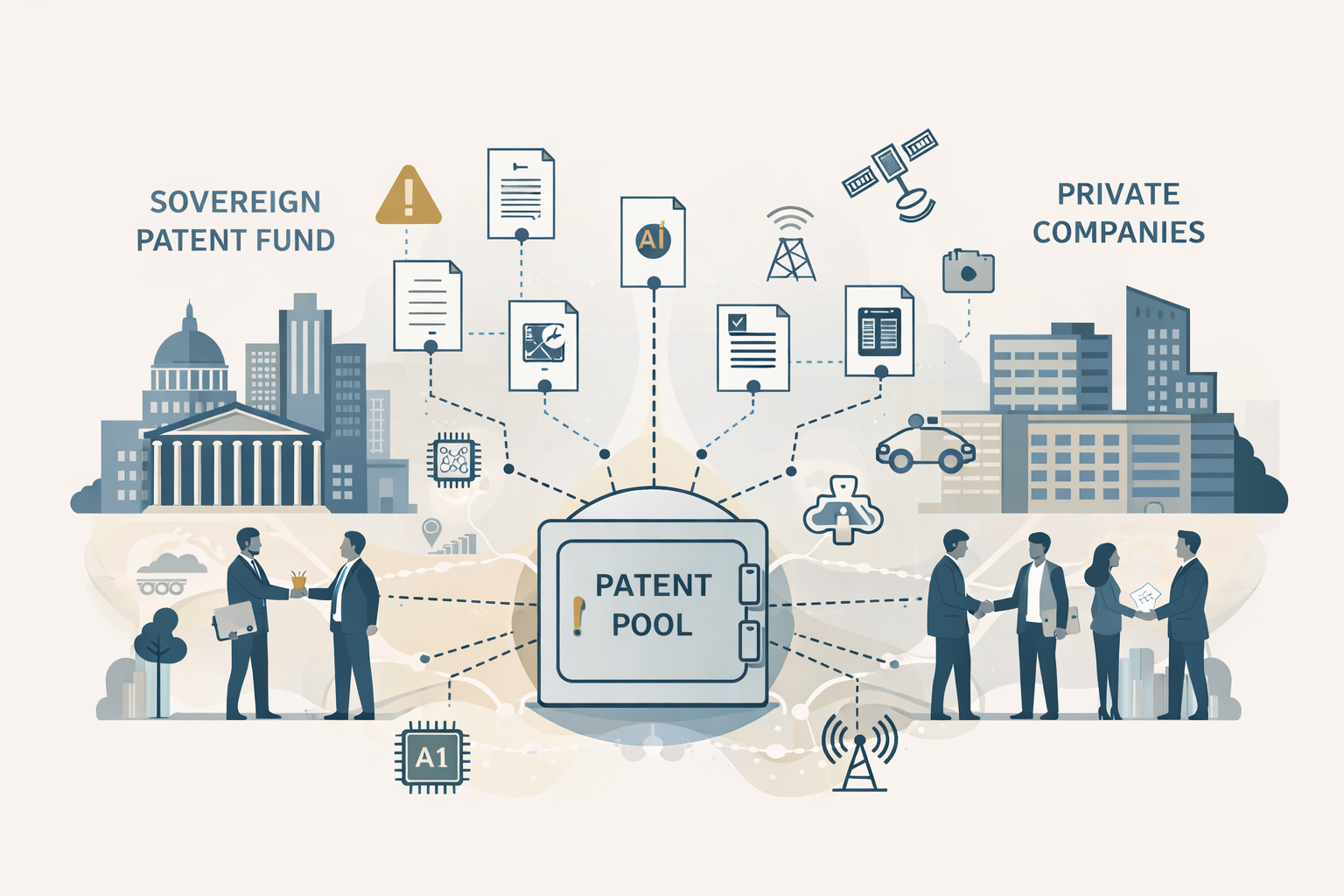
If mandatory pools were implemented, private companies owning patents relevant to an industry standard would contribute these patents to the pool. In return, they would gain access to the aggregated portfolio and receive a share of pooled royalty revenues. This structure, theoretically, would streamline licensing. However, mandatory pools in practice would limit the autonomy of patent owners in joining the pool. Even more important, they would reduce licensing revenues, discouraging R&D investment, and harming innovation.
For companies actively engaged in R&D and technology development, mandatory pooling of patents would limit their flexibility to structure licensing arrangements. These licensing arrangements may reflect the unique value, use, and investments behind their innovations. A single licensing model, while uniform, would likely not account for the diversity of commercial applications or industry-specific needs. This could lead to an inflexible system that may disincentivize investment in high-risk, high-reward innovation as the market realities are overlooked.
Furthermore, mandatory inclusion of patents may inadvertently interfere with free market dynamics. It would restrict voluntary negotiations, undermining bilateral business relationships and reducing the strategic autonomy of patent owners. These factors could have a chilling effect on technological advancement and slow down innovation in competitive sectors.
Business Viability of Patent Pools
Patent pools are mostly composed of complementary and/or standard-essential patents. Hence, pools promote innovation and interoperability without compromising market competition due to the threat of cartelization. Regulatory authorities generally support such pools, provided they are formed and administered in ways that uphold competitive fairness and consumer welfare.
Multiple factors are considered by companies (both licensors and licensees) while joining patent pools. This includes whether the royalty sharing system of the pool accurately reflects the patent’s technical and market contribution. Moreover, the companies also ought to ensure that they can continue to negotiate bilateral licenses on fair, reasonable and non-discriminatory (FRAND) terms with those prospective licensees who find the pool unattractive. Lastly, companies balance how membership in the pool might improve market access, and international commercial positioning.
At the same time, when pools manage to attract relevant technology portfolios, implementers can enjoy a one-stop solution for licensing them. In these cases, pools can reduce transaction costs.
In recent times patent pools have evolved in the field of consumer electronics with great success. For example, the Avanci 5G Vehicle patent pool brings together over 80 standard-essential patent owners to streamline licensing for connected vehicle technologies. The pool allows manufacturers to enter a single transaction to obtain licenses covering thousands of patented technologies, thereby simplifying the complex licensing process.
Conclusion
Patent pools have emerged as important mechanisms to simplify licensing, encourage innovation, and support market adoption of standardized technologies. When carefully structured, they reduce transaction costs, enhance collaboration, and provide fair access to essential patents. At the same time, mandatory pooling and SPFs risk undermining innovation, limiting flexibility, and raising competition concerns. Ultimately, the business viability of patent pools depends on striking the right balance between efficiency, fairness, and respect for the diverse needs of patent owners and implementers.
Disclaimer
Views expressed above are the author’s own.
END OF ARTICLE