Vinay Kumar
Have you ever wondered why we set age limits for obtaining a driving licence, consuming alcohol, or even getting married? The answer lies not in arbitrary tradition but in science — more specifically, in the very architecture of the human brain. The prefrontal cortex — the part of the brain responsible for judgement, planning, impulse control, and weighing long-term consequences — is not fully mature in childhood or adolescence. Neuroscientific research shows that the prefrontal cortex is often not fully developed until about the age of 25, with fine-tuning continuing into the early thirties. This developmental timeline helps explain why adolescents are more susceptible to impulsive behaviour, emotional volatility, and peer influence.
Yet today, children as young as eight, nine, or ten are routinely handed devices that provide unfettered access to social media. These are digital landscapes engineered to capture attention, exploit emotional vulnerabilities, and shape experiences through opaque algorithms. There is growing global recognition that unrestricted social media access for children is a public health issue with profound neurological and social implications.
Over the past year, several countries have moved from debate to decisive action. Australia was the first to implement a nationwide ban on social media use for children under 16 in Dec last year, leading to the removal of millions of underage accounts from platforms such as TikTok, Instagram, Facebook, Snapchat, YouTube, and others. France’s National Assembly has now approved legislation to prohibit social media access for children under 15, with the bill now progressing through the Senate. Several other European countries — including Denmark, Spain, and Germany — are considering age limits or stricter parental consent regimes. Malaysia has announced plans to ban social media use for those under 16 starting in 2027, while Egypt is formulating restrictions to counter what officials describe as “digital chaos”.
These measures are not acts of cultural censorship. They are responses to accumulating evidence that social media exposure during critical developmental years can distort social perception, fuel anxiety and depression, disrupt sleep, and intensify cyberbullying. Parliamentary inquiries in France have linked algorithm-driven content loops to stress, sleep disturbances, and psychological distress among minors. In Australia, the rationale for regulation has been framed explicitly as child protection — shielding young minds from manipulation and addictive engagement mechanisms that their still-developing brains are ill-equipped to manage.
From a medical perspective, the adolescent brain is in a state of flux. Executive control centres are still under construction, even as reward and emotional systems are highly sensitive to social stimuli and novelty. Social media platforms are uniquely designed to exploit these reward pathways, reinforcing patterns of intermittent positive feedback through likes, comments, and shares. For children whose prefrontal cortex is still maturing, the consequences can be significant not just mentally but socially as well.
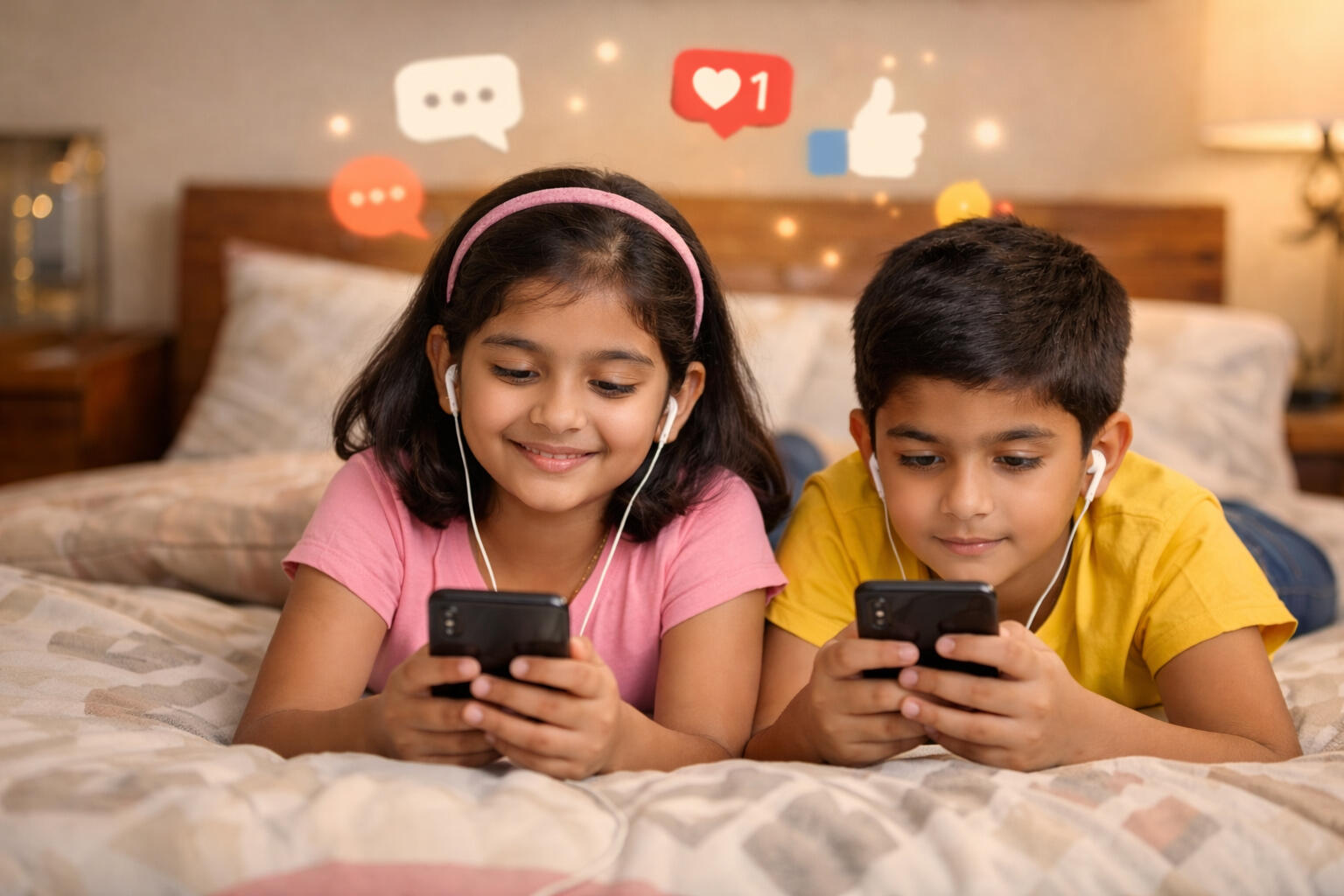

Log Out: Bans are not acts of cultural censorship. They are responses to accumulating evidence that social media exposure is harmful in the developmental years
Early and intensive social media use encourages adolescents to measure their self-worth against curated highlight reels rather than authentic human experiences. It creates an environment in which image becomes identity and external validation overshadows internal values. It can distort perceptions of friendship, intimacy, and self-worth — developmental processes that are best nurtured in the real world, under the guidance of parents, educators, and communities. In this sense, unrestricted social media access for children is not only a neurological risk but also a societal one, undermining our collective responsibility to raise resilient, empathetic, and grounded citizens.
India, with over 700 million internet users under the age of 25, stands at a critical crossroads. Recent reports suggest that Goa is examining Australia’s ban as a possible model, while other states are considering similar measures. This moment offers a vital opportunity for national leadership to shape policy that prioritises child health and social well-being.
Restrictions or a clear ban on social media access for children up to the age of 16, supported by robust age-verification mechanisms, would align India with emerging global public health norms. However, such a policy must be nuanced and evidence-based, complemented by investments in digital literacy, parental education, and mental health support. Tech companies must be held accountable for creating age-appropriate digital environments. Schools and community organisations should be empowered to teach healthy digital habits, and parents must become active guides in their children’s digital lives.
We must also anticipate unintended consequences — such as migration to unregulated platforms or covert use — by creating safe, structured avenues for digital engagement. Any restriction should be protective, not punitive, fostering a culture in which childhood is preserved as a time for exploration, creativity, and real-world connection rather than algorithmic commodification.
The recent episode involving the morphing of images on Grok is a stark reminder that we must do better to protect our kids.
Dr Lahariya is a health policy expert and specialist in parenting and child development
Disclaimer
Views expressed above are the author’s own.
END OF ARTICLE