Vinay Kumar
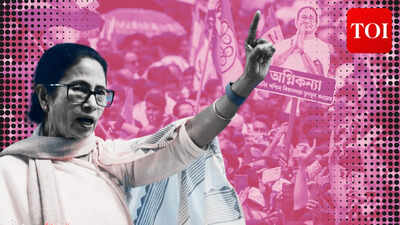
Cash, care and constant connect: How the ‘Didi model’ is shaping Bengal’s ballot
The welfare architecture of Mamata Banerjee’s government in West Bengal has emerged as a defining feature of its governance, combining large-scale social support programmes with significant political implications as the state heads toward the 2026 Assembly elections.As the state prepares for the first phase of polling on April 23, the “Didi Model” of governance is not only acting as key social welfare schemes that have redefined rural economics, but has also served as the ultimate political insurance for Mamata Banerjee’s enduring grip on power.
Lakshmi in every home
At the centre of this model is the Lakshmir Bhandar scheme, launched in 2021 to provide monthly financial assistance to women aged roughly 25 to 60. Regardless of the marital or employment status, this scheme covers all women residents of Bengal.Currently, beneficiaries receive Rs 1,000 per month, while women from Scheduled Caste and Scheduled Tribe communities receive Rs 1,200. Designed to cover household expenses and improve financial security, the scheme has gained widespread acceptance and is increasingly viewed not as a “freebie” but as an economic entitlement.The scheme has also become a major political talking point, with the ruling All India Trinamool Congress (TMC) promising to raise the assistance by Rs 500 if re-elected.However, implementation challenges persist. In a recent case from East Midnapore, around 7,000 women reportedly did not receive payments for nearly five months, prompting the Calcutta High Court to seek a report. Despite such issues, the scheme continues to expand, with approximately 1.25 lakh new beneficiaries added to an existing base of 2.2 crore women.
No one sleeps hungry
Food security remains another cornerstone of the state’s welfare strategy through the Khadya Sathi programme, launched in 2016. The scheme provides rice and wheat at subsidised rates of around Rs 2 per kilogram and currently covers nearly 9 crore people.Eligible beneficiaries are categorised based on their ration card. This constitutes the “poorest of the poor”, including landless labourers, marginal farmers, rural artisans, and households headed by widows or terminally ill persons. Families living below the poverty line (BPL) or in the economically weaker section (EWS) are also the beneficiaries of this scheme.With expenditure exceeding Rs 1 lakh crore, it is among the largest such initiatives in the country.It is complemented by the Duare Ration initiative, which delivers food grains directly to households, reaching about 7 crore people at a cost of over Rs 1,700 crore.The state government claims that these combined efforts have helped lift around 1.7 crore people above the poverty line by 2023, reinforcing its narrative of inclusive growth driven by welfare spending.
Cash for classroom over ‘Chhadnatola’
In education and gender empowerment, the Kanyashree Prakalpa remains a flagship programme. Launched in 2013, it provides Rs 1,000 annually to girls aged 13 to 18 who remain in school and unmarried, along with a one-time grant of Rs 25,000 at age 18 for those continuing education or training.With over 7 crore cumulative enrolments, the programme is one of the largest conditional cash transfer schemes for girls globally and was recognised with the UN Public Service Award. However, challenges remain in ensuring awareness, documentation, and sustained participation beyond eligibility.
Healthcare without bills
Healthcare coverage has been expanded through the Swasthya Sathi scheme, introduced in 2016. It offers cashless treatment up to Rs 5 lakh per family per year and covers nearly 9 crore people across 2.5 crore families.Notably, smart cards are issued in the name of the female head of the household. The scheme has recorded over 1 crore hospitalisations, with government spending exceeding Rs 13,000 crore. While it boasts one of the highest coverage rates in India, estimated at around 74.5 per cent, concerns persist regarding hospital participation, claim settlements, and out-of-pocket expenses in private healthcare facilities.
The unemployment cushion
Most recently, the government has turned its attention to unemployment with the launch of Banglar Yuva Sathi, announced in the 2026 Interim Budget. The scheme provides Rs 1,500 per month to educated unemployed youth aged 21 to 40 for up to five years or until they secure employment.Targeting Madhyamik-qualified individuals not covered under other programmes, it was fast-tracked with initial payments released on March 7, 2026. Backed by an allocation of around Rs 5,000 crore, with projections going up to Rs 15,000 crore, it is positioned as a key intervention to address unemployment ahead of the elections.Together, these schemes form the backbone of the TMC’s welfare-driven governance model, blending direct benefit transfers, food security, healthcare, and social empowerment. While the scale and reach of these programmes have drawn both national and international attention, their long-term sustainability and implementation efficiency remain under scrutiny as political stakes rise in West Bengal.