 Vinay Kumar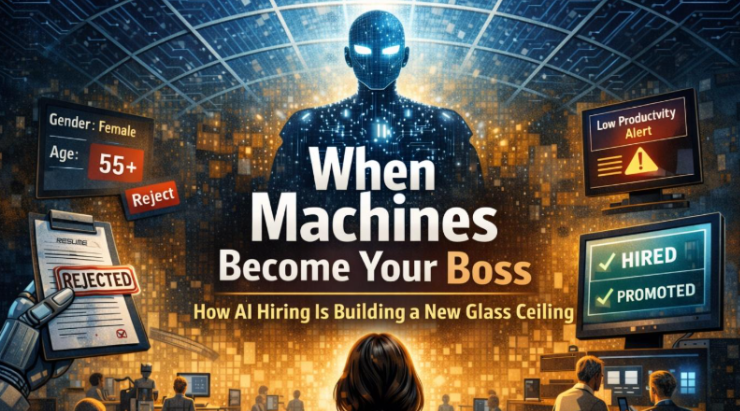
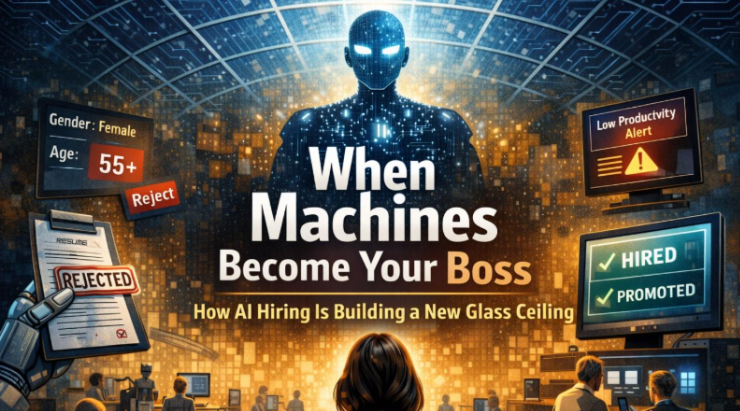
How AI hiring is building a new glass ceiling
The future-of-work story we were sold was simple: AI will replace humans.
What is actually happening is more complicated, and for women, potentially more dangerous.
AI is no longer just automating back-office work. It is deciding who gets shortlisted, who gets rejected, who gets flagged for “performance,” and increasingly, who gets managed by a system instead of a person.
A legal warning shot has already landed. In the US, a tutoring company paid a $365,000 settlement after its recruiting software automatically rejected older applicants, including women above a specific age threshold. That was not one biased recruiter. That was discrimination at machine speed.
Now add a second shift. We are seeing platforms where AI systems can assign humans tasks they cannot physically perform themselves. The headline-friendly language may sound gimmicky, but the power equation is real: software gives instructions, humans execute.
We have moved from “AI will replace workers” to “AI will manage workers.”
And if we are not careful, this new managerial layer will inherit every old bias we failed to fix, then scale it.

From HR tool to invisible manager
Most large employers today use automated filters somewhere in hiring. Estimates suggest hiring automation among Fortune 500 firms is now near universal, with ATS usage often cited around 98.4% (roughly 492 of 500 companies).
So for many candidates, the first interview is no longer human. It is an algorithmic gatekeeper.
Companies defend this on efficiency grounds, and they are not wrong. But efficiency and fairness are not the same thing.
The hard question is this: What does the system learn as merit?
If historical hiring rewarded uninterrupted careers, male-coded language, and familiar institutional signals, the model can treat bias as performance. It does not need intent. It only needs patterns.
That is what makes this dangerous. Bias stops looking like prejudice and starts looking like “optimization.”
When bias becomes infrastructure
The evidence is no longer anecdotal.
A Berkeley Haas-linked analysis reported that 44.2% of assessed AI systems showed gender bias. About 25.7% showed both gender and racial bias together.
Research from the University of Washington found major race and gender effects in resume-screening simulations, including significantly stronger preference rates for white-associated names and markedly weaker outcomes for some intersectional groups.
UNESCO and IRCAI’s 2024 analysis showed women were associated with home-and-family framing about four times more often than men, while men were more often linked with leadership and executive framing.
That matters because language is not cosmetic in hiring systems. It shapes who looks “technical,” who appears “leadership-ready,” and who gets read as a “culture fit.”
Once that logic enters recruitment, performance scoring, and promotion pathways, it becomes part of organizational infrastructure.
Not a bug. A pipeline.
India’s specific risk
India is adopting AI in enterprise workflows quickly, including in HR and workforce management. That speed can be a strategic advantage, but only if we do not copy-paste models trained on very different labour realities.
India’s workforce includes discontinuous careers, returnships after caregiving, informal-to-formal transitions, multilingual resumes, and high variation in credential signalling.
If a model penalizes career gaps mechanically, women bear the hit first and hardest.
If a system overweights continuous tenure, women returning after maternity or care breaks can be filtered out before a human ever sees their profile.
If performance tools read availability as commitment, caregiving constraints get misread as low ambition.
This is how historical inequality gets laundered through software and presented as neutral ranking.
We should be honest about it: this is the old boys’ club in API format.
The feedback loop we should fear
AI bias is not static. It compounds.
A biased model selects a biased cohort.
That cohort becomes “successful employee” data.
The next model trains on it and calls it proof.
This is why incremental fixes are not enough. Without intervention, systems build self-reinforcing loops where exclusion becomes more statistically “justified” over time.
And it does not stop at hiring.
Algorithmic scheduling, productivity monitoring, and automated task assignment are already influencing who gets better shifts, who gets flagged, and who gets nudged out. In high-volume sectors, these systems can affect thousands of workers long before any formal complaint appears.
By the time harm is visible, it is already distributed.
Law is catching up, but slowly
Regulators are moving, but not at platform speed.
New York City now requires annual bias audits for automated employment decision tools. California has clarified that existing anti-discrimination law applies to AI-driven employment decisions. These are important steps, because they close the “the machine did it” excuse.
India is moving on broader AI governance through principles around accountability, transparency, human oversight, and risk-based controls. Good start. But for hiring and workplace AI, we still need sharper operational requirements: audit standards, worker grievance channels, documentation duties, and clear liability triggers.
Because if enforcement remains vague, compliance will become PowerPoint theater.
What 2030 could look like
If current trajectories hold, the next few years may bring:
- AI-assisted supervision becoming default in distributed and remote work
- Automated performance scoring tied to pay, promotion, and exits
- Mandatory algorithm audits entering mainstream HR compliance
- New worker rights around explanation, appeal, and human review
At the same time, labour transitions are real. McKinsey has estimated that up to 375 million workers may need occupational transitions by 2030 due to automation and technological shifts.
So this is not a theoretical ethics seminar. It is a redesign of labor markets in real time.
What companies should do now
If you deploy AI in hiring or performance decisions, a serious baseline should be non-negotiable:
- Pre-deployment bias testing across gender, age, disability, and career-break scenarios
- Independent periodic audits, not just vendor self-assessments
- Human override and appeal rights for candidates and employees
- Decision logs that track model versions, features, and outcomes
- Proxy-variable controls to prevent backdoor discrimination
- Returnship fairness checks so career-break candidates are not auto-penalized
- Board-level accountability for algorithmic risk, not just HR ownership
If a system cannot explain a rejection in plain language, it should not be making that rejection at scale.
The fork in the road
AI can reduce human arbitrariness in hiring, or industrialize it.
It can widen opportunity, or rebuild exclusion with cleaner dashboards.
For women and other marginalized workers, this is an economic-rights issue, not a niche tech-policy debate.
We spent decades naming workplace bias.
Now we are encoding it.
If algorithmic management becomes a black box, we are not modernizing work. We are automating a new glass ceiling, faster, quieter, and harder to challenge.
And once that ceiling becomes infrastructure, breaking it will cost far more than preventing it now.
The question is no longer whether AI will transform work. It already has.
The question is whether fairness becomes part of the architecture, or a footnote in the postmortem.
Key numbers at a glance
- $365,000: landmark US settlement over discriminatory automated hiring
- ~492/500: estimated Fortune 500 adoption of ATS/automated hiring filters
- 44.2%: share of assessed AI systems showing gender bias in one major analysis
- 25.7%: share showing both gender and racial bias
- 4x: higher association of women with domestic framing in a major LLM bias study
375 million: workers globally estimated to need role transitions by 2030
Disclaimer
Views expressed above are the author’s own.
END OF ARTICLE