Vinay Kumar
The article is in two parts, giving out the silent help both Russia and China are giving to Iran to sustain this war. India needs to watch the battlefield to adapt to the new challenges being faced by the spectrum Warfare.
Part I: The new battlefield and the urgent need to watch the war live
In the Gulf and beyond, a new kind of war is unfolding. It is fought not primarily with tanks or massed artillery but with radar beams, satellite feeds, encrypted coordinates and electronic pulses. Recent conflicts have shown that the electromagnetic spectrum—signals, navigation, imagery and communications—has become the decisive terrain.
Whoever sees first and blinds the other wins.
The lesson is immediate and stark: India cannot wait six months to form a body that watches, learns and acts in real time. The country must establish a National Spectrum Warfare Task Force now, with a mandate to monitor ongoing conflicts, extract operational lessons as they happen, and translate those lessons into doctrine, procurement and training within weeks, not years.
Signals as strategic weapons
Modern precision strikes depend on accurate, timely intelligence. Satellite imagery, signals intelligence and secure navigation feeds are the nervous system of precision strike doctrines.
When an adversary can feed coordinates, jam or spoof navigation, or blind sensors, conventional advantages evaporate. The recent theatre where Russia and China have supported a regional actor demonstrates how intelligence flows and exported EW hardware can rapidly erode a technologically superior opponent’s edge.
This is not theoretical. Reports from recent engagements indicate that external satellite feeds and advanced radar systems materially changed the battlefield picture for the recipient state.
The result was faster target acquisition, compressed reaction windows for defending forces, and the ability to prosecute stand-off strikes with high accuracy. For India, the implication is clear: in any future conflict with Pakistan or China, the electromagnetic domain will be contested from the outset.
The OP Sindoor allegation and its implications
Allegations have circulated about an operation—referred to in some reports as “OP Sindoor”—in which Pakistan, reportedly aided by Chinese satellite and EW support, engaged Indian aircraft at stand-off ranges.
According to these accounts, advanced PL-15 family missiles, launched from beyond visual range and guided by external targeting feeds, tried to engage Indian Rafale aircraft. Most of these aircraft managed to evade the attack.
Whether every detail of these reports is correct or not is not the real issue. However, the operational pattern they describe is instructive: external intelligence and long-range missiles can convert stand-off engagements into decisive blows.
For India, the OP Sindoor scenario—if validated—would highlight three vulnerabilities: dependence on external navigation and imagery, the fragility of airborne survivability in a contested spectrum, and the danger of adversaries using third-party systems as force multipliers.
Even if the specific incident remains contested, the pattern is plausible and must be treated as an urgent warning.
Why India cannot rely on external help
In a high-intensity spectrum war, India should plan to operate with limited external assistance. Strategic partnerships are valuable, but in the opening hours of a conflict, the political calculus of allies may delay or limit support.
The Gulf conflict has shown that great-power politics and competing priorities can constrain immediate assistance. India must therefore assume it will have to fight alone initially and build resilient, independent capabilities that deny adversaries the ability to blind or mislead our forces.
Immediate operational priorities
The Task Force must be empowered to do three things immediately:
- Watch the war live: Establish a dedicated operations cell to monitor ongoing conflicts, collect open and classified signals, and produce daily operational lessons for commanders and acquisition authorities.
- Harden critical systems now: Accelerate military-grade encryption for NavIC and secure comms for frontline units; field interim anti-spoofing kits for aircraft, ships and mobile formations.
- Field rapid prototypes: Move from concept to field trials for counter-drone EW packages, shipborne and mobile jammers, and low-cost microsatellite launches to provide redundancy in imagery and navigation.
These actions are not long-term luxuries. They are immediate force-protection measures that can blunt adversary advantages within weeks.
Organizational Enhancements
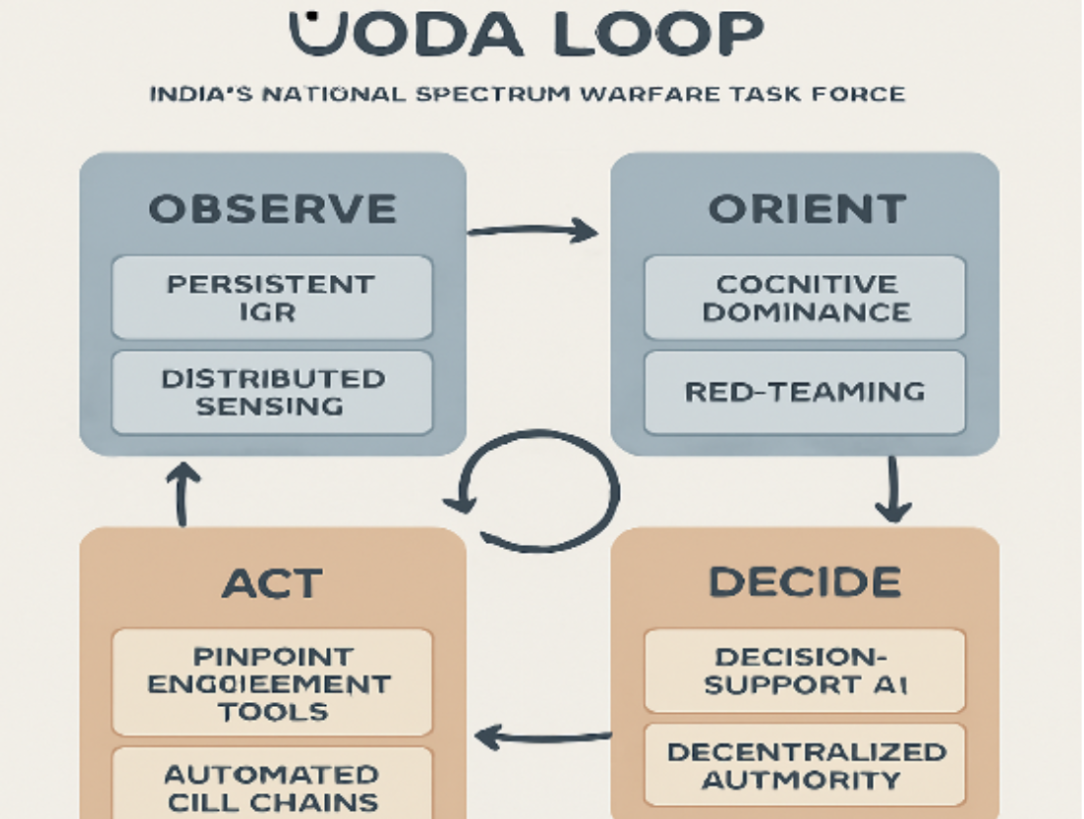
- National Spectrum Warfare Task Force: A joint body integrating the Army, Air Force, Navy, DRDO, and cyber agencies for unified OODA acceleration.
- Daily lesson extraction: Institutionalise real-time learning from field operations, updating doctrine and tactics continuously.
- Visual command frameworks: Use pictorial charts and flow diagrams to ensure clarity in the chain of command and rapid comprehension under stress.

Strategic insight
China’s strength lies in mass and speed; India’s counter must be precision and adaptability. By embedding AI, decentralisation and real-time operational learning, India can compress its OODA loop to seconds, achieving pinpoint engagements that deny the adversary initiative.
Disclaimer
Views expressed above are the author’s own.
END OF ARTICLE