 Vinay Kumar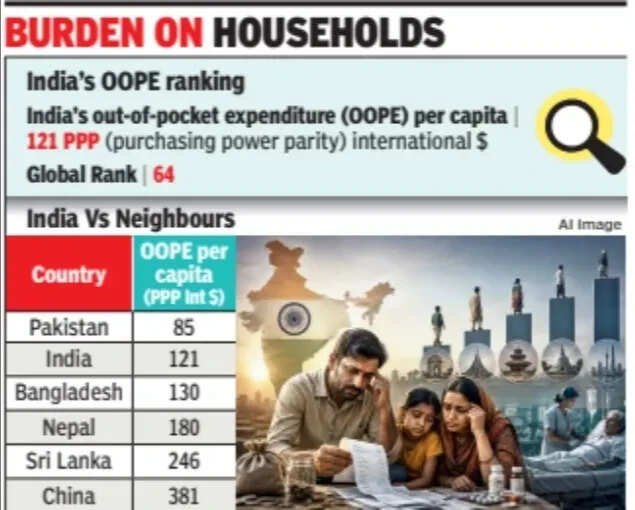
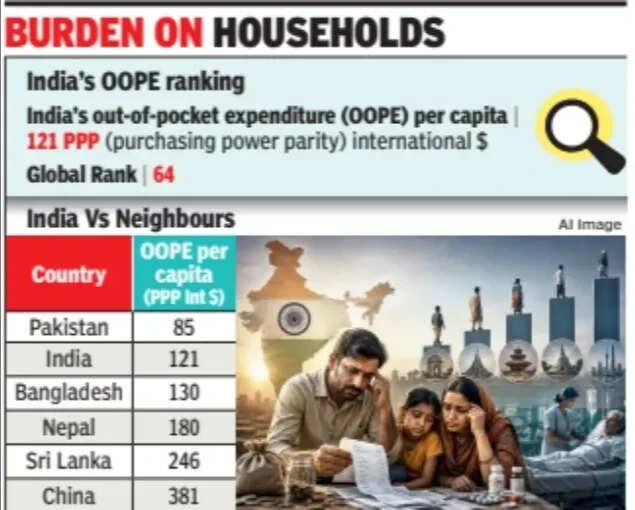
The report, however, pointed to a major long-term improvement within India. Out-of-pocket expenditure as a share of total health expenditure declined sharply from 64.2% in 2013-14 to 43.4% in 2022-23. Govt officials attributed the decline to rising public health spending, expansion of Ayushman Bharat PM-JAY, free drug schemes, Jan Aushadhi outlets and wider access to primary healthcare services through Ayushman Arogya Mandirs.The report showed govt health expenditure nearly tripled over the decade, rising from Rs 1.3 lakh crore in 2013-14 to Rs 3.8 lakh crore in 2022-23. Health economists say India’s healthcare financing system continues to remain heavily dependent on household spending despite recent improvements.According to the report, medicines and pharmaceutical purchases remain the single-biggest driver of personal healthcare spending in India. The international comparison also showed massive contrasts globally. Switzerland reported the world’s highest per capita out-of-pocket health spending at 2,302 international dollars, followed by Malta at 1,729 and Singapore at 1,647.Among major developed economies, the US reported OOPE of 1,380 international dollars, while the UK stood at 857 and Canada at 1,038.At the lower end of the global ranking, Kiribati reported the world’s lowest OOPE at just 2 international dollars, followed by Tuvalu and Solomon Islands at 4 international dollars each.Public health experts say lower out-of-pocket spending is considered a key indicator of stronger public healthcare systems because it reduces the risk of families falling into poverty due to medical expenses.