Vinay Kumar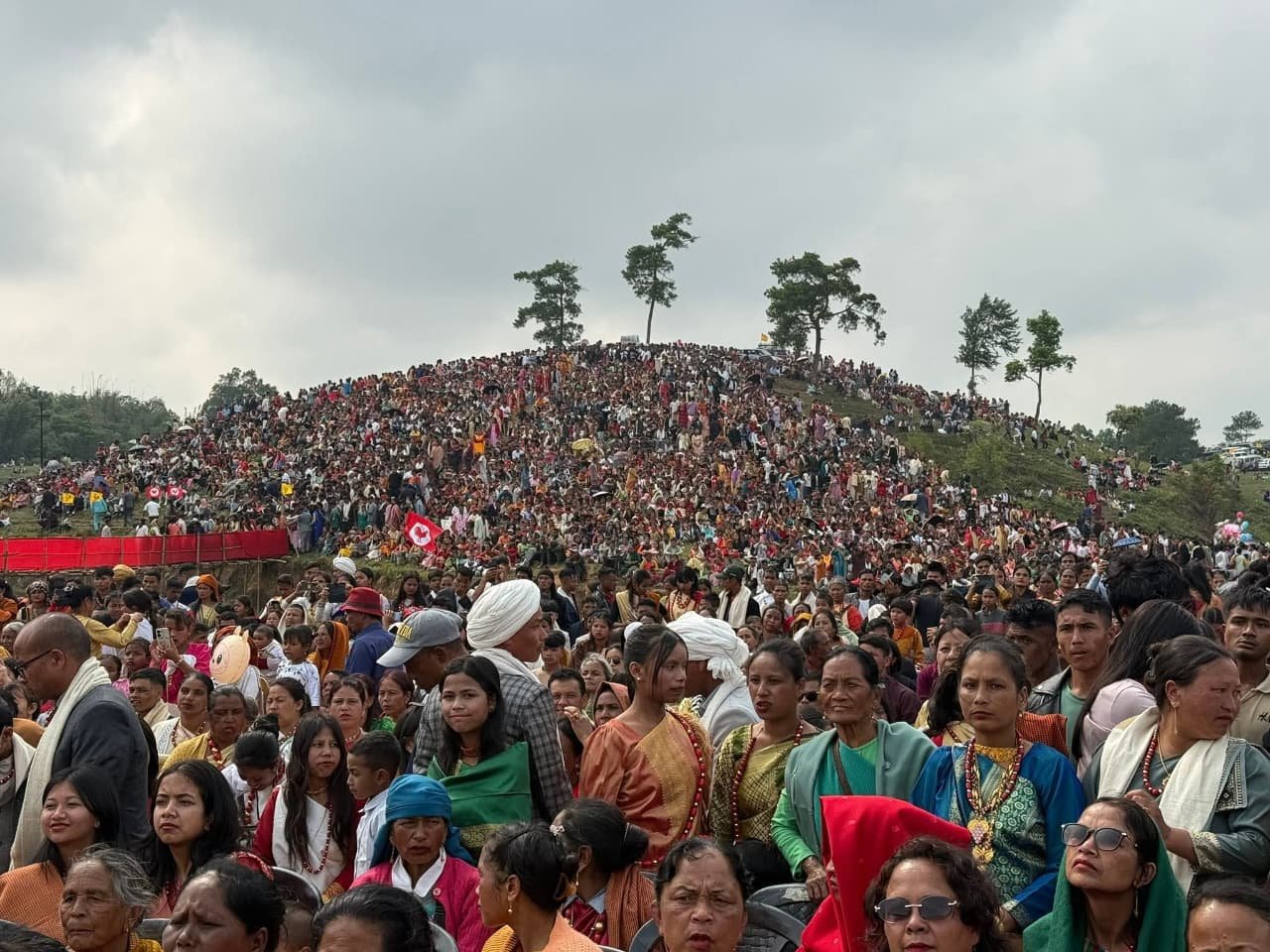
Almost a month before the grand three-day celebration of Meghalaya’s 36th Seng Khihlang, I received a gracious invitation from Rgh. H. R. Kurbah, president of the organisation, to attend and speak at the conclave. Though I was aware of this unique congregation of the Khasi–Pnar community, nothing truly prepared me for the profound experience that awaited me at Sein Raij Muthlong in the West Jaintia Hills of Meghalaya from April 17 to 19, 2026. What I witnessed there was far beyond a conventional gathering, it was a living continuum of an ancient civilisation, where tradition was not preserved as memory alone, but practiced as a vibrant, breathing reality. In that serene landscape, amidst hills, monoliths, and devoted faces, history, spirituality, and cultural identity merged into a deeply moving experience.
The Seng Khihlang, a gathering of Meghalaya’s Khasi-Pnar indigenous faith community, unfolds over three thoughtfully structured days, each imbued with meaning and symbolism. The first day marks the arrival of delegates from various Sein Raij and Seng Khasi units, accompanied by the ceremonial procession of the Mawbynna (monoliths), signifying the sacred commencement of the Lympung (gathering). The second day deepens the spiritual essence with the installation of these monoliths, followed by awareness sessions, community interactions, and collective prayers that reinforce shared values and ancestral wisdom. By the third day, the gathering blossoms into a vibrant cultural expression. Over 30 Sein Raij and Seng Khasi units come together in traditional dances and folk songs, filling the air with rhythm, colour, and devotion.
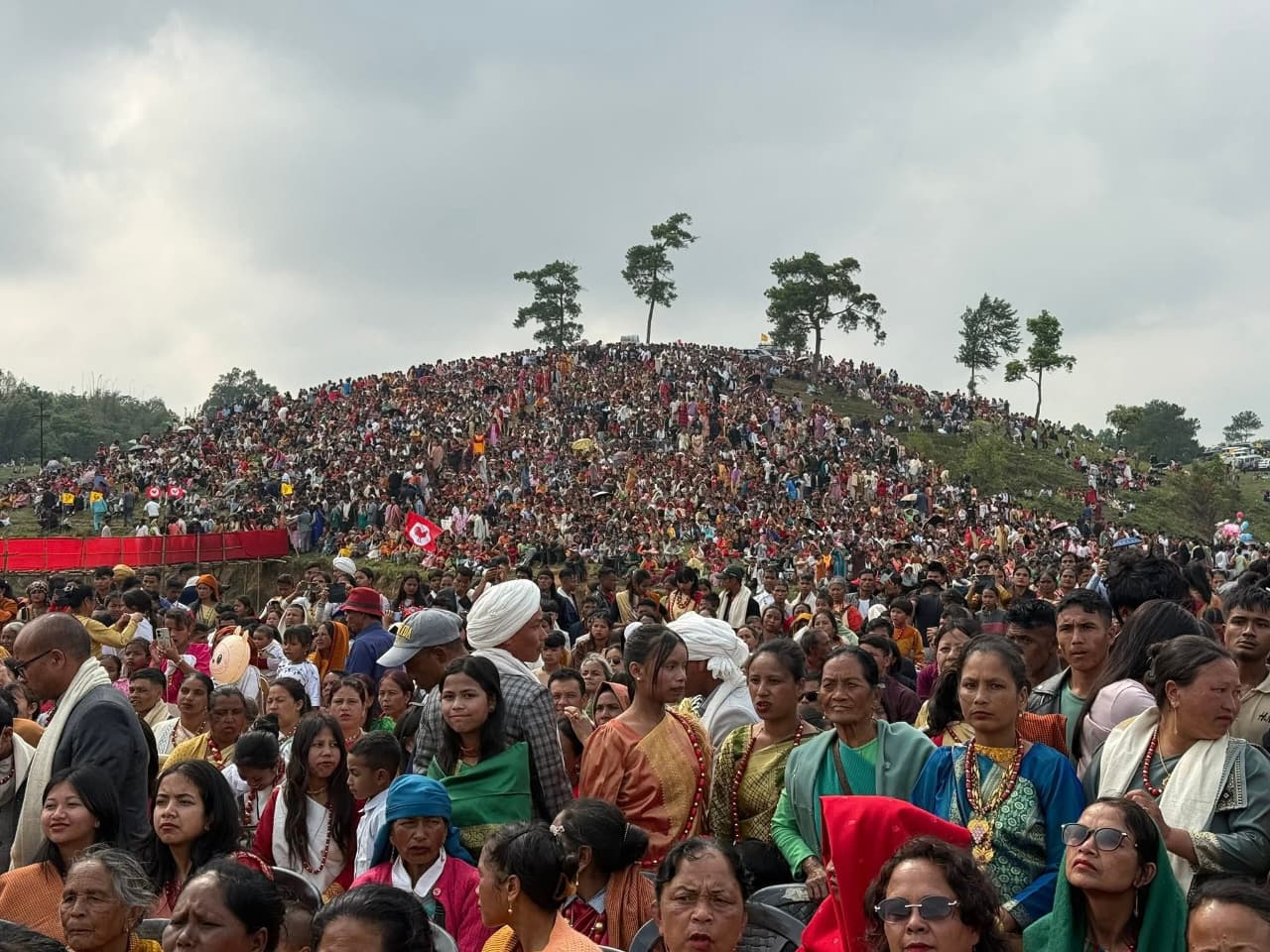

In my early interactions with local organisers, I came to understand that Seng Khihlang is not just an annual event but a conscious civilisational response. The Seng Khasi and Sein Raij communities, though historically part of the same indigenous stream, often grouped together as the Hynniewtrep community, had experienced separation during colonial rule, particularly after the British consolidation in the region following the annexation of the Jaintia Kingdom in 1835 CE. Yet, in the early 1980s, farsighted community leaders recognised this rupture and worked towards restoring unity. Thus, Seng Khihlang began in 1981 with barely 30–40 participants. Standing there in 2026, witnessing more than a lakh devotees on the concluding day, I felt I was watching history heal itself.
Our journey from Guwahati brought us late at night to the serene village of Sein Raij Muthlong, about ten kilometres from Jowai. The landscape was alive with thousands of red and yellow flags, each bearing the rooster, symbol of U Malymboit Malymbiang, who, according to Khasi-Pnar belief, restored light during a time of darkness and reconnected humanity with the divine. As I stood under the drifting clouds of the Jaintia Hills, with distant silhouettes of ranges like Lum Shyllong and the sacred Lum Sohpetbneng etched in my thoughts, I felt a deep stillness. I was quietly anxious about the weather for the next day, but my host Nidapbiang Lyngdo reassured me with conviction. Proper ritual offerings had already been performed by the Pa Dollois, the traditional custodians of faith, to appease the forces of nature. Their rituals, involving chants, offerings, and sacred invocations, were meant to maintain harmony with the elemental deities. His words reminded me of my childhood in Mayurbhanj, Odisha, where I had seen similar faith in nature. I realised again that for indigenous communities, spirituality is not separate from life, it is life. True to our faith backed by rituals, the next day saw no rain, no scorching heat, but a pleasant weather.
We stayed that night in a simple villager’s home. The warmth, the care, the insistence that we eat more, rest well – these were not gestures, but expressions of a worldview rooted in “Atithi Devo Bhava.” Over my sixteen years in Northeast Bharat, I have repeatedly experienced this quiet dignity of hospitality. The next morning, after a refreshing bath, we were served a traditional breakfast with steamed local rice, boiled leafy greens, forest herbs, roots and simple yet nourishing preparations. Before we left, our host draped a finely woven muga muffler around my shoulders. I instinctively folded my hands. It felt less like a welcome and more like a blessing.
As we walked towards the venue, nearly a kilometre away, I found myself absorbed in the movement of people. Entire families, young and old, walked together, dressed in traditional attire, adorned with beads and ornaments that reflected both identity and continuity. There was a quiet joy in their faces, a sense of belonging that cannot be manufactured. At the entrance, three towering Mawbynna (monoliths), installed during the first day’s ceremonial procession, stood as silent witnesses of time. These stones, I was told, continue a tradition that dates back several centuries, particularly flourishing between the 16th and 18th centuries CE in places like Nartiang. They are not mere markers; they are memory itself commemorating ancestors, events, and the social fabric of a matrilineal society.
We then walked towards a slightly elevated patch where the sacred Seven Huts had been constructed. Inside the main hut, a holy fire burned continuously, tended carefully with copper utensils used in traditional rituals. Devotees approached with folded hands, bowed their heads, and sat briefly in silent communion around the fire. A handful of sacred rice was distributed as prasad. I took some, ate a little, and instinctively kept the rest in my bag. It felt like carrying a piece of sacred possession with me.
The philosophy behind this ritual moved me deeply. The story of Ki Hynniewtrep, the Seven Families, is not just mythology; it is a civilisational memory. It speaks of a time when humanity was directly connected to the divine through a golden ladder, believed to have existed at the present Lum Sohpetbneng, near Umiam Lake. When this sacred connection was broken due to human greed, symbolised by the cutting of a divine tree, the seven families remained on earth, becoming the ancestors of the Khasi–Jaintia people. Since then, their duty has been to live in harmony with nature and uphold righteousness. The principles: “Tip briew tip blei” (to know man is to know God), “Tip kur tip kha” (to understand parental kinship), and “Kamai ia ka hok” (to earn righteousness), are not philosophical abstractions but lived ethics. As I observed people quietly offering prayers, I realised that this was dharma in its most organic form.
When I reached the main stage, I paused for a moment. It was massive, filled with dignitaries representing every layer of society. Among the distinguished dignitaries present at the grand gathering were Sniawbhalang Dhar, Deputy Chief Minister of Meghalaya; Wailadmiki Shylla, Minister, Government of Meghalaya; Sanbor Shullai, Minister, Government of Meghalaya; Matthew Beyondstar Kurbah, Member of Legislative Assembly; Laski Rymbai, Deputy Chief Executive Member of the Jaintia Hills Autonomous District Council (JHADC); the traditional institutions were represented by the esteemed Dollois of Shangpung, Raliang, Jowai, and Nangbah Elakas. I was accompanied on the stage by fellow social workers like Shri Ramanand Kale and Yogesh Shastri. Sitting among them, I felt both humbled and deeply connected.
In front of the stage was a vast circular arena alive with cultural performances with traditional dances, rhythmic chants, and folk songs that echoed across the hills. The surrounding natural hill slopes had turned into amphitheatres filled with thousands. I was told that over 33,000 vehicles had reached the site and that the gathering had crossed a lakh people. What struck me most was the discipline. People with families sat wherever they could, ate what they had brought from their homes, and remained immersed in the program for hours without restlessness.
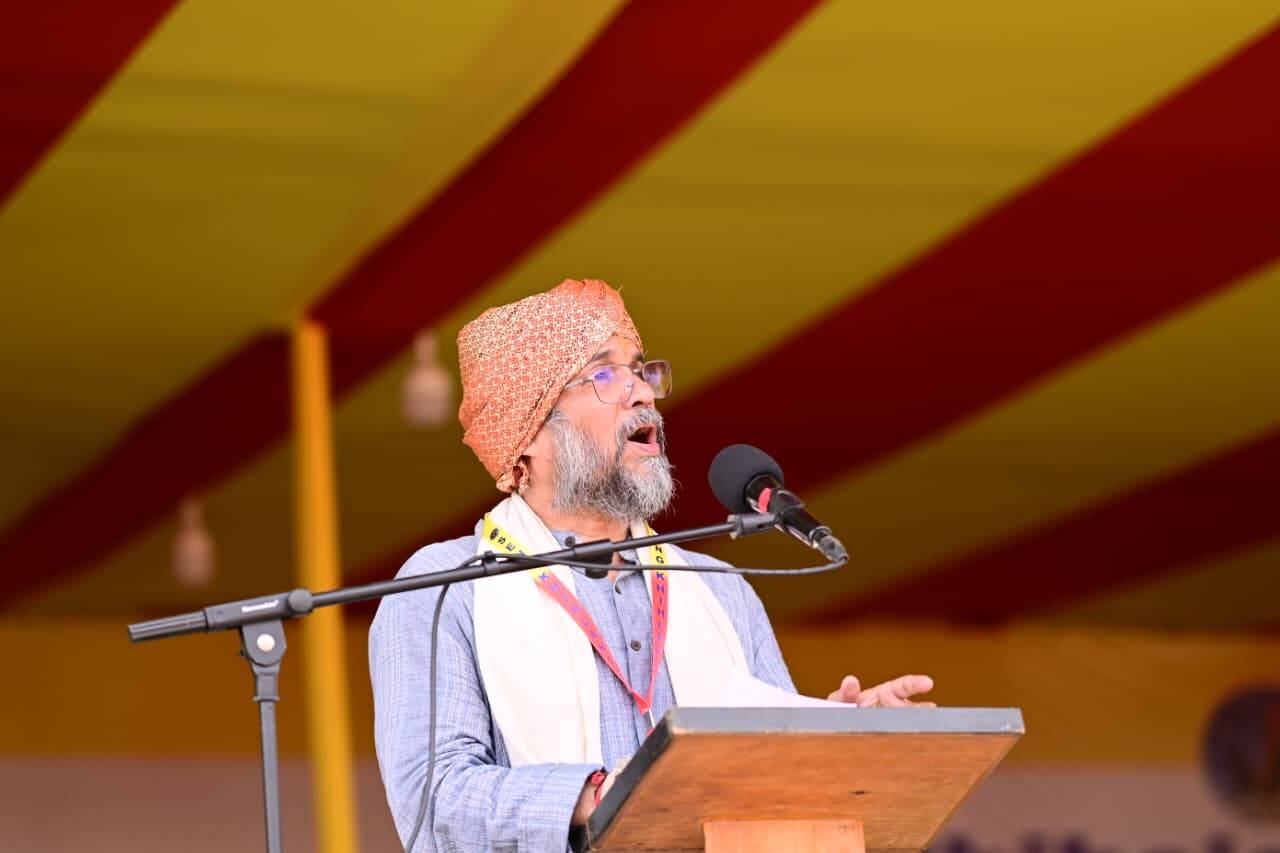
As I listened to the speakers, with translations provided by those beside me, I absorbed layers of history and philosophy. When my turn came, I spoke from both study and experience with deep responsibility. I shared how the Northeast is not a peripheral space, but represents one of the most authentic continuities of Bharat’s ancient civilisational ethos. If one wishes to understand Bharat not through texts alone but through lived tradition, one must come here. If one seeks to understand the organic form of Indian civilisation, unmediated by excessive modern abstraction, one must look towards these regions where traditions continue in their most authentic forms. Here community life precedes individualism.

I referred to revered historical figures such as Urmi Rani (c. 600–630 CE), Krishak Pator, Hatak, and Guhak, and later rulers like Prabhat Ray Syiem (1500–1516 CE), Laxmi Sinha (1670–1701 CE), who constructed the Jayantia Rajbadi around 1680 CE, and Rajendra Singh Syiem (1832–1835 CE), the last ruler before British annexation. I also paid tribute to great freedom fighters like U Tirot Sing (c. 1802–1835), U Kiang Nangbah (1836–1862), and Pa Togan Sangma (d. 1872), who stood against colonial expansion with immense courage.
Moving to a philosophical plane, I spoke about the shared foundations of indigenous traditions across the Northeast, among communities like the Nyishi, Apatani, Galo, Mishing, and Kachari. Despite diversity, all revere the Panch Bhutas, the five elements. Drawing from the Rig Veda, I cited “Eko’ham Bahusyamah,” the One becoming many. I emphasised that in the Bharatiya worldview, diversity is not division but manifestation of unity expressing itself in multiple forms. Thus, we celebrate diversity as the thread of unity inherent.
I also reflected on the global relevance of indigenous traditions. Just as the Ganga depends on its origin Gangotri, Indigenous Faith is the Mother of world’s modern civilisations and organised religions, which depend on their indigenous roots. If indigenous faith is lost, the modern world will lose its moral and spiritual balance. I mentioned platforms like the International Council for Cultural Studies (ICCS), which bring together world’s ancient traditions like Māori, Aboriginal, Aztec, and Zulu, etc. all sharing the ethos that “All are One.”
In the context of the centenary of the Rashtriya Swayamsevak Sangh, I spoke about Panch Parivartan like family values, environmental protection, social harmony, self-awareness, and civic duty, as essential for societal renewal. I emphasised that true spirituality lies in conduct, in compassion, discipline, and service.
After my speech, as I walked through the crowd, I felt an overwhelming sense of connection. A young girl came running towards me, her face glowing with excitement, and said that my comparison of Seng Khihlang to a “Kumbh Mela of Meghalaya” was exactly how they felt proud about it. Another local leader told me that while such gatherings were usually addressed by tribal leaders, my presence as a non-tribal speaker marked a meaningful beginning, one that could foster deeper shared understanding, an opportunity for wider civilisational dialogue that strengthens, rather than dilutes, the indigenous identity.
As the Lympung came to a close, I had the opportunity to witness the Shad Talawiar, a beautiful circular dance that brought everyone together in a spirit of joy and fulfilment. Men, women, and youth from different Sein Raij units joined in, moving rhythmically in a circle, celebrating the successful completion of the gathering. The atmosphere was filled with live traditional singing, phawar, and indigenous folk songs rendered by the youth, creating a deeply vibrant and emotional moment. Watching it, I felt that this was not just a dance, but a collective expression of unity, cultural pride, and shared happiness.
As I left Sein Raij Muthlong that evening, I felt a quiet transformation within. Seng Khihlang was not just something I attended, it was something I experienced deeply.
Seng Khihlang is not merely a cultural event, it is a civilisational assertion. It reminds us that indigenous traditions are not fragments of the past, but foundational pillars of humanity’s futuristic spiritual journey. It also reaffirms that despite historical disruptions and modern narratives of divisions and binaries, the deeper truth of Bharat remains one of unity in diversity, not as a slogan, but as a lived reality.
Amidst the monoliths, the sacred fire, the sacred chants, and the people rooted in their tradition despite modern challenges, I witnessed a living civilisation which is age old, inclusive, and profoundly spiritual. It reaffirmed to me that Bharat’s strength does not lie merely in its diversity, but in its ability to see unity within that diversity – not as an idea, but as a lived reality. I witnessed a timeless continuity. Seng Khihlang was not just another event I attended, it was an experience that reaffirmed this enduring spirit of Bharat.
Disclaimer
Views expressed above are the author’s own.
END OF ARTICLE