
 Vinay Kumar


In 1961, Dr Frank Drake proposed a probabilistic, though highly speculative, equation to determine the number of intelligent communicating civilizations in the Milky Way galaxy. It was also a quantified response to the thought process started in 1950 with the Nobel laureate physicist Enrico Fermi (one of the lead scientists in the Manhattan Project building the first atomic bomb) who made a lunchtime remark, “where is everybody?”
Fermi’s remark (also known as Fermi paradox) highlighted the apparent contradiction that despite the high probability of extraterrestrial life in the universe, we have not yet detected any signs of intelligent alien life? It has caught and held the attention of every SETI (search for the extraterrestrial intelligence) researcher since. It seems that Fermi was inclined to believe that humans were the Galaxy’s only intelligent species. However, neither it is a new question, nor a new belief in our being unique. Ever since the human species gazed at the night sky, it started wondering, “are we alone?” It has been a profound and enduring quest for humanity. Rather than just being a scientific inquiry, it reflects on our identity and place within the universe which echoed across generations, cultures, and civilizations.
“We are special” is the traditional answer to this question. The geocentric model placed the Earth at the centre of the universe. A corollary to this model was the idea that life (as a gift of God) appeared only on earth. This picture started crumbling in the modern age, when the geocentric model is first replaced by the heliocentric model and then by a model of universe in which nothing is special about the earth or the sun. The basic assumption is the principle of mediocrity, i.e., conditions in the solar system and on Earth are nothing particularly special but rather represent common conditions found elsewhere in the galaxy. Now, modern science has started talking of the multiverse, stripping away the special status of this universe also.
With such an onslaught of science on the traditional religious-philosophical beliefs, God is reduced from the status of the Supreme Agent to the God of gaps. Even this status is increasingly being taken away by Aliens who are the new God of gaps. Any inexplicable situation, technology, possibilities and happenings are being attempted to be explained by bringing in the agency of Aliens. But then the question is, where is everybody? With so many chances for intelligent life to arise, we should expect to see evidence of extraterrestrials.
It appears that the Fermi Paradox is a very large extrapolation from a very local observation. Therefore, Dr. Frank Drake in 1961 devised a probabilistic formula (N = R* × fp × ne × fl × fi × fc × L) to estimate N or the number of extraterrestrial communicative civilizations (with technology that can be detected by humans) in our galaxy. The Drake equation represents the first credible attempt to quantify SETI. The equation comprises seven key variables: R*: rate of star formation; fₚ: fraction of stars with planets; nₑ: number of planets per star capable of supporting life; fₗ, fᵢ, fc: fractions relating to life, intelligence, and detectable communication; and L: longevity or the average lifetime of such civilizations.
The Drake equation is more a subjective statement of probabilities than a true scientific equation. The first six factors of the equation are technical and somewhat quantifiable, whereas the last factor L is completely subjective and is not a subject of scientific enquiry but is dependent on speculation about intelligent life’s behaviour. Obviously, we have little basis for estimating L. Based on our own experience, some people think that humanity is hellbent on self-annihilation. Others are less dramatic and more optimistic. In dealing with the Drake equation, the pessimists place very low values on L (perhaps 100 or so years), while the optimists insist that L is several thousand to several million years.
The value of L has a profound impact on the thinking about the nature of advance Alien civilizations. Scientists, generally, agree that belligerent and hate-driven civilizations will destroy themselves quicker than becoming an interstellar civilization. Therefore, an advance Alien civilization must be peaceful and co-operative. 1996 movie “The Mars Attack” has put this idea as a satire. However, there is also a view that such Aliens may not value humanity more than we value ants or mosquitos. In movie Odyssey, Odysseus reject the possibility of Cyclops negotiating with humans by saying, do we negotiate with ants?
In 1961, essentially none of the seven factors in the equation was known except the first. Even now, only first two factors are better understood due to exoplanet discoveries. Due to uncertainties of the factors of this equation, estimates for N is ranging widely. Drake himself suggested that N = 10,000. Since then, various efforts have been made to estimating the number of intelligent alien civilizations by putting different values in Drake equation. The table below is showing very optimistic and very pessimistic values that have been used in SETI discussions.
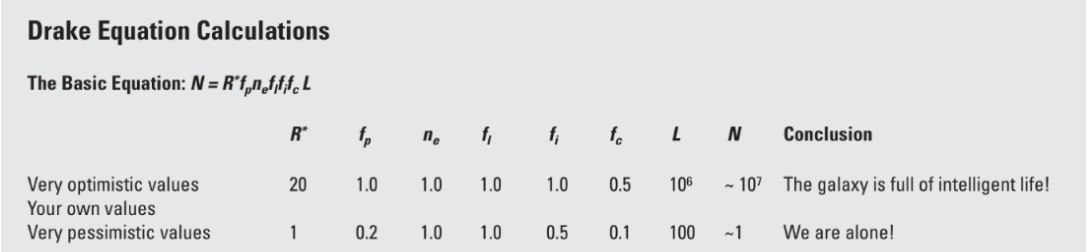

Our galaxy is ~10 to 13.6 billion years old and contains perhaps 100 billion stars. If N is about 10 million then the average distance between intelligent, communicating civilizations is 100 light-years. If N is 100,000, then these extraterrestrial civilizations on average would be about 1,000 light-years apart. But if N is only 1,000 then they would typically be some 10,000 light-years apart.
Consequently, even if our galaxy contains a few such civilizations, they may be just too far apart to achieve communication within the lifetimes of their respective civilizations. For example, at a distance of 10,000 light-years, it would take 20,000 years to start an interstellar dialogue. This gives one of the answers to the Fermi paradox that why others are not here yet. There are many more attempts to respond to Fermi’s profound question, which could be categorised in two groups:
- Pessimists reply that we see no signs of intelligent extraterrestrial civilizations because we really are alone. Maybe we are the first technically advanced intelligent beings to rise to this level. If so, then perhaps it is our cosmic destiny to be the first species to sweep through the galaxy spreading intelligent life.
- Optimists offer a variety of reasons: aliens are not interested in us; or they communicate by means beyond our comprehension; or we are being kept as a “zoo” by alien zookeepers who monitor our activities without revealing themselves. Another interesting response is that we are descendants of ancient star travellers who visited Earth millions of years ago when a wave of galactic expansion passed through this part of the galaxy.
The Drake Equation is sometimes called the second most important equation in science after the E=mc2. It is a step toward answering the question, are we alone, by counting how many detectable alien societies may exist? While the Drake Equation cannot be solved or even accurately calculated, it retains considerable utility for discussions about extraterrestrial life and intelligence. It is no wonder that despite the financial and other hardships (including no success till date) for the SETI program, it is the hope inherent in the Drake Equation that has kept SETI alive.
Disclaimer
Views expressed above are the author’s own.


