 Vinay Kumar
Prime Minister Narendra Modi‘s visit to Indonesia, Australia and New Zealand has put the spotlight on New Delhi’s relationships with countries further east in the Indo-Pacific region. The visit comes at a time when countries in the neighbourhood are increasingly wary of China’s growing assertiveness in the Indo-Pacific.On the day PM Modi landed in Jakarta, China launched a submarine-launched ballistic missile during a pre-scheduled exercise with Russia, an old and trusted strategic partner of India. PM Modi’s visit also comes just three days after Japanese Prime Minister Sanae Takaichi concluded her visit to India. At the same time, India is cooperating with partners Australia, Japan and the United States, under the banner of the Quadrilateral Security Dialogue (Quad) to ensure a free and open Indo-Pacific. The Quad is seen as a stabilising force in the region, with all four member nations strengthening their military capabilities.
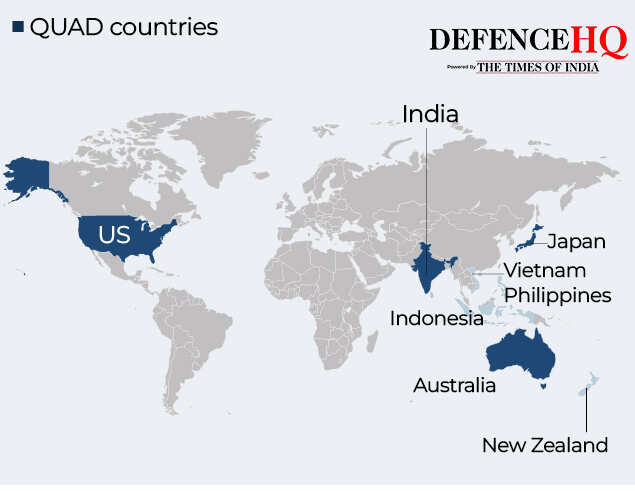
India and the Indo-Pacific
India has a strong historical and cultural ties with South East Asia, with countries such as Cambodia and South Korea tracing aspects of their civilisational origins to India. India’s first major policy to strengthen ties with Southeast Asian countries began with former Prime Minister PV Narasimha Rao’s Look East Policy in 1992, which later evolved into the Act East Policy under the current government in 2014. The policy is driven by the “4 Cs” — culture, commerce, connectivity and capacity building.India has a long and storied relationship with the region. From around 200 BC until the 15th century, Southeast Asia was strongly influenced by India through trade, culture and politics. Kingdoms in present-day Myanmar, Thailand, Indonesia, the Malay Peninsula, Cambodia and Vietnam absorbed Hindu-Buddhist traditions brought by South Indian traders, priests and adventurers. The Pallava kingdom’s openness to maritime trade encouraged exchanges across the sea routes.New Delhi is now working to expand its defence relationships with other nations in the region. PM Modi’s visit to these three countries has at its core a a strong strategic element. India is working with its Quad partners on shared concerns such as freedom of navigation, maritime domain awareness and countering coercive behaviour, while simultaneously engaging other regional players through bilateral partnerships.The Indian Navy is also expanding its presence in the Indo-Pacific, with a P-8I maritime patrol aircraft currently in Hawaii as part of the multinational RIMPAC naval exercise hosted by the United States Indo-Pacific Command. The Navy has regularly been sending ships to the region for port calls and exercises, increasing its presence across the Indo-Pacific. It also undertakes humanitarian assistance and disaster relief (HADR) missions, as well as anti-piracy operations, positioning India as a reliable partner. By offering capacity building, training and increasingly, defence exports, New Delhi is reinforcing its role as a stabilising force in the region.
The Quadrilateral of India, Australia, UK and the US was expected to grow in strength, and was taking firm steps forward. Though its stated objectives were non-military, the Chinese had misgivings about the Quad being a geostrategic entity. However, President Trump’s policies have had even the best optimists being acutely sceptical about the organisation’s efficacy and future course.For India, Southeast Asian nations have always been a priority. The Chinese threat is a common refrain for all these countries, and provides the rationale for greater co-operation. We have been witnessing mutual arrangements to buy military hardware, and port developments between India and Philippines, Indonesia and Vietnam. A limping Quad provides the impetus for such arrangements. Pursuing Southeast Asian nations for firmer relationships is also an extension of India’s Act East Policy.
Brig SK Chatterji (retired), author and strategic expert
Vietnam: Expanding defence cooperation
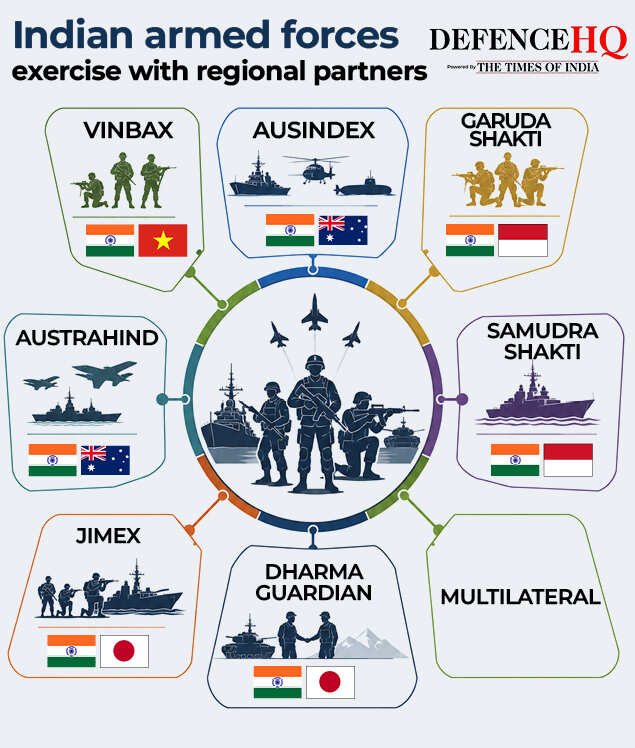
India and Vietnam elevated their ties to an Enhanced Comprehensive Strategic Partnership earlier this year in May, during Vietnamese President To Lam’s visit to India. Defence and security are the cornerstones of this relationship. China claims territories contested by both countries — India’s territories in the high Himalayas and Vietnam’s claims in the South China Sea. The bilateral defence relationship is driven by strategic convergence, particularly over shared concerns regarding Chinese expansionism and freedom of navigation in the South China Sea.Both nations have released a Joint Vision Statement on the India-Vietnam Defence Partnership. India has extended a line of credit to Vietnam for procuring defence equipment and also assists the country in maintaining some of its Russian-origin military platforms. Both countries are also said to be negotiating a deal for the BrahMos supersonic cruise missile. India previously gifted the indigenously built missile corvette INS Kirpan to the Vietnam People’s Navy. The armies of India and Vietnam also participate in the VINBAX bilateral military exercise.
Indonesia: Maritime cooperation and two sides of China’s Malacca dilemma
India and Indonesia have elevated their relationship to a Comprehensive Strategic Partnership, with defence and security forming a central pillar of this engagement. Both New Delhi and Jakarta have repeatedly emphasised the importance of maintaining a free, open and rules-based Indo-Pacific. The bilateral defence relationship is shaped by shared strategic interests as maritime neighbours across the Andaman Sea, where India’s southernmost tip lies just 150 km from Indonesia.Both countries have expanded defence-industrial cooperation, with Indonesia procuring India’s Brahmos supersonic cruise missile system and Astra Mk-1 air-to-air missiles.The two countries regularly conduct coordinated naval patrols, known as IND-INDO CORPAT. In addition, bilateral exercises such as Garuda Shakti (Army) and Samudra Shakti (Navy) are held periodically. Indonesia will also station an International Liaison Officer at India’s Information Fusion Centre–Indian Ocean Region (IFC-IOR) in Gurugram.India has proposed establishing a Joint Defence Industry Cooperation Committee to promote technology transfer, joint research and development, and supply-chain linkages aimed at supporting Indonesia’s military modernisation efforts. The growing defence partnership reflects the strategic convergence between the two nations in ensuring regional stability and addressing emerging security challenges in the Indo-Pacific.
Philippines: India’s first major defence export destination
India and the Philippines regard each other as strategic partners, with defence and maritime security forming a central aspect of the bilateral relationship. Both nations share concerns over China’s assertions and emphasise their commitment to a free, open and rules-based Indo-Pacific. India has consistently supported the Philippines’ sovereignty and the 2016 Arbitral Tribunal ruling on territorial disputes in the South China Sea, which rejected China’s claims.The navies of the two countries regularly conduct Maritime Cooperative Activities (MCAs) and joint deployments within the Philippines’ Exclusive Economic Zone. India has supplied the BrahMos cruise missile to the archipelagic nation under a $375 million agreement, marking India’s first major defence export. Discussions on follow-up purchases and frameworks for expanding missile cooperation have also taken place.Defence-industrial cooperation has also deepened, with Indian manufacturer SMPP Limited and the Philippines’ Asia Defence and Firepower Corporation (ADFC) establishing a joint venture to manufacture, assemble and distribute defence hardware directly in the Philippines. This growing partnership underscores the strategic convergence between New Delhi and Manila.
New Zealand: India expands its reach
India and New Zealand elevated their bilateral relationship to a Strategic Partnership during PM Modi’s recently concluded visit to the island nation. The visit has laid the framework for expanded defence, maritime security and counter-terrorism cooperation. The move reflects a shared commitment to a free, open, inclusive and rules-based Indo-Pacific. Maritime cooperation between the Indian Navy and the Royal New Zealand Navy has also been strengthened through a logistics support arrangement.
Japan: Deepening strategic partnership
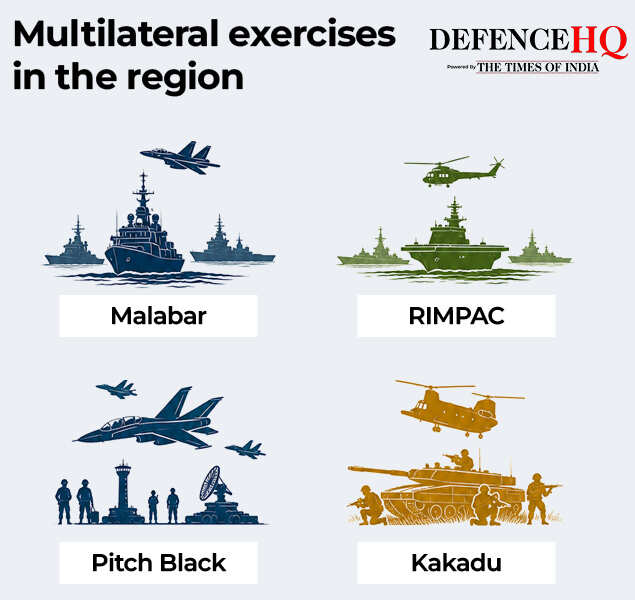
India and Japan regard each other as Special Strategic and Global Partners, with a relationship anchored in a shared vision of a free, open and secure Indo-Pacific. The partnership is designed to address common regional security challenges.Maritime security and interoperability form the foundation of this partnership. Japan and India have signed the Reciprocal Provision of Supplies and Services Agreement, allowing their armed forces to access each other’s facilities for logistics support. To enhance interoperability, the armed forces of both countries regularly conduct joint exercises, including JIMEX (naval), Malabar (with the United States and Australia) and Dharma Guardian (Army). Information sharing has also improved through cooperation on maritime domain awareness.
Australia: Strengthening interoperability
India and Australia regard each other as top-tier security partners. Their relationship is anchored in the Joint Declaration on Defence and Security Cooperation, which provides the framework for cooperation in advanced maritime security, reciprocal military logistics and defence-industrial collaboration.The Mutual Logistics Support Agreement (MLSA) has strengthened the operational reach of both militaries by granting reciprocal access to military bases and ports for logistics support. Defence-industrial and technological cooperation has also expanded through the India-Australia Defence Innovation Corridor, which aims to improve coordination among startups, research institutions and industry.Joint military exercises are held regularly, including bilateral engagements such as AUSINDEX (Navy) and AUSTRAHIND (Army), alongside participation in major multilateral exercises such as Pitch Black, Malabar and Kakadu.
India: An independent player
India, a founding member of the Non-Aligned Movement, has historically pursued strategic autonomy, often described today as multi-alignment. India has maintained diplomatic relationships independent of bloc politics, reflecting its long-standing commitment to strategic autonomy. While the Quad remains an important pillar of India’s Indo-Pacific strategy, New Delhi is not confined to it. By engaging a broader set of partners, India has ensured that its Indo-Pacific approach remains multi-layered and balanced.As India strengthens its defence industrial base and expands its naval presence, these partnerships across the region will become even more significant. In the years ahead, India’s Indo-Pacific story will be defined not only by its role in the Quad but also by its ability to weave together a wider network of defence relationships.