 Vinay Kumar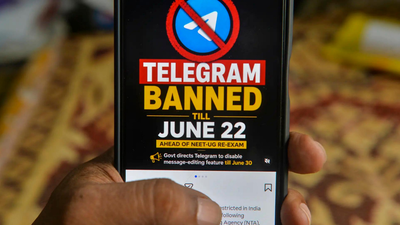
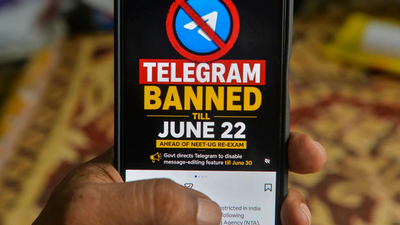
NEW DELHI: The Delhi high court on Thursday questioned the Centre’s decision to temporarily block access to Telegram ahead of the June 21 NEET-UG 2026 re-examination, asking how the rights of nearly 150 million users could be curtailed because of concerns that some may misuse the platform during the exam.A vacation bench of Justice Tejas Karia reserved its verdict on Telegram’s plea challenging the government’s order, which restricts access to the messaging app until June 22 to prevent the alleged circulation of leaked question papers and other exam-related malpractice. “How can we stop the rights of 150 million people just because one set of citizens are appearing in examinations?” the court asked during the hearing, according to news agency PTI.The Centre defended the move, arguing that Telegram’s architecture makes it uniquely vulnerable to misuse. Appearing for the government, Solicitor General Tushar Mehta said the platform allows a single account to create up to 40 bots, enabling the rapid and large-scale dissemination of information.“Bots can further multiply. Telegram offers infrastructure that can disseminate information in bulk with minimal human oversight,” Mehta told the court, adding that such features are not available on platforms like WhatsApp or Facebook.He also argued that Telegram’s cloud-based design makes it difficult for law enforcement agencies to trace users involved in illegal activities. Referring to an official report, the law officer said the platform has frequently been used for terrorist activities and other unlawful purposes, posing additional challenges for investigators.The bench, however, questioned whether a blanket restriction on the platform met the test of proportionality.“The question is, can you block somebody else’s rights to protect someone else’s rights?” Justice Karia observed, referring to the Supreme Court’s ruling in the Anuradha Bhasin case on restrictions affecting fundamental rights.The court also asked whether blocking an entire platform was an effective response, noting that once leaked material goes viral, the damage may already have been done.“We are all alive to the situation. There are so many students who were affected. But can you ban the whole app? There is a power. To what extent can it be exercised?” the judge asked.Attorney General R Venkataramani defended the government’s order, saying it was a reasoned and proportionate response to an extraordinary situation. Describing Telegram’s design as a major concern, he remarked that the platform’s architecture was “a Frankenstein”.The Centre maintained that the temporary restriction was aimed solely at ensuring the smooth conduct of the June 21 NEET-UG re-examination, following last month’s cancellation of the May 3 test amid allegations of a paper leak. The controversy is currently being investigated by the CBI.The Ministry of Electronics and Information Technology (MeitY), acting on the National Testing Agency’s recommendation, invoked Section 69A of the Information Technology Act to block access to Telegram until June 22.After hearing extensive arguments from both sides, the High Court reserved its verdict and asked the parties to submit written submissions by Thursday evening.