Vinay Kumar
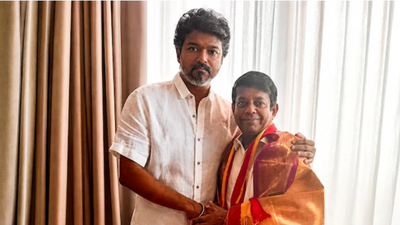
From scripted reel heroics performed with perfection to the unscripted challenges of real politics, it was baptism by fire for C. Joseph Vijay – who got a taste of realpolitik two days into office as the chief minister of Tamil Nadu. The actor-politician’s first political appointment triggered such a storm that he was forced to revoke it in a day.Vijay announced the appointment of Rickey Radhan Pandit Vettrivel, his longtime spiritual adviser and astrologer, as officer on special duty (OSD) on May 12 and revoked it on May 13.Interestingly, Rickey Radhan Pandit Vettrivel’s one-day stint would perhaps go down in the record books as the shortest stint for any officer on special duty (OSD) in Tamil Nadu chief minister’s office. Opposition parties accused Vijay of legitimising superstition using taxpayers’ money, while rationalist groups and even sections within his broader secular support base questioned how such an appointment fits into Tamil Nadu’s deeply Dravidian political culture.Ironically both – the controversy over appointment and then the abrupt removal – point to political moments not often seen in politics. While the appointment led to many questioning the political wisdom of the first-time politician, the retreat reflected his courage to bow down to public criticism – a trait rarely seen in today’s politics.
Vijay not the first
Vijay is not the first politician in Tamil Nadu to have an astrologer connection. MGR and his wife Janaki Ramachandran were big on astrology. Jayalalithaa was also into prayers, rituals, and astrology. So why did Vijay come in the firing line of not just his opponents but also allies? The answer is: Vijay did what most others avoided. “This was a first for any astrologer to come out in the open and claim he has been advising a chief ministerial aspirant and now the CM,” says political analyst R. Kannan, who has followed the state’s politics for decades.“Interestingly, Vijay’s astrologer was reportedly also the astrologer of Jayalalithaa,” he adds. “It is believed that the ‘auspicious date and time’ for MGR’s swearing-in in 1977 and 1980 were marked by Vidwan Lakshmanan, his ghost writer as well as an astrologer. Again in 1984, Cho Ramaswamy reveals that when MGR took seriously ill, his wife had approached him with MGR’s horoscope to consult the astrologers he knew and advice her if MGR would return from his medical treatment in the US healthy and will win the polls and return as CM. All three astrologers confirmed to Cho that MGR would return healthy and be reelected,” Kannan said.Late J. Jayalalithaa’s political life was deeply intertwined with astrology, rituals and temple ceremonies. During periods of political crisis — especially corruption cases and electoral uncertainty — reports frequently emerged of elaborate yajnas, special pujas and astrological consultations being conducted for her political recovery. “Jayalalithaa was also big on prayers, rituals, and astrology. But neither MGR nor Jayalalithaa discussed these things in public. Nor did their astrologers,” Kannan said.
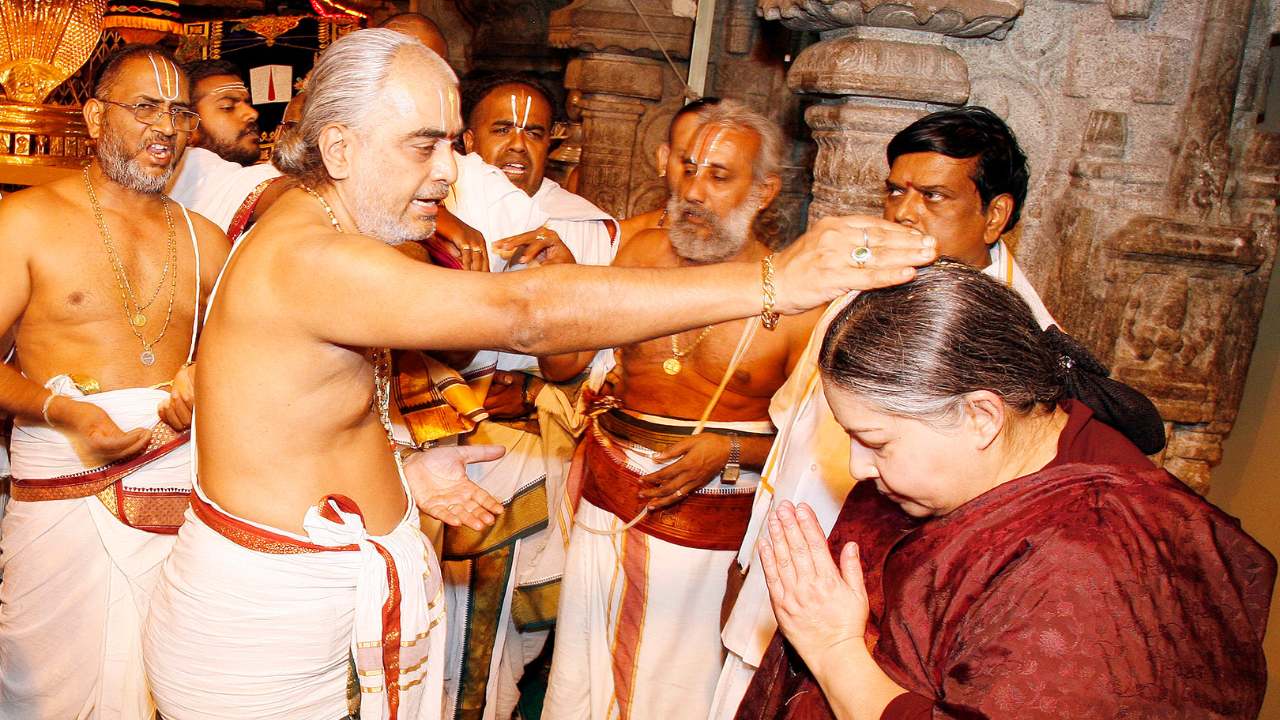
Jayalalitha taking blessings from head priest at Sr Vari Temple. (Photo by Tirumala Tirupati Devasthanams)
What does the law state?
Was Vijay legally wrong to appoint his personal astrologer as OSD? The answer is “No”.Under Article 51A of the Constitution, India is a constitutional republic committed to scientific temper, humanism with ‘spirit of common brotherhood transcending religions, linguistic and regional diversities.’Supreme Court lawyer and constitutional expert Gyanant Singh states appointment of OSD in the chief minister’s office is a fully discretionary power of the chief minister. “As far as law is concerned, every state has its own business projects and concerns based on which the chief minister selects his advisers and his personal officers. Private people can be made OSD through government appointment at the pleasure of the minister or the chief minister and can be removed at any point,” Gynanant Singh saysExplaining the role of an OSD, Singh said, “The OSD is generally appointed to the rank of joint secretary. That goes as per the state finance department and the rank is stated in the appointment letter. The appointment letter includes the line that he will hold the rank of an official. The tenure would be at the pleasure of the chief minister but under the signature of secretary.
So, why Vijay blinked
Unlike most political controversies, Vijay’s astrologer row did not end with defiance. It ended with retreat. The reversal was politically striking because not many politicians today do so – despite criticism or political attacks. Vijay got unprecedented support in the recent assembly elections. The youth of Tamil Nadu voted for him in large numbers. So, when some political opponents questioned the impact this row would have on the youngsters who looked up to him, Vijay could not afford to ignore the messaging debate. The actor-politician perhaps did not want to start his political innings on a controversial note and that perhaps explains why the actor-politician made a hasty retreat. “When it comes to Vijay’s case, it has nothing to do with power because the appointment was very much correct (not against law). Vijay backed out as he did not want public outrage. Generally, politicians do not go against public view. So, he may have reversed his decision to ensure that there is no adverse opinion about him or his appointment. Right now, people have confidence in him and whatever he does,” said Gyanant Singh. While Vijay buckled under pressure of criticism, his counterpart in West Bengal remained unfazed by attacks over his picks despite questions by the opposition. Adhikari faced criticism over appointments of a poll official, who oversaw the West Bengal assembly elections, and a working journalist into governance-linked roles. Suvendu, however, stuck to his decision. “In the West Bengal case, it is again the chief minister’s personal opinion. Law permits that as these appointments are at the discretion of the chief minister.”Suvendu, a seasoned politician, did what most others would do. And that is what perhaps makes Vijay’s reversal significant. The debate was never simply ‘can he legally appoint an astrologer?’ The larger question was: ‘Should taxpayer-funded state offices be used for appointments rooted in personal belief?’ And politically, Vijay appeared to accept that distinction when he revoked the order.
The hidden influence of astrologers in Indian politics
Behind many public speeches around development and scientific temper, politics has long maintained a parallel culture of astrology, numerology, auspicious timings and spiritual consultations that cuts across ideology, region and party lines.The phenomenon predates modern India itself.When India attained Independence in 1947, even the timing of the transfer of power reportedly became entangled in astrological considerations. Some Hindu astrologers had reportedly raised concerns about August 15 being astrologically inauspicious. The midnight ceremony was eventually seen as a compromise between constitutional procedure and astrological advice, with Rajendra Prasad participating in religious rituals linked to the transition.Since then, almost every major phase of Indian politics has carried stories of leaders quietly depending on astrologers while publicly avoiding acknowledgment.Former Prime Minister Indira Gandhi was linked to controversial spiritual figure Chandraswami, who later emerged as one of the most influential godmen in Delhi’s political circles during the 1980s and 1990s.Chandraswami’s rise reflected how spiritual advisers could operate as shadow political intermediaries. He cultivated relationships not only with Indian politicians but also businessmen, foreign leaders and bureaucrats. He dispensed spiritual advice to the Sultan of Brunei, Sheikh Isa bin Salman Al Khalifa of Bahrain, actress Elizabeth Taylor, British premier Margaret Thatcher and arms dealer Adnan Khashoggi among other famous figures. Over time, he became associated with power brokering, political networking and influence operations at the highest levels of government.Even leaders known for administrative sophistication were not immune to astrological influence. P. V. Narasimha Rao, credited with launching India’s economic liberalisation, was widely believed to have consulted astrologers regularly. Rao himself possessed deep knowledge of Hindu philosophy and Sanskrit texts, and political observers often described him as someone who blended intellectual pragmatism with spiritual belief.Former prime minister H. D. Deve Gowda has similarly long been associated with astrology and auspicious timings. Political schedules, oath ceremonies and even travel plans were often rumoured to be aligned with astrological consultations.Even in the era of hyper-modern politics and digital governance, such beliefs remain deeply embedded. The inauguration of India’s new Parliament building sparked debate not only over constitutional symbolism but also over the choice of ceremonial rituals and auspicious timing. Critics argued that state functions increasingly appeared intertwined with religious and astrological symbolism.
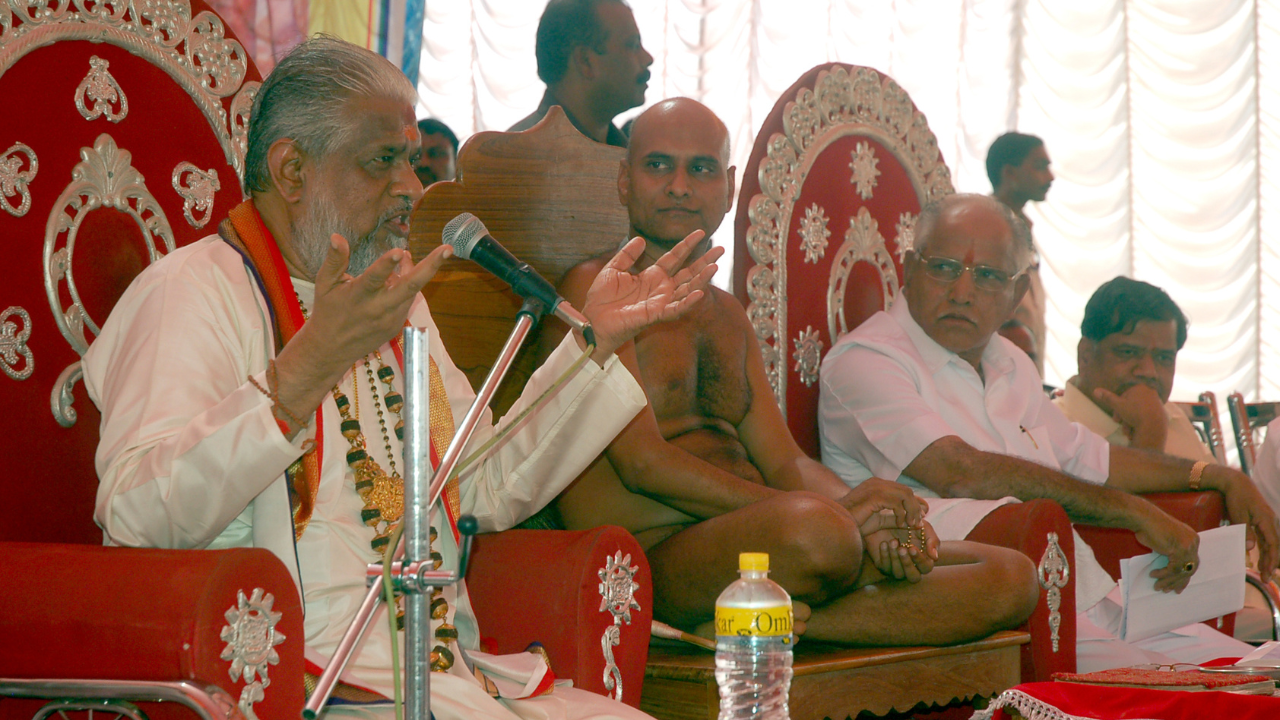
Godman Chandraswami speaks during Maha Mastakabhisheka ceremony in Hubli next to Sri Gunadharanandi Maharaj, seer of the Sri Navagraha Teertha in Varoor as then-Karnataka CM B S Yeddyurappa. (TOI photo)
From Lalu Prasad Yadav to Digvijay Singh – astrology in politics runs deep
In Bihar, Lalu Prasad Yadav and the Rashtriya Janata Dal faced criticism in 2017 after an astrologer appointment in the Chief Minister’s Office generated controversy similar to Vijay’s episode. Astrologer Shankar Charan Tripathi was appointed as the RJD national spokesperson but was later expelled when he spoke against Congress leader Rahul Gandhi.In Karnataka, B. S. Yediyurappa reportedly altered the spelling of his name to “B.S. Yeddyurappa” based on numerological advice, believing the modification would improve his political fortunes. Such numerological interventions are remarkably common in Indian politics, particularly in southern states where film and political cultures often overlap.In Maharashtra, members of the Shiv Sena family have long been associated with astrology and spiritual symbolism. Bal Thackeray was known for wearing multiple gemstone rings, which hold astrological significance. His grandson Aaditya Thackeray also attracted attention after modifying the spelling of his first name from “Aditya” to “Aaditya.”
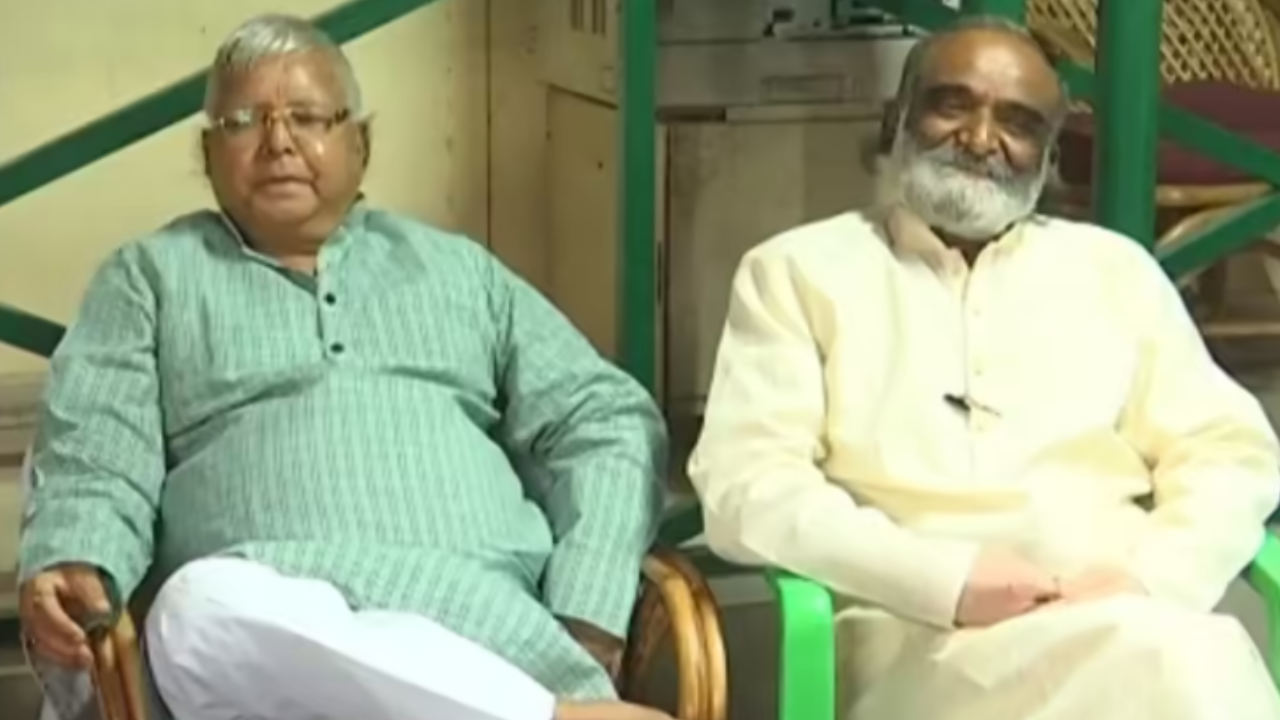
Lalu Yadav with astrologer Shankar Charan Tripathi. (File photo)
In Madhya Pradesh, Digvijaya Singh openly spoke about astrology, spirituality and religious practices. The culture extends far beyond individual leaders. In Telangana, K. Chandrashekar Rao became known for conducting elaborate religious rituals after the formation of the state in 2014. His government frequently organised massive yajnas and temple ceremonies supposedly linked to prosperity and political stability. His son K. T. Rama Rao also drew public attention when the party altered colours and symbols associated with branding decisions that critics linked to astrological considerations.For all its modernity, electoral sophistication and constitutional language, Indian politics still remains profoundly shaped by faith, symbolism and the belief that power is influenced not only by voters and institutions, but also by the stars.The bond between politicians and astrologers is not new even though it’s rarely discussed in the open. Publicly, the politicians speak the language of governance and development. Privately, many consult astrologers before elections, cabinet expansions, oath ceremonies, party launches and even crisis-management decisions.