
 Vinay Kumar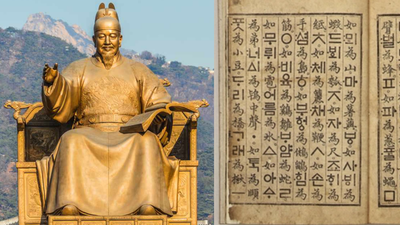
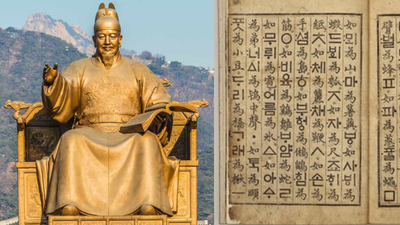
Most writing systems evolved gradually over centuries, making it impossible to identify who invented their letters. Nobody knows who created A, B or C, or the original forms of most scripts still used today. Korea’s Hangul is a remarkable exception. Created in 1443 by King Sejong the Great and officially published in 1446, it is the world’s only major writing system with a known inventor and a surviving document explaining exactly how and why each letter was designed. Even more remarkably, every basic consonant was shaped to reflect the position of the tongue, lips or throat when producing its corresponding sound.
How Korea’s Hangul alphabet was designed around the human mouth
Before Hangul, Koreans primarily wrote using Chinese characters known as Hanja. Although effective for Chinese, Hanja was difficult to adapt to the Korean language because of major differences in grammar and pronunciation. Learning thousands of characters required years of education, meaning literacy was largely restricted to aristocratic men. King Sejong wanted an easier writing system that ordinary people, including farmers, women and artisans, could learn without extensive formal education.To turn that vision into reality, King Sejong began developing an entirely new writing system instead of simply modifying Chinese characters. Working with scholars from the Hall of Worthies, the royal research institute of the Joseon court, he created an alphabet from first principles, carefully designing each letter to reflect how the human speech organs produce sounds.What makes Hangul unique is its scientific design. Rather than inventing arbitrary symbols, King Sejong designed the five basic consonants to represent the position of the speech organs while producing each sound. For example, ㄱ resembles the tongue touching the back of the mouth for a “g” or “k” sound, ㄴ reflects the tongue touching the upper gum for “n”, ㅁ resembles closed lips for “m”, ㅅ represents the teeth for “s”, and ㅇ symbolises the open throat. Additional consonants were created by adding strokes to these basic shapes to indicate related sounds.
A writing system based on science and philosophy
Hangul’s vowels follow a different but equally thoughtful design. They were inspired by traditional Korean and Confucian philosophy, using three simple symbols to represent Heaven, Earth and Human. Every vowel is formed by combining these basic elements according to consistent rules. Together, the consonants and vowels create what linguists describe as a featural writing system, where the appearance of each letter provides clues about how it should be pronounced.
The instruction manual that still survives
Unlike almost every other alphabet, Hangul came with its own design guide. In 1446, King Sejong published the Hunminjeongeum, followed by the Hunminjeongeum Haerye, a companion document explaining the principles behind every letter. The text describes why each consonant has its shape, how vowels were formed and how the writing system should be used. This surviving document gives historians a rare, first-hand account of an alphabet’s creation and makes Hangul unique among the world’s major writing systems.
It was not accepted immediately
Despite its practical advantages, Hangul initially faced strong opposition from Korea’s Confucian elite, who believed Chinese characters represented higher culture and education. For centuries, Hanja remained the preferred script for official documents and scholarship, while Hangul was mostly used by women, commoners and writers of popular literature. It was only during the late 19th and early 20th centuries, amid educational reforms and growing Korean nationalism, that Hangul gradually became the country’s primary writing system.Today, Hangul is used in virtually every aspect of daily life in both South and North Korea, from newspapers and books to government records and digital communication. Modern Korean uses 24 letters, compared with the original 28 introduced by King Sejong. The alphabet is widely praised by linguists for its logical design, simplicity and efficiency, and Korea now enjoys literacy rates exceeding 99 per cent. More than 580 years after its creation, Hangul remains one of history’s greatest examples of purposeful language design, proving that an alphabet can be both scientifically structured and accessible to everyone.