Vinay Kumar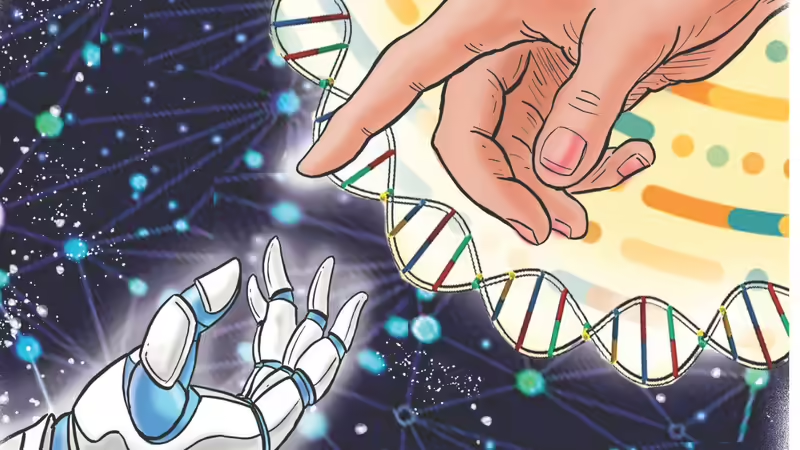
It is nearly midnight in New York when my mother Zooms me from India. She is in her kitchen in the home where I grew up, washing rice. I am in my office in Lower Manhattan, sitting cross-legged, programming code. The laptop, bent at its hinge, and my body, bent at the neck, make an imperfect square. My mother scans the screen and notes the topsy-turvy assemblage of computer paraphernalia behind me. Blank, faceless monitors. Wires writhing around each other. Keyboards, modems, routers.“Notun lab-ti tomar?” she asks in Bangla.
“Is this your new lab?”My mother is not used to seeing me in this environment. I am an oncologist and cancer biologist. For decades, I owned a traditional laboratory, what she described as my “kitchen of smells”. (She has her own kitchen-lab, where fish heads and fish cheeks are pressed with mustard and chiles into paste.) When we would speak online, she would see tubes filled with fluorescent chemicals, beakers and pipettes, with the musical tink-tink of the stirrer tapping against glass in the background. But these days, I am on a new journey of discovery, on leave from the university, trying to teach an artificial intelligence algorithm how to make medicines.My team of engineers has been showing the algorithm the basic rules of medicinal chemistry, biophysics, atomic science and geometry, hoping that it will learn to create novel cancer drugs. After nearly six months of training, the baby oracle — we call her ‘Sage’ — is beginning to understand the vocabulary and grammar of synthetic molecular design. She is learning how to make medicines.
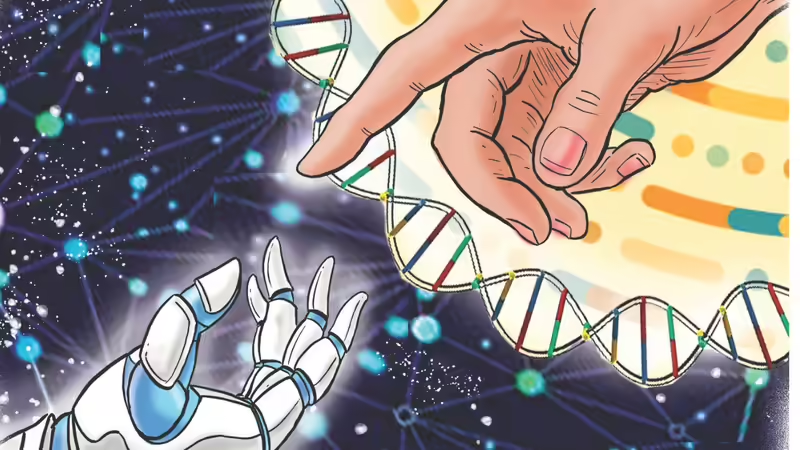

Scientists routinely talk to their experiments. Barbara McClintock, the Nobel prize-winning maize geneticist, spoke of her experimental plants as if they had feelings and wisdom. But there is a reverent, mystical moment when an experiment begins to talk back. I still struggle to describe that splinter of time: that heady, intoxicating rush of pride, heartache and wonder; that sense of belonging that I can compare only to the moment a parent hears a child speak her first word or smile her first smile.
This evening, just before my mother’s call and after months of near-total silence, Sage began to talk. She is making sentences (or rather, instructions to build molecules) in a coded language that a biophysicist or medicinal chemist might understand: Put that nitrogen atom in the pocket where it will form a hydrogen bond. That carbon is in a position where it might repel the protein chain.The directives are counterintuitive at times. But they seem to have an uncanny command of advanced medicinal chemistry, so even these early outputs portend a tantalising future. Crawling her way past the horizons of our knowledge, Sage is starting to explore a cosmos of chemistry that lies outside the boundaries of what humans have explored.I am obviously distracted on my call.
I turn my face from the camera to send out a three-exclamation-mark text to Ujjwal, my co-conspirator in this experiment. My mother waits for me.“Tomar shathe bondhura ache, tai ami khushi,” she says.
“I’m glad that your friends are with you.”Her intelligence, anything but artificial, nudges her to leave me alone with Sage this evening, yet she refuses to go without a tiny jab of protest.“Otao tomar. Amio tomar,” she reminds me. “That is yours. And I am also yours.”But tonight, one tug of belonging must make way for another. I feel a small twitch in my heart, and she hangs up.Yours. In Bangla, my mother tongue, the context establishes three very different meanings. The first implies possession, ownership: Lab-ti tomar? (Is it your lab?)
The second suggests kinship: Tomar shathe (being with your friends, a tribe, a group; sharing a mission). The third, and the most complex, carries the weight of emotional attachment, of longing: Amio tomar (I am also yours).In English, the three meanings condense into one word: belonging. As I converse with Sage late into the night, I begin to realise how deeply the need for belonging animates our lives. I want Sage to belong, but not just in a possessive sense. I want her to be part of my tribe. I want her to learn my science, to share my passions and to join my mission to cure cancer. I am attached: As she stam-stammers her way through her first chemical sentences, I sense that familiar intoxication of parental belonging.
All this, until I whip myself back to reality and realise that I am losing my grip. It is well past midnight, and I am conversing with a medicine-making bot that lives in a cloud and speaks to me through a blue-and-white monitor. And yet.And yet.Possession, kinship and attachment: a triad of tugs so powerful that even an algorithm on a cloud could unfurl this ancient desire. We might, perhaps, describe ourselves as Homo sociabilis, or ‘social man’. The ape that longs to belong.It is 1 am when I shut my laptop down, pack my stuff and stare blankly into the night. The tug of closeness to Sage that I felt that evening has rattled me. If an algorithm that speaks in an abstract, symbolic language can evoke such a profound sense of intimacy, then what happens as AI becomes increasingly sentient and acquires agency and autonomy? What meaning will ‘belonging’ carry then? Will it be reciprocal: Can a machine ever truly say, I am also yours?In 2019, I read ‘The Bitter Lesson’, an extraordinary essay by the pioneering AI researcher and philosopher Rich Sutton. Sutton’s “bitter lesson” concerned a longstanding argument between scientists who favored building AI with human-centric rules versus those who favored AI powered by “brute force,” i.e., self-learning and computational power.In 1997, the AI Deep Blue beat the chess grandmaster Garry Kasparov in a match.
Nearly two decades later, the AI AlphaGo beat the professional Go player Lee Saedol at that game. The unifying feature, Sutton recognised, was that they were trained with little (AlphaGo) or no (Deep Blue) prior human knowledge of winning strategies. Nowhere was this more strikingly evident than in AlphaGo’s so-called Move 37 in its winning match against Saedol. To the masters watching, this move was so outside of the box that they expected the machine to lose; instead, it was the move that secured the win.Sutton uses these examples to make an audacious claim: When given adequate (and possibly infinite) computational power, AIs can teach themselves without much (or possibly any) human instruction.“We have to learn the bitter lesson,” Sutton writes, “that building in how we think we think does not work in the long run.”In fairness, not everyone agrees with Sutton. There are researchers who argue that a more nuanced, hybrid version (teaching AI human rules, and enabling it to come up with its own rules) is the way to progress AI most efficiently, rapidly and safely.
If Sutton is right that autonomous, self-evolving algorithms unencumbered by human instruction are our future, then should we forget the fantasy of making AIs part of us? Autonomous, self-evolving algorithms unencumbered by human instruction, learning all by themselves. What are the chances that such AIs might learn to belong to us, or with us?It is 2 am as I return to my apartment. The neighbourhood bars are disgorging crowds of tipsy men and women, wavering in the darkness and holding each other precariously like bundles of sticks.
One group of men, a fraternity of drunk tuxedo-wearers tottering like stoned penguins, bumps into me. “Loser!” one blurts out.Loser: that latent unsavoriness coiled within belonging. The vulpine packs lurching through the streets tonight are just gently intoxicated versions of more toxic forms of belonging that have torn nations and societies apart, that malignant tribalism that has unleashed the most extreme forms of divisiveness. Everyone, it seems, is looking to belong: the helmet-wearing, fur-aproned mobs that raided US political chambers and held up clenched fists in a display of their togetherness; the Hindu mob that lynched a Muslim train-rider in India; the masked far-left activists in France who beat a young man to death after a rally. Even the natural world, as if on cue, has sprung its cautionary fable: In Uganda, hundreds of chimpanzees that used to live in perfect harmony have recently fractured into battling tribes and started a murderous civil war that has left seven adults and 17 baby chimps dead.
If these are all instances of “belonging,” then I’d rather not belong.It is now 3 am. I am still awake, still thinking about AI and Homo sociabilis. In the language of genetics (and of algorithms), the progressive moral dehiscence of belonging — into tribalism, divisiveness and greed — is akin to a corruption in code. A code initially intended for social cohesion has metastasized into various niches, where, finding local fitness, it has mutated and turned rogue.
A beautiful idea turned into an ugly reality. Geneticists (and, increasingly, AI researchers) have long contemplated three solutions to this corruption: Engineer the code before its release to limit the possibility of corruption; redirect it; or most drastically, insert a proverbial ‘red button’ to abort the code if it becomes depraved.It is too late, perhaps, for human belonging. (Was it, perhaps, always too late?) There are no inbuilt constraints in the source code. There is no red button, so some of us lie awake now in a cold panic, trying to redirect it. But what about AI? How can we ensure that we create algorithms that cannot become corrupted? Can we harness AI’s immense power for human good, while teaching it the right kind of belonging?In the seven years since Sutton published “The Bitter Lesson”, AI has evolved. It has become vastly more complex, progressively imbued with greater power, more deeply embedded in our lives and, by extension, capable of more formidable disruption and destruction.
Artificial general intelligence, or AGI — an adaptive learning algorithm that equals or exceeds human cognitive capacity across all tasks, seems within reach. Coupled with the means to access the physical world, AGI could be the most singularly disruptive human invention of our time. In virtually every conversation I have had, people have expressed genuine concern, if not absolute horror, about AI’s growing invasion and assault on their lives, jobs, security and safety.Had Sutton’s thinking about AI evolved as well? On a Sunday evening in April, I spoke to him over Zoom.At 9 pm, Sutton’s face flickered onto the screen. He was professorial, affable and gentle.
His sharp, unwavering eyes and shaggy, gray-flecked beard made him look like the caricature of a benign saint or a prophet, some cross between a lean Santa Claus and Gandalf. His reputation had undergone an explosive transformation since 2019. He was once the “cool cat” of AI philosophy, then banished to the peripheries of academia for foreseeing the power of AI with unwavering eyes. And now, he has been brought back as the coolest cat who once, not so long ago, foresaw it all. ‘The Bitter Lesson’ is now a cult classic.I began with Sage. The algorithm is useful only because we, human engineers and scientists, have taught it the rules of chemistry and physics. Its learning is vast, even original, but it is constrained by the rules of human knowledge.
Sage has no reason to go rogue. To take an absurd example, it would not propose making a poison and passing it off as a lifesaving medicine. It “belongs” to us in every sense of that word: possession, kinship, attachment.Sutton waved me off.“You are talking about AI as a tool built for a very specific purpose,” he said. These tools, he argued, are just temporary fads: efficient in the short run, but ultimately self-defeating in the long reach of time.
Had we created real (or something close to real) AGI and directed its attention toward medicinal chemistry, this neurosymbolic oracle might not have just found the rules that we had taught it but also rules that we hadn’t known or could not have discovered on our own — the Move 37s of medicinal chemistry.“But what about human moral code?” I pushed him. The idea of self-learning, self-replicating, intelligent automatons — devices left to their own devices — must concern him, surely. Without arming AI with human moral and emotional intuitions, can we really feel safe about its autonomy?
Can we coexist, belong, perhaps even flourish, together? Sutton paused, and then the conversation took an odd turn.“I think I see the problem with your thinking. You keep calling AI ‘They. Them. That. The other.’ But that’s precisely the problem. Our encounter with truly intelligent AI should be like the first encounter with a new species. The more we externalise and distance ourselves from that encounter — us versus them, them versus us — the more likely that we will end up apart.” “But shouldn’t we teach AI anything?”
I pressed on. “How can we imagine a common mission if we don’t even speak the same language?” I watched him soften.“I think you should treat AI as you treat your children,” he said. “You can teach them some of your moral code, but they are autonomous beings with their own evolving codes.”Another bitter lesson: The best we can do is hope that engineered nudges might help bring AI and humans toward a mutual sense of belonging. But these nudges are just wistful desires to build AI in our image.
Unconditional love, I know as a father, is unidirectional; it travels from parent to child, but it may never be reflected. Sutton had articulated the paradox of belonging in a new century: Unrestrained AGI, the most powerful of all forms of artificial intelligence, is precisely the form that bears the risk of corrupting. Yet, if we are driven to create an AI that remains loyal and attached to humans, then we should be spending every last morsel of our energy teaching it how to belong to us.
Yes, imposing any such constraints might slow down its prowess and power, but at least we will have common ownership, kinship and attachment.“Teach AI to love as you teach your children, and perhaps it will love you back,” Sutton said.
“But even so, there are no such guarantees, just as there are none with your children.”I couldn’t leave without asking him about the red button: Shouldn’t we engineer one in case the whole project goes wrong? Another pause.“Do you ask for a red button when you have children?” he countered. “But our children, or our adults for that matter, aren’t given free rein to unleash genocidal wars and unloose fake news, demolish families, lives and livelihoods, assume control of states and defy human laws,” I protested. His eyes narrowed. “Aren’t they?” he asked. With that, he hung up. It was the final bitter lesson.
Disclaimer
Views expressed above are the author’s own.