 Vinay Kumar


Major Akhill Pratap
Major Akhill Pratap has been working as the Social Media Consultant of Ministry Of Defence (Govt of India), Jury Member of Ministry of Culture (Govt Of India), Award Winning F LESS
… MORE
“What’s in a name? That which we call a rose
By any other name would smell as sweet.”
— Romeo and Juliet (William Shakespeare)
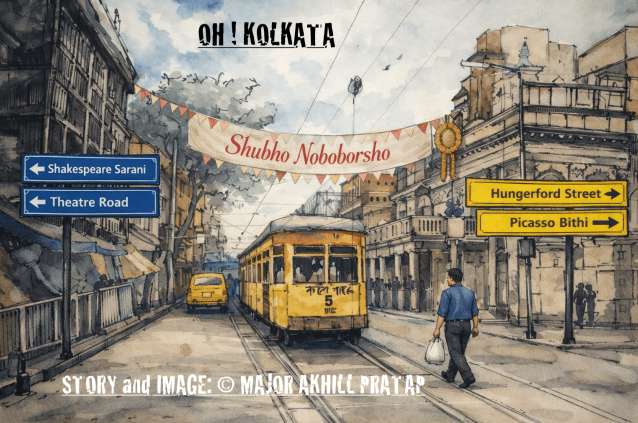
Ghonta quoted Shakespeare as we stood at Shakespeare Sarani looking for Theatre Road. Ghanashyam Talukdar aka Ghonta and I were lost in our own city. A city which holds the record of highest number of name changes in the history of India. A city which refuses to let go of its past but embrace changes rapidly. Mirza Ghalib was probably right when he famously said in the 1800s that West Bengal is both a 100 years ahead of India and also a 100 years behind. Welcome to The City Of Firsts on Poila Boishakh (Bengali New Year).
One of the many days when India marks its New Year, Poila Boishakh is an auspicious day for West Bengal. Growing up in the iconic Rawdon Street of Calcutta, Ghonta returned home on this day to Sarojini Naidu Sarani of Kolkata. I was better off. I left my home at Wood Street of the same Calcutta and returned to Dr Martin Luther King Sarani of the now Kolkata. All these name changed within five years.Who says Bengal is laid back?

The extensive name changes in and of the Capital Of West Bengal reminds me of my Service Selection Board (SSB) interview. It was more than two decades back when I had cleared the coveted Union Public Service Commission (UPSC) written exams and was one step short of becoming an Indian Army Officer. The last question the board asked was, ‘Coming from Calcutta, what’s your view on the decision of the Govt Of Bengal to rename Calcutta to Kolkata?’ I was a tad taken aback by a political question thrown upon a candidate of an apolitical profession. I maintained my poker face and responded, ‘Sir, without commenting on the politics of name change, it doesn’t matter in my view. Factually stating, it’s an unnecessary burden on the exchequer. It would cost crores of rupees to implement this name change and it won’t value add to the state or sons of its soil. In deed, it would further bring down Calcutta in the Central Govt’s order of precedence from ‘C’ to ‘K’. West Bengal is already at the bottom of the Indian list. Alphabets and names matter in India much more than we can think of. It creates our identity which, in turn, decides our lives. Rather than pouring the same crores to fix the grave unemployment scenario of Bengal, this seems like fixing when it’s not broken. Psychology has it that simple names are remembered more than complex ones.
In any case, it has always been Kolkata to Bengalis. From Roshogollla to Bomkesh, there’s hardly any legend without an ‘O’ in Bengal.’ Done with my stupid sense of humour and talkative character, I was sure of being rejected by the serious men of Indian Armed Forces. Thankfully, they did not do so. Humour also has an ‘O’. My application left from Calcutta and my posting orders arrived at Kolkata. The other changes in between were to my social status and my state losing out crores of public fund.
Coming back to the Capital Of Bengal. Do you know why it is called The City Of Joy? Irrespective of being Calcutta or Kolkata, it is still the Cultural Capital Of India, The Food Capital Of India, The City Of Storytellers, The City Of Festivals, The City Of Liberty-Equality-Fraternity, The City Of Work-Life Balance, The City Of Bandhs and of course, The City Of Romance. Pick up any of these words and you will find The City Of Joy, unchallenged across India. The ‘O’ invariably in place. Here’s how.
Camac Street may have been rechristened as Abanindranath Thakur Sarani but you would find that Advocate AN Thakur has a hobby of singing Robindro Shongeet. Your mouth may begin watering at Waterloo Street, sniffing the variety of food trail via Lindsay Street to Russel Street via Kyd Street but your hunger for Chelo Kebab would only be fulfilled by Mother Teresa at her Sarani. You won’t find these places in the Kolkata of new millennium. Waterloo street is now Nabab Sirajuddaula Sarani, Lindsay Street is Nellie Sengupto Sarani, Kyd Street is Dr Md Isak Road, Russel Street is Anandilal Poddar Sarani and the iconic Park Street is Mother Teresa Sarani. Shazam! Alright, now. Wanna listen to storytellers? Visit Lenin Sarani – not Dhormotola. Dhormotola has made way for Lenin and a true-blue Calcuttan would know who are the storytellers of Dhormotola. Ahem, moving on! As far as festivals are concerned, there’s a famous saying in Bangla – Baro Mashe Tero Parbon (13 festivals in 12 months). I strongly protest (à la Bengali). I had once counted 26 in my childhood. From the UNESCO recognized Durga Pujo to the Boro Din (Christmas) celebrations, Kolkata makes merry in every single Indian festival. This festive spirit of Kolkata is one of the biggest contributors to its Liberty-Equality-Fraternity or let’s say vice-versa. However, The City Of Work-Life Balance and The City Of Bandhs are not exactly co-related. Work-Life Balance stems from the signature character of Bengal. Bandhs are political. The Adda loving Kolkata would prefer a Sunday like a Sunday rather than a Monday like the maximum city Mumbai. The morning must begin with shopping with your kids at the local paara (neighbourhood) followed by Adda, the afternoons must have a fish-rice plate on the table followed by a siesta, the evenings begin with football ending with Adda again and the nights ruing the following work-day. A sprinkle of quarrels is part of the day. Quarrels take me to romance. On one of my many romantic dates, a taxi driver instantly dropped me at Victoria Memorial (not sure why has the queen not been renamed). The moment I asked him to take us to Shahid Bhagat Singh Udyan, he first lost his temper and then lost his way to find the address. He was probably angry because I intended to romance at a holy place. Had the taxi wallah known that it was the new name of Minto Park, he would have instantly obliged me. Lord Minto wouldn’t care a damn about Indians, anyways. I dropped the idea of taxi after my romantic date expired. On my way back to drop my then girlfriend, we boarded the metro rail from Tollygunge to Bansdroni. The romantic couple boarded with Mahanayak Uttom Kumar and off boarded to find the great freedom fighter, Master da Surjo Sen. Those were the new names of the stations. Out of guilt or patriotism, I dropped my girlfriend altogether. Rather than being my Bou (bride), she is currently a motherly matron of Bepin Behari Ganguly Street (erstwhile Boubazar Street).
I am, however, proud to put it on record that one unique characteristic of my good old Kolkata hadn’t changed irrespective of the record name changes of Calcutta. The human touch of its common people. That includes their fondness for conversation, the easy going lifestyle, their helpful nature, respect for women, compassion towards children, care for the elderly and the deep cultural legacy. All of these traits of Kolkata come together to make it The City Of Joy. Kolkata is like its Biryani. It pulls you in with its aroma.
By the time you find the number of ‘O’ in this story, Ghonta found Theatre Road while standing at Shakespeare Sarani. Shakespeare Sarani was Theatre Road. Shakespeare and Theatre, Calcutta and Kolkata – same difference. Oh! Kolkata.
“So Romeo would, were he not Romeo call’d,
Retain that dear perfection which he owes.”
Shubho Noboborsho (Happy New Year)!
Disclaimer
Views expressed above are the author’s own.
END OF ARTICLE