Vinay Kumar
Life, as understood in the profound traditions of Hindu philosophy, is neither a random unfolding of events nor a purposeless drift through time.
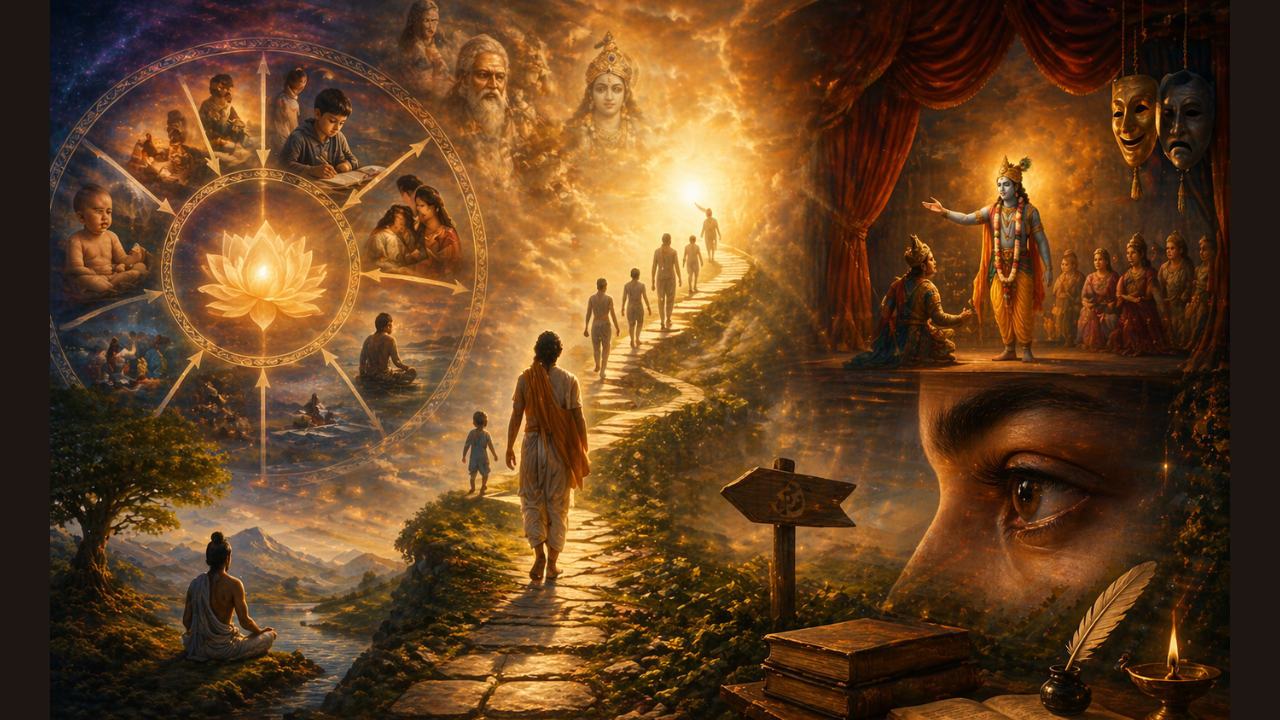
It is a vast and meticulously structured school in which every experience—whether joyful or painful—serves as a lesson in the gradual evolution of the soul. The ancient seers recognised existence as inherently educative.

Nothing that happens is without meaning. Every joy refines sensitivity, every sorrow deepens understanding, every challenge tests inner strength, and every relationship reveals hidden dimensions of our being.
In this grand design, the universe becomes the classroom, time the silent teacher, and the soul the eternal student journeying from ignorance to wisdom.
Within this cosmic school, individuals stand at different levels of learning. Some absorb life’s lessons with awareness and humility, transforming experience into insight and compassion. Others resist or misunderstand these lessons, driven by ignorance, ego, or attachment, and thus find themselves repeating the same patterns of suffering.
Hindu thought often compares this to a student who must repeat a class until the subject is mastered. In the same way, the soul returns again and again to the cycle of birth and death—saṃsāra—until it assimilates the lessons of existence.
Reincarnation, therefore, is not a punishment but a continuation of unfinished learning. It is an expression of divine compassion, granting the soul repeated opportunities to grow, evolve, and ultimately realize its true nature.
The Bhagavad Gītā offers a deeply reassuring insight: no effort on the path of growth is ever lost. Even the smallest step forward carries into future lives.
The soul progresses gradually, life after life, moving through different levels of physical, mental, emotional, and spiritual development, until it attains the ultimate “graduation”—mokṣa, liberation from all limitations and the realization of unity with the Supreme.
At the root of this repeated return lies the subtle but powerful force of desire. Desires are not merely fleeting wishes; they are formative energies that shape the trajectory of the soul’s journey. Each desire leaves behind an impression—a saṃskāra—that seeks fulfillment.
When desires remain unresolved at the end of a lifetime, they generate a momentum that draws the soul back into embodiment. Thus, reincarnation is not imposed from outside but arises from the inner continuity of one’s own tendencies and longings.
As long as desires persist, the cycle continues; when they are understood and transcended, its hold begins to loosen.
At the same time, the soul’s journey unfolds within what Hindu philosophy beautifully describes as a divine play—līlā. The world is a stage, and each individual is an actor entrusted with a unique role.
Some roles appear prominent, others modest, yet each is essential to the harmony of the whole. The significance of a role lies not in its outward grandeur but in the sincerity and awareness with which it is performed.
This insight is reflected in the teaching of svadharma in the Bhagavad Gītā. One is encouraged to perform one’s own duty, however humble, rather than imitate another’s, however attractive it may seem. A drama cannot function if every actor insists on playing the hero; diversity of roles is essential for coherence and meaning.
Likewise, life becomes harmonious when individuals accept and perform their unique roles with dedication, free from comparison and envy. Even a small role, performed with excellence, can elevate the whole.
To live with this understanding is to transform life into conscious participation in the divine drama. One acts wholeheartedly, yet remains inwardly unattached to outcomes.
Success and failure, praise and criticism, gain and loss are recognised as parts of the script rather than measures of true worth. The wise perform their duties with sincerity and cheerfulness, without wishing to exchange roles, knowing that each path is uniquely suited to the soul’s growth.
At a deeper level, individuality is not accidental. It is shaped by a complex interplay of heredity, environment, culture, and—most significantly—the accumulated impressions of past lives. Hindu philosophy offers an integrated view of human personality, acknowledging both visible and invisible influences. The conditions into which one is born are not arbitrary; they are the natural outcomes of past actions, providing the most appropriate setting for further growth.
The observation that “the story of one’s life is written in the eyes” reflects this deeper continuity. Beneath the surface personality lies a vast, unspoken history—a record of experiences carried across lifetimes.
Yet, this history is not fully accessible to conscious memory. Such total recall would overwhelm the mind. Imagine carrying the complete memory of countless lives—the joys, losses, relationships, and regrets. The mind would be burdened beyond endurance.
Nature, in its wisdom, veils this vast storehouse of memory. This is not a limitation but a compassionate necessity, allowing us to function effectively in the present.
While explicit memories fade, their essence remains in the form of saṃskāras, subtly shaping thoughts, preferences, habits, and emotions. What we call character is largely the expression of these accumulated impressions.
Thus, our inclinations—our talents, fears, attractions, and aversions—are not random. They are the unfolding of a long evolutionary journey.
A person who exhibits innate kindness or wisdom may have cultivated these qualities over many lives; another who struggles with anger or attachment may be working through deeply rooted patterns. Life, in this sense, becomes a continuous process of self-unfoldment, where each moment offers an opportunity for refinement and growth.
Yet, despite this continuity, free will ensures that the future is not rigidly determined by the past. While past actions shape present circumstances, our response remains within our control.
At every moment, we can either reinforce old patterns or transcend them. This dynamic interplay between past conditioning and present choice lies at the heart of human evolution. It affirms both the justice of the cosmic order and the possibility of transformation.
Ultimately, the aim of this long journey is not merely to accumulate experiences, but to transcend them—to realise one’s true nature as the Self, beyond all limitations.
When this realisation dawns, the need for further cycles of birth and death comes to an end. The soul, having fulfilled its learning and exhausted its desires, attains mokṣa—a state of freedom, peace, and unity with the Divine.
Until that realisation is attained, life continues as both a school and a stage. Every experience becomes a lesson; every role an opportunity for expression and growth. With this understanding, life is no longer a burden but a meaningful journey.
Complaints give way to curiosity, envy to self-fulfilment, and resistance to acceptance. One begins to see that nothing is trivial—every moment contributes to a greater unfolding.
In this integrated vision, the metaphors of the classroom and the stage merge into a single profound truth: we are both students learning through experience and actors participating in a divine play. When approached with awareness, sincerity, and detachment, life itself becomes a path to liberation.
The journey, then, is from unconscious participation to conscious realisation—from being lost in the role, to recognising the actor, and finally to realising the One who is both the actor and the witness of the entire play.
In that realisation, all distinctions dissolve, all lessons are fulfilled, and the soul abides in its original nature—pure, infinite, and blissful.
Disclaimer
Views expressed above are the author’s own.
END OF ARTICLE