
 Vinay Kumar

Saleya (name changed), a victim of domestic violence and sexual abuse, was forced into the sex trade by a woman from her own village. She had just returned to her parental home (MENTION CITY OR STATE) after escaping an abusive marriage, and was looking for work. The woman deceived her with the promise of domestic work in Mumbai and sold her at the Falkland Road Red-Light Area for Rs. 1,00,000.While working at the red-light area, she gave birth to a girl. Later, she met a man in Akluj and built a family with him. However, her happiness did not last long. She had to leave as her partner was an alcoholic and unfaithful. She kept moving between Tuljapur, Akluj, and Mumbai, working hard to care for her children independently. She sought institutional help and kept on juggling between several rehabilitation centres while she trained to be a beautician. In 2025, when she discovered that she was pregnant again, she shifted to a Mumbai shelter for survivors of human trafficking.“I do not wish to go back to my family. They do not even know about my present situation. I have learned a skill here and wish to earn money while taking care of children on my own,” Saleya said.Udaan House is Saleya’s new address, which she now shares with 5 other women whose lives followed a similar storyline before they were rescued and rehabilitated. Varsha Kamble, working as a project manager at the shelter, said that most of the survivors she rescued were either living in poverty, looking for a stable source of livelihood or were emotionally manipulated by their lovers. Traffickers lured them with false promises of education, financial stability, love and a better life, and when they started trusting them, they were pushed into the sex trade.
What data reveals
‘Crime in India Report’, released in May by the National Crime Bureau, registered a modest decline of 3.3% in human trafficking cases from 6,043 in 2023 to 5,839 in 2024.However, what lies under this muted achievement is a dark reality revealing the grave situation of women’s safety in India. The report documented that a staggering 40% of human trafficking cases were committed for the purpose of prostitution. And when mapped against the data over five years, it is revealed that the number of cases surged significantly from 2022 to 2024.Maharashtra accounted for the highest number of cases at 829, followed by Telangana (770), Andhra Pradesh (279), and Bihar (97). This is not the first time these states sit at the centre of this crisis, together accounting for a majority of the cases nationally. Maharashtra has led the country in human trafficking cases committed for the purpose of prostitution since 2017.
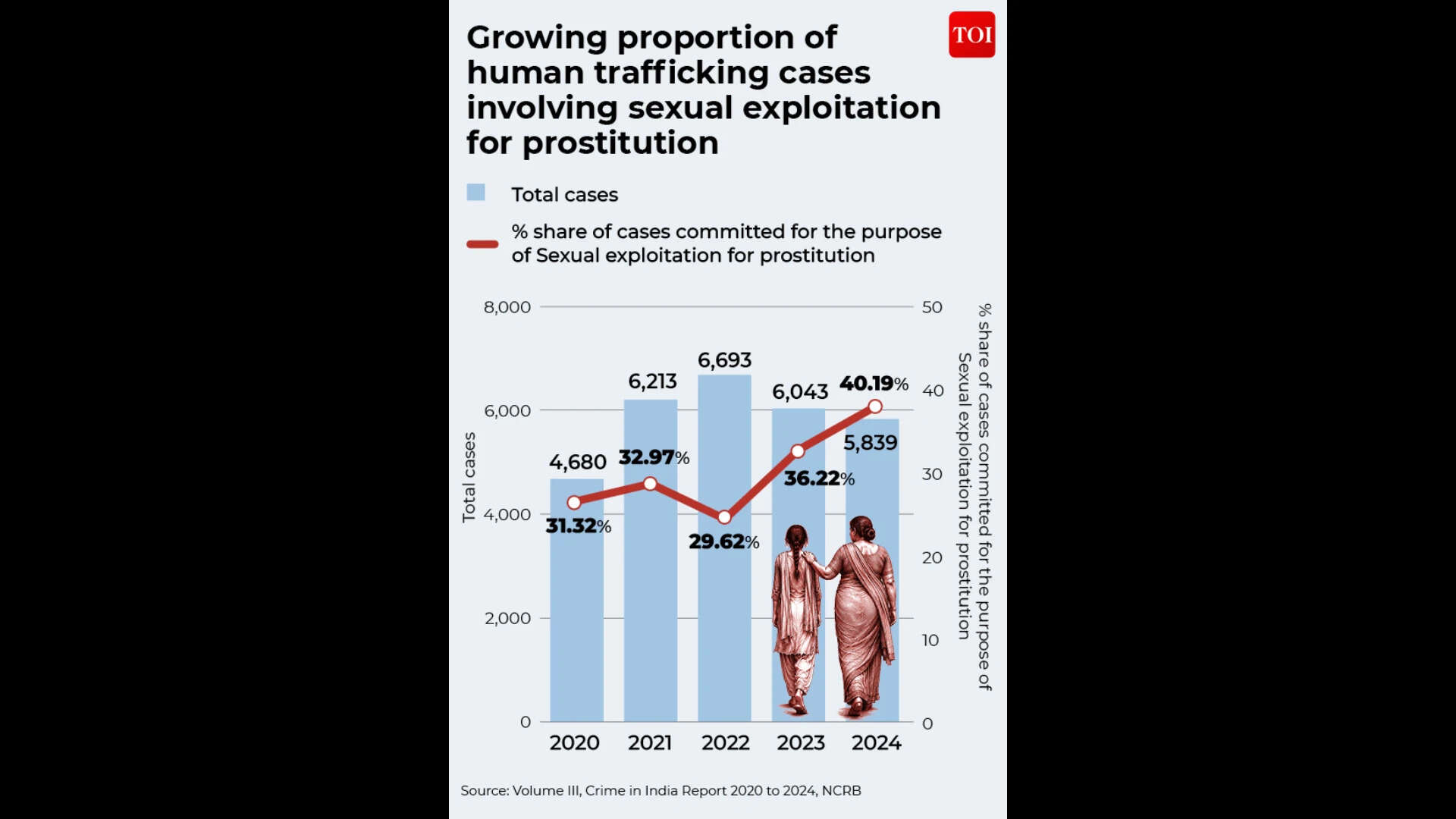
Growing proportion of human trafficking cases involving sexual exploitation for prostitution.
Bottlenecks in the anti-trafficking framework
Taking note of the gaps in the existing protection and support efforts for the survivors of sex trafficking and commercial sexual exploitation, the Supreme Court delivered a landmark judgment on March 30 and constituted a nationwide “Victim Protection Plan”. The proceedings had begun with a PIL filed by anti-trafficking NGO Prajwala in 2004. Invoking its powers under Articles 32 and 142 of the Constitution, a bench of Justice J.B. Pardiwala and Justice R. Mahadevan issued a detailed set of binding directions constituting a nationwide “Victim Protection Plan” covering rescue operations, identification, rehabilitation and prosecution.“The lack of a Victim Protection Plan is a serious lacuna that carries the risk of derailing any and all rescue efforts, as there is no clear, guiding, and binding framework for how victims are to be handled, both during and after rescue,” the judgment stated as reported by Bar and Bench.The Plan also sets out detailed operational standards for Anti human-trafficking units (AHTUs) and rescue teams. Units must be led by a DSP-rank officer and have at least two women police officers, with a cybercrime officer included wherever feasible. States are required to notify AHTUs as police stations for their entire district, granting them the jurisdiction to register and investigate trafficking cases. Each unit must maintain a database which has to be updated every month and covers traffickers, victims, and vulnerable communities, with the information moving up to the State Anti-Trafficking Bureau and from there to the NCRB.However, there exists a major schism between the establishment, maintenance and operation of AHT units ordered by the authority and their implementation on the ground.In 2019, a scheme to set up AHTs across all districts was launched by the ministry of home affairs and funded under the Nirbhaya Fund. The intent was to provide every district in the country with a dedicated unit equipped to detect, investigate, and respond to human trafficking cases. While states like Uttar Pradesh, Uttarakhand, and West Bengal have succeeded in achieving this goal, the implementation has been uneven. Several states continue to have a number of functional AHT units that fall significantly short of their total district count which means that a substantial share of districts across these states are operating without a unit that is specifically mandated to handle trafficking cases.
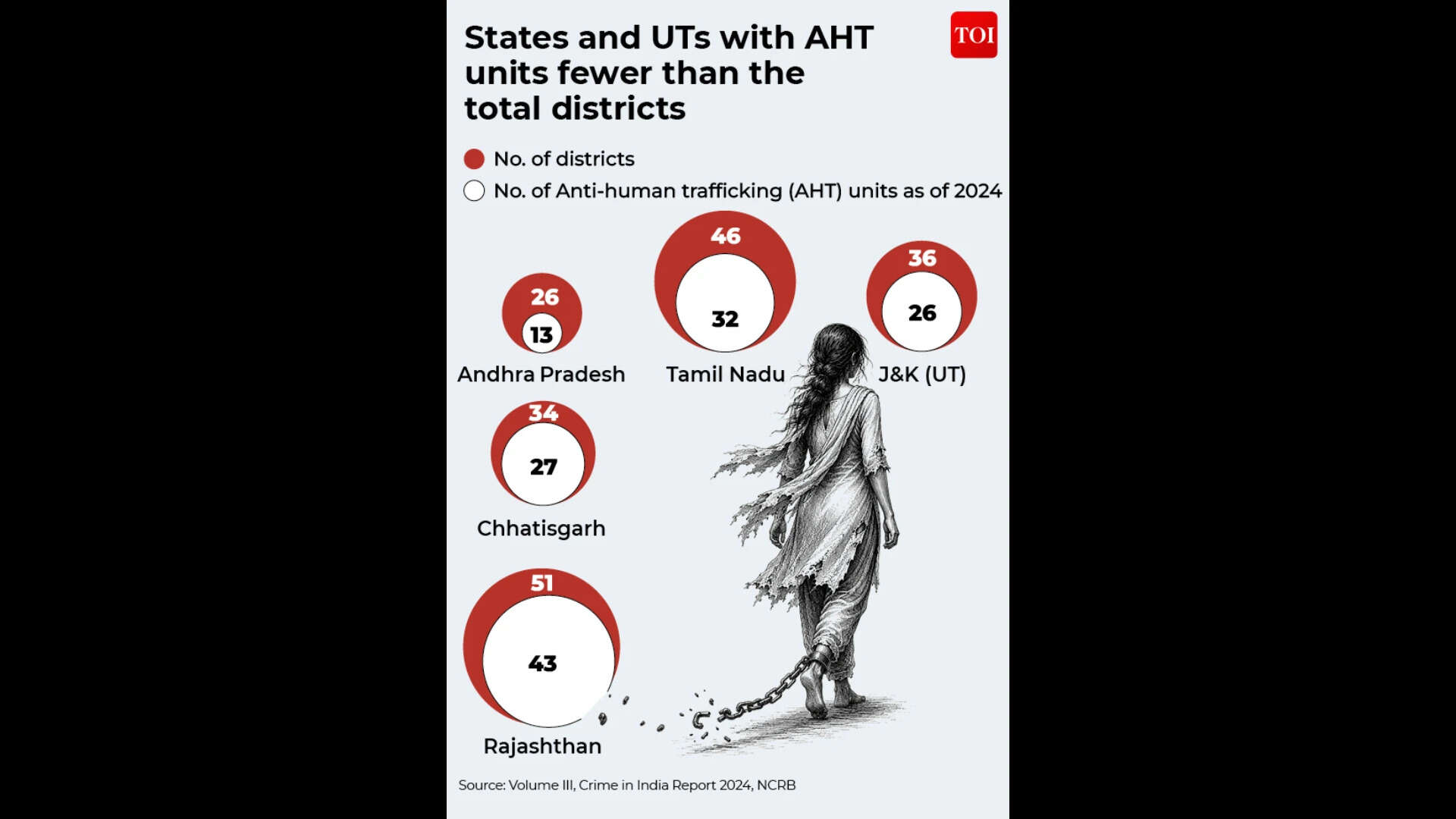
States and UTs with AHT units fewer than the total districts.
Data shows children at centre of the crisis
In 2023, Kamble rescued a minor girl in Navi Mumbai’s Kalamboli area. The girl was just 14 when she was forced into sex trade by her own mama and mami (maternal uncle and aunt). Her father had died and her mother used to beg to sustain the family. Her uncle and aunt brought her to Mumbai from Uttar Pradesh’s Kishanganj with the false promise of education and job. “She used to tell them that it hurts and she can’t do it. They would tell her that this is what everyone does in Mumbai to earn money,” Kamble said.She mentioned that deception by their own family members robs them of their ability to trust anyone. “When we raid the brothel, women think we have come to arrest them. Even during their rehabilitation, they lie about their past, and only gradually do they trust us and reveal the truth,” she added.As per the report, under the Immoral Traffic (Prevention) Act 1956, a total of 2,301 female victims were reported. Among all the states, Andhra Pradesh, Karnataka, Maharashtra, Tamil Nadu, and Bihar recorded the highest numbers, placing them at the top of the list. Andhra Pradesh and Karnataka were notably prominent within this group.Of particular concern is the age profile of the victims in three of these top five states, including Tamil Nadu, Karnataka, and Andhra Pradesh, where over forty per cent of the victims were under the age of 18, as recorded under Section 5 of the Act.
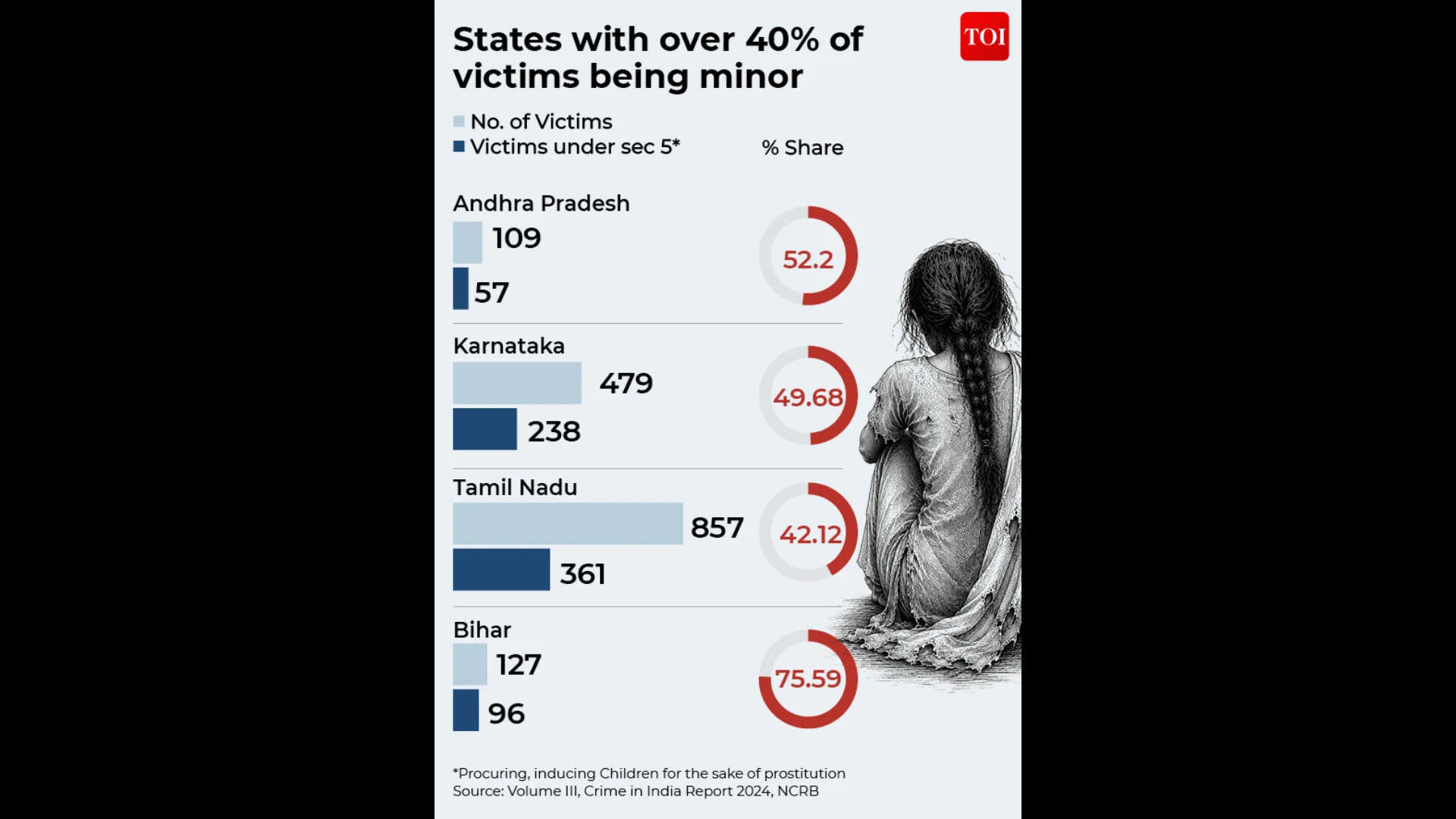
States with over 40% of victims being minor.
Role of police and judiciary in human trafficking cases
Kamble, whose NGO has held many anti-trafficking raids jointly with the police, noted there had been instances where their rescue operations failed because the police leaked the information.“We no longer tell the police the exact location where the crime is being committed. We ask them to come to a nearby spot and take care of the rest on our own,” Kamble said.Apart from the potholes in police proceedings, an analysis of the five years of NCRB’s data reveals that the journey has not been smooth even with the judicial system. The data points to two critical concerns:First, the conviction rate in cases registered under the Act has witnessed a significant decline from 2022-2024, indicating a deteriorating rate of successful prosecutions.Second, and perhaps more strikingly, the percentage of cases pending trial has consistently remained above 90% for the past five years. This reflects a prolonged and persistent backlog within the system.
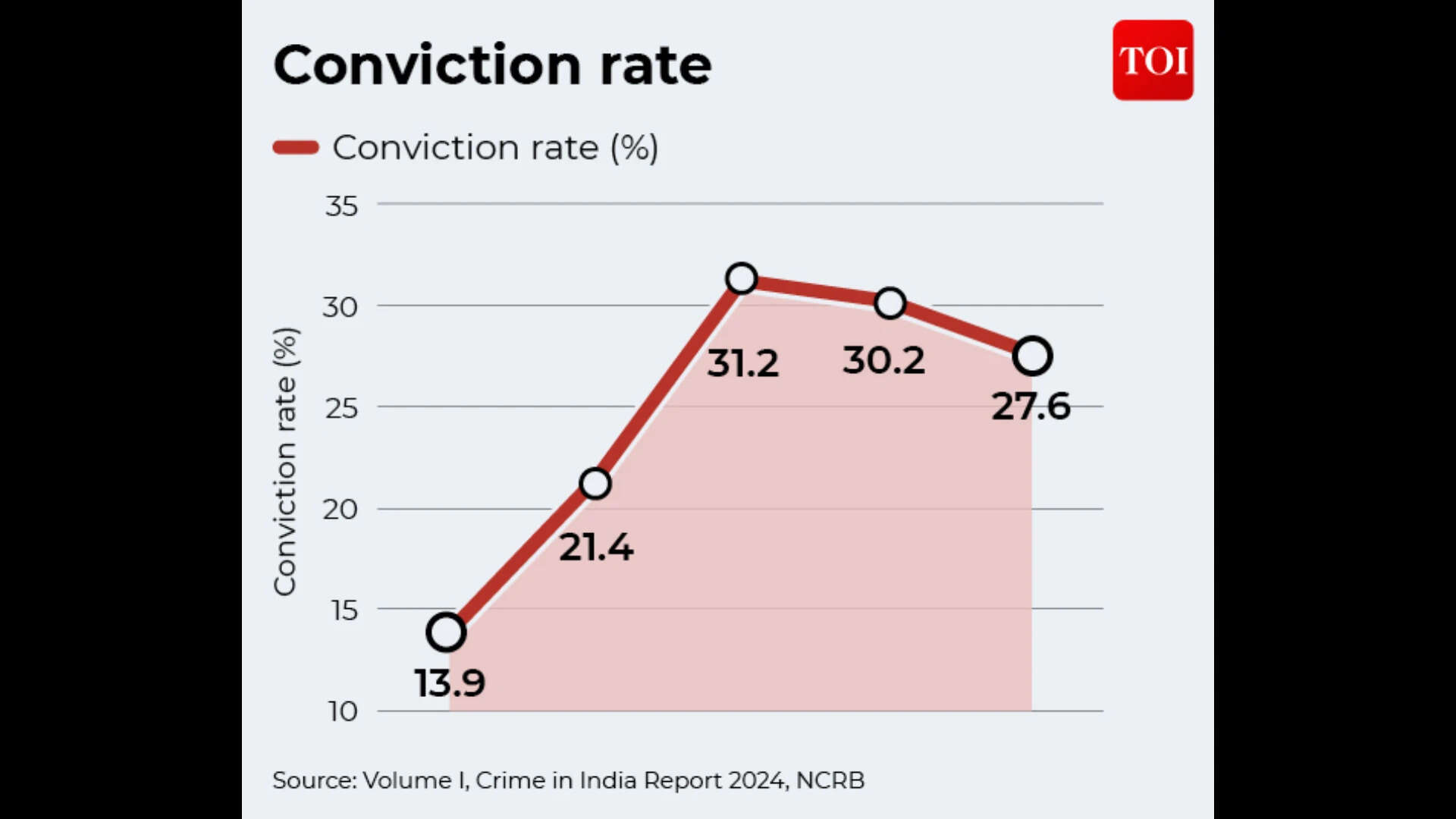
Conviction rate
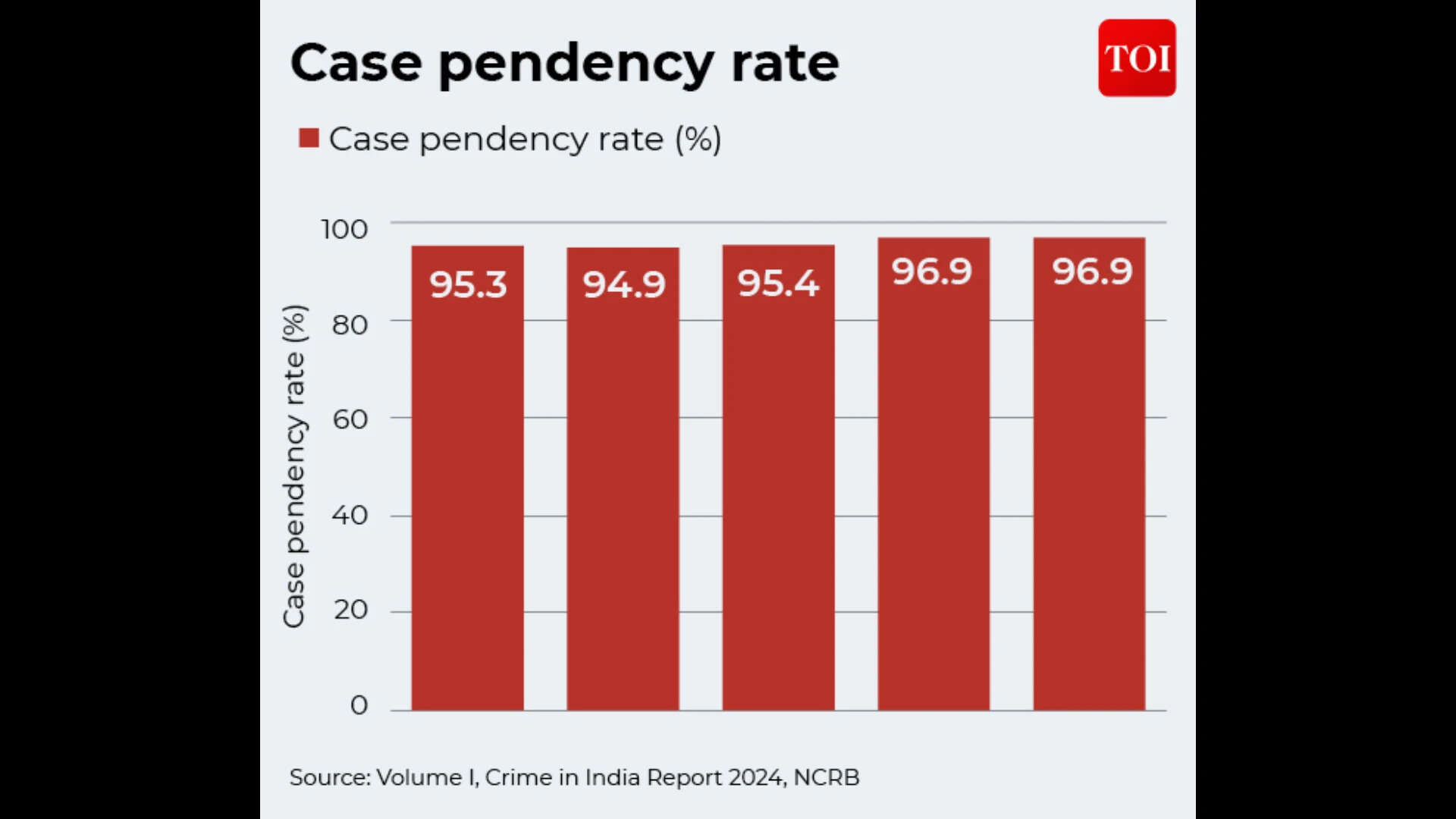
Case pendency rate
“In my experience, I have observed that while those arrested under the POCSO Act face stringent criminal proceedings, it is comparatively easier for those arrested under the Immoral Traffic (Prevention) Act to obtain bail and secure release.” Kamble addedMeanwhile, Saleya continues to work to rebuild herself and wishes to work as a beautician, a skill she has worked hard to acquire through multiple training sessions. She envisions a secured and dignified future for herself and her children. She does not wish to return to her parental home where her years were marked by hardship, violence, and limited access to education. Fear of societal shame and familial abandonment continue to haunt her.