Vinay Kumar
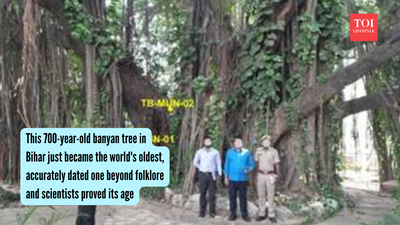
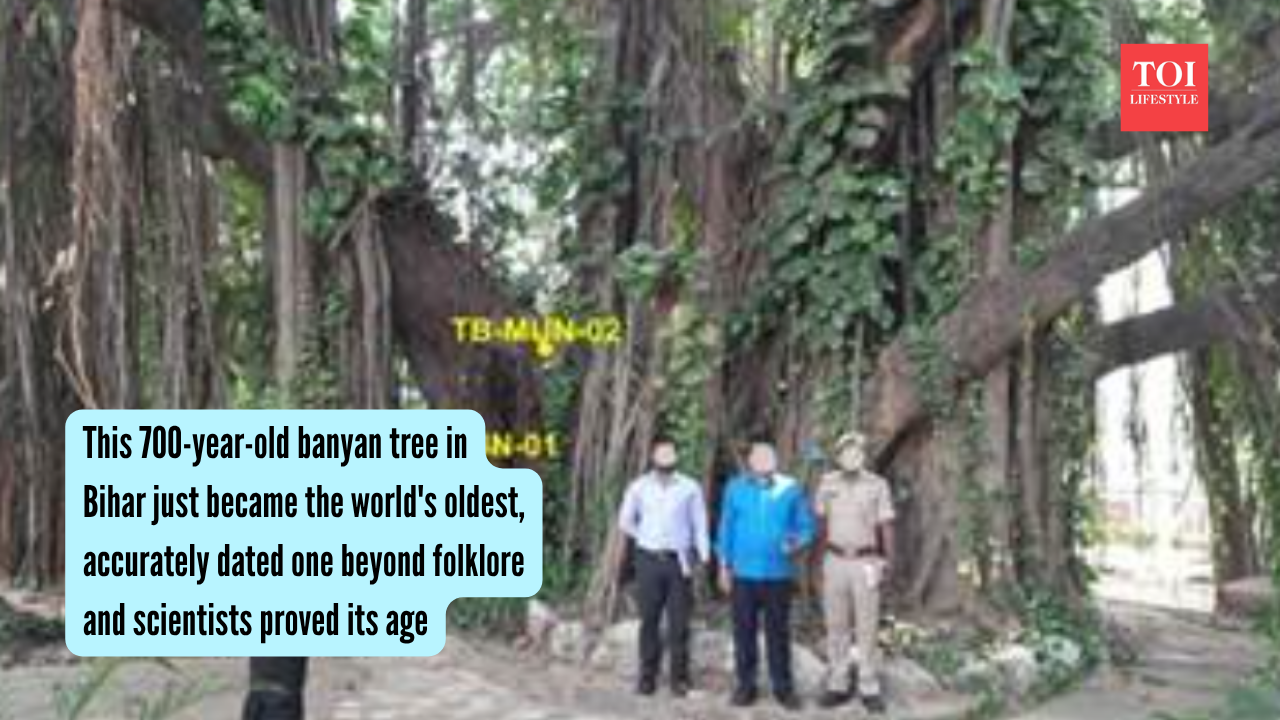
700 year old Banyan Tree in Munger, Bihar (Photo: PIB)
Some trees don’t just grow old, they grow into living pieces of history. For generations, communities have gathered under certain massive, sprawling trees for various purposes, be it religious ceremonies or village meetings, often believing these trees to be centuries old simply because of local stories passed down through time. But believing something is old and actually proving it are two very different things.That gap between folklore and fact has just been closed for a particular tree in Bihar. Using a scientific technique usually reserved for archaeological discoveries, researchers have now put an exact number on the age of a banyan tree that locals have treated as ancient for a long time.
Assumed to be ancient, the world’s oldest accurately dated banyan tree now has an age
A massive banyan tree in Bihar’s Munger district has officially been recognised as the world’s oldest accurately dated banyan tree, or Ficus benghalensis, with scientists estimating its age at approximately 700 years, according to the Press Information Bureau (PIB).Unlike previous age estimates for such trees, which typically depended on folklore, oral history, or local records, the exact age of the tree comes from formal scientific data, specifically radiocarbon dating, according to the report.Banyan trees are a familiar part of India’s flora and are popular for their massively spread-out root systems and their role as natural meeting points for communities for generations. But despite their cultural importance, accurately dating them had remained a challenge. Tropical broadleaf trees like the banyan don’t produce clear annual growth rings, which means that traditional tree-dating methods, commonly used for temperate trees, are not applicable to these trees.
Who found out the exact date of the Banyan tree?
The breakthrough traces back to Dr. Trina Bose of the Birbal Sahni Institute of Palaeosciences (BSIP) in Lucknow, an autonomous institute under India’s Department of Science and Technology.When the Bihar Forest Department approached her to determine the tree’s true age, she identified that conventional dating methods wouldn’t hold up for a tropical species like this one, according to PIB. This pushed her to help build an entirely new scientific approach suited specifically to trees like the Munger banyan.Teamed along with researchers Dr. Mayank Shekhar and Dr. Akhilesh K. Yadava, Dr. Bose’s team extracted alpha-cellulose, a highly stable component of plant cell walls, from wood samples taken near the pith of the tree’s secondary trunk and one of its oldest branches. The pith mattered most because it holds the earliest wood the tree ever produced, essentially its biological starting point.These samples were then studied using Accelerator Mass Spectrometry and calibrated against the IntCal20 curve using OxCal software, which allowed the team to pin down a scientifically dependable age for the tree.
The tree is more than a historical survivour
The research didn’t just confirm the tree’s age, they overturned a long-standing local assumption. Many believed the tree had been planted side by side, with the nearby “Burra Bunglow,” a colonial-era structure estimated to be around 300 to 350 years old.But the entire story flipped instead; the research shows the banyan predates the building entirely and is likely a surviving remnant of a natural forest that once stood in the region, according to the PIB report. So, the tree didn’t grow up around the building, the building was constructed near a tree that had already been standing for centuries.The study has been published in the journal Quaternary Research, and researchers say the same method can now be used to date other ancient tropical trees around the world, supporting conservation, heritage protection, and even climate history research well beyond Bihar.